
Can 5-Axis CNC Machining Improve Composite Material Part Quality?

Struggling with complex composite parts? Poor quality and wasted materials can be frustrating. Advanced machining offers a solution.
Yes, 5-axis CNC machining significantly improves composite material part quality. It allows for intricate designs, superior surface finishes, and higher precision by machining from multiple angles in a single setup, reducing errors and handling.
You might be wondering how exactly this technology achieves such results. It's not just about adding more axes; it's about a fundamental shift in how we can approach manufacturing. Let's explore the details and see why it's a game-changer, especially for demanding applications like those we handle at Worthy. If you want to understand the real impact, keep reading.
What are the benefits of 5-axis CNC machining?
Tired of multiple setups causing errors? Long lead times and inconsistent finishes plague many projects. 5-axis machining offers a streamlined, higher-quality approach.
The main benefits include machining complex shapes with greater accuracy, improved surface finish, shorter lead times due to single setups, and reduced need for multiple fixtures. This directly translates to better quality composite parts.
When I talk to clients like Mark Chen, who values quality but also needs competitive pricing, the benefits of 5-axis machining become very clear. First, complex geometries, which are common in composite parts for aerospace or automotive applications, become much easier to produce. Think about undercuts or deeply contoured surfaces. A 5-axis machine can approach the workpiece from almost any angle. This means we can often complete a part in a single setup. Fewer setups mean less chance of human error from re-fixturing and improved positional accuracy.
At Worthy, we often see this lead to much better surface finishes, achieving the standard 125 Ra or even better if required. This is crucial for composites where the material integrity is key. For composite materials especially, minimizing stress and ensuring clean cuts without delamination is vital, and 5-axis control helps achieve this. This also leads to faster turnaround, which helps Mark avoid missing his peak sales seasons.
What are the capabilities of 5-axis CNC?
Are standard machines limiting your design freedom? Traditional methods often can't handle intricate composite part designs efficiently. Discover what true 5-axis capabilities unlock.
5-axis CNC machines can simultaneously move a cutting tool across five axes. This enables the creation of highly complex parts, deep cavities, and intricate contours, especially for materials like composites, achieving tight tolerances.
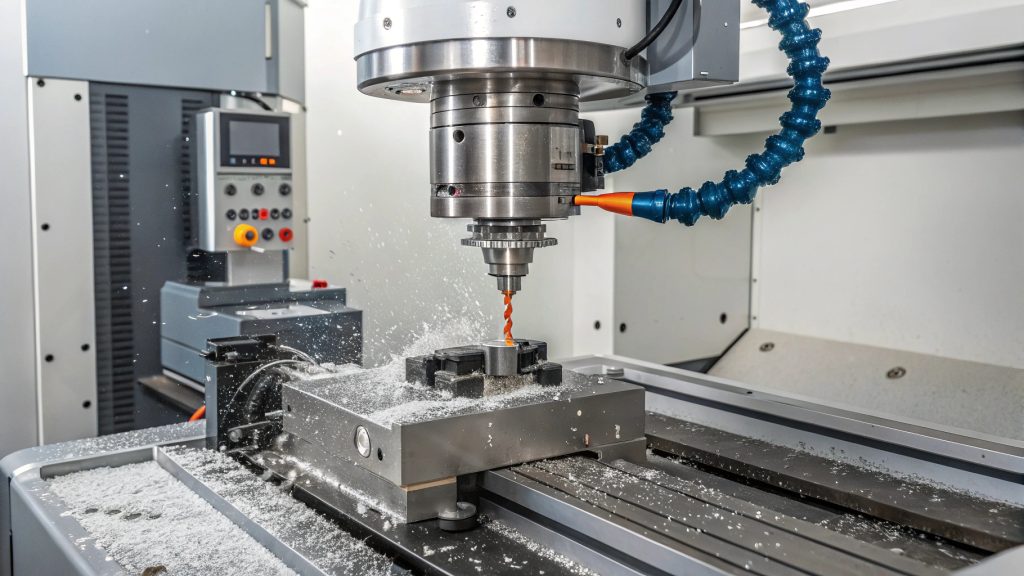
The true power of 5-axis CNC lies in its five-axis simultaneous movement. This means the machine tool and/or the workpiece can move along X, Y, and Z linear axes, and rotate on two additional axes (usually A and B, or B and C). My insight here is that this capability is what allows us to tackle those "impossible" parts that standard 3-axis machines can't touch. For composite materials, which often have complex curves and varying thicknesses for optimal strength-to-weight ratios, this is indispensable. W
e can machine intricate 3D surfaces, angled holes, and undercuts without needing to manually re-position the part. This is why it’s heavily used in aerospace, shipbuilding, and high-end mold making – industries where precision and complex forms are standard. At Worthy, our 5-axis machines can handle parts up to 80” x 48” x 24”, and we consistently hold tolerances down to +/- 0.005", even tighter to sub +/- 0.001" when the design demands it, which is critical for composite assemblies.
What are the disadvantages of 5-axis machining?
Is 5-axis always the best choice? The advanced capabilities come with considerations. Understanding these helps make informed manufacturing decisions for your composite parts.
Disadvantages include higher initial machine cost, more complex programming requiring skilled CAM programmers and operators, and potentially longer setup times for very complex jobs if not managed efficiently. Cost can be a factor.
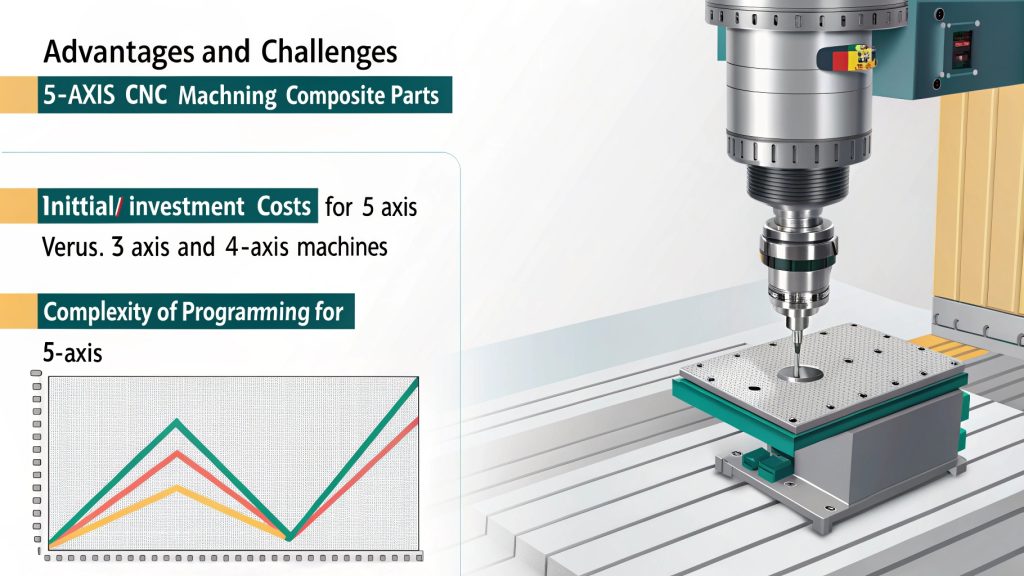
While 5-axis CNC machining offers amazing benefits for composite parts, it's important to acknowledge it's not without its challenges. The initial investment in a 5-axis machine is significantly higher than for 3-axis or 4-axis machines. This cost naturally has to be factored into piece prices. Then there's the programming. Creating the toolpaths for 5-axis simultaneous motion is far more complex. It requires sophisticated CAM software and, crucially, highly skilled programmers and machine operators. I've seen that the learning curve can be steep.
At Worthy, we invest heavily in training our engineers and technicians for this very reason. Another point is that for simpler parts, the setup complexity and programming time for 5-axis might not be justified compared to a quicker setup on a 3-axis machine. So, while it’s a powerful tool for complex composite components, we always evaluate if it's the most cost-effective solution for the specific part. It's about matching the right technology to the job.
What is the difference between 4 and 5-axis CNC?
Confused about 4-axis versus 5-axis? More axes mean more capability, but understanding the specific differences is key for your composite projects.
A 4-axis machine adds one rotational axis (usually A-axis) to a 3-axis setup. A 5-axis machine adds two rotational axes (A and B, or B and C), allowing for full five-sided machining in a single setup.
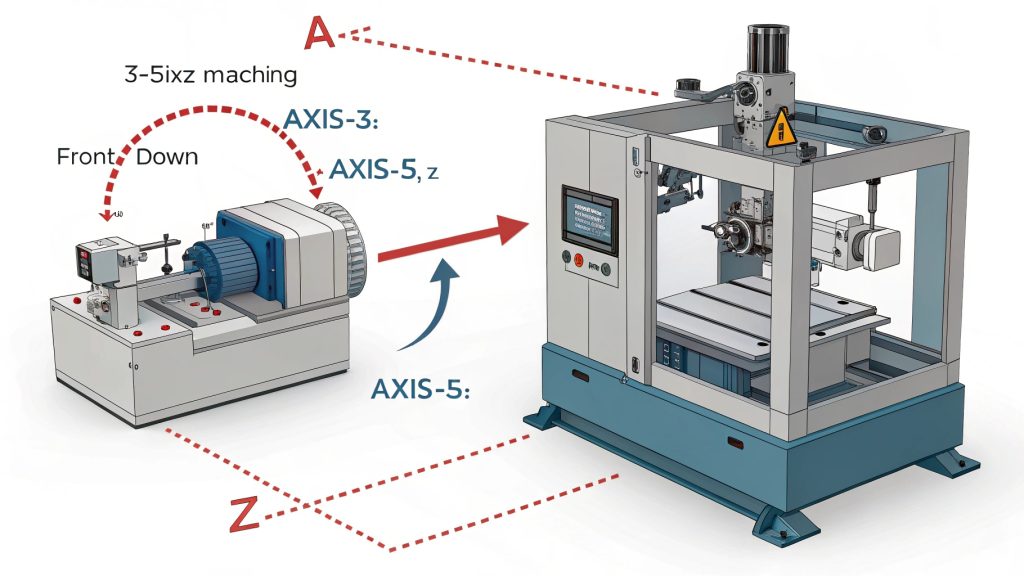
The key difference lies in the degrees of freedom for the cutting tool or the workpiece. A standard 3-axis machine moves in X (left-right), Y (front-back), and Z (up-down). A 4-axis machine adds a rotational axis, typically the A-axis, which rotates around the X-axis. This allows machining on four sides of a part or creating indexed features without re-clamping.
Now, a 5-axis machine adds a second rotational axis. This could be a B-axis rotating around the Y-axis, or a C-axis rotating around the Z-axis, often in combination with a tilting A or B axis. The main advantage this brings, especially for composite parts, is the ability to machine highly complex shapes and maintain an optimal cutting angle relative to the material surface. This is crucial for composite materials to avoid fiber pull-out or delamination.
With 5-axis, we can often machine five sides of a part in a single setup (sometimes called "5-sided machining" or "3+2 machining"), or perform true simultaneous 5-axis contouring for the most complex surfaces like impellers or aerospace components. This versatility reduces setups, improves accuracy, and often results in a better surface finish compared to what's achievable with 4-axis machining alone for these types of parts.
Conclusion
5-axis CNC machining truly elevates composite part quality through superior precision, complex geometry capability, and efficiency. It is a key technology for modern manufacturing needs.