
How To Select The Right Grade Of Polypropylene For Your Manufacturing Project?

Choosing polypropylene feels overwhelming. So many grades, how do you pick? I'll help you select the right one for your project.
Select the right polypropylene by understanding its main types: homopolymer, block copolymer, and random copolymer. Consider application needs like impact strength, stiffness, and temperature resistance. This ensures optimal performance for your parts.
Getting the grade right is super important for your project's success. I've seen many clients, like Mark Chen from Canada, struggle with this initially. Let's look closer at the common questions my clients often ask. This will help you make a better choice for your CNC machining parts or other manufactured goods.
What is the standard grade of polypropylene?
Heard "standard grade" PP but unsure what it means? This confusion can lead to wrong material choices. Let me clarify it for you.
"Standard grade" polypropylene usually refers to PP Homopolymer (PPHP). It offers good stiffness, chemical resistance, and is widely used for general-purpose applications like packaging, containers, and fibers. It's a common starting point.
When we talk about a "standard grade" of polypropylene, we're generally pointing towards Polypropylene Homopolymer (PPHP). This is the most basic and widely utilized type. I've seen it used in countless projects here at Worthy Hardware, especially for custom CNC parts that need good rigidity.
Key Characteristics of Standard PP (Homopolymer)
It's made by polymerizing only propylene monomer. This simple structure gives it some distinct properties that many of my customers, who are often company owners or procurement officers, look for:
-
Good Stiffness: It's quite rigid. This is great for structural applications where the part shouldn't bend easily.
-
High Tensile Strength: It can withstand pulling forces well. This is important for parts under stress.
-
Excellent Chemical Resistance: It stands up well against many acids, bases, and solvents. This is a big plus for industrial or lab equipment.
-
Good Processability: It's relatively easy to mold and extrude. This helps keep manufacturing costs down.
However, its main limitation is lower impact strength, especially at cold temperatures. It can become brittle. I always make sure my clients are aware of this if they are considering PPHP for applications in cold environments.
| Property | Typical Value for PPHP | Implication for Your Project |
|---|---|---|
| Density | ~0.90-0.91 g/cm³ | Lightweight parts |
| Tensile Strength | High | Good for load-bearing (static) |
| Impact Strength | Moderate to Low | Not ideal for high-impact uses |
| Heat Deflection Temp | Good | Can handle moderate temperatures |
For many general-purpose applications, like food containers, packaging films, and even some automotive parts that don't need high impact resistance, this "standard" grade is often the go-to. It provides a good balance of properties and cost-effectiveness.
What is impact grade polypropylene?
Do your polypropylene parts crack or break easily? You might need better impact resistance. Let's explore impact grade polypropylene for tougher parts.
Impact grade polypropylene is typically a Polypropylene Block Copolymer (PPCP). It's modified for enhanced toughness and impact resistance, especially at low temperatures. It's used where durability is crucial, preventing easy breakage.
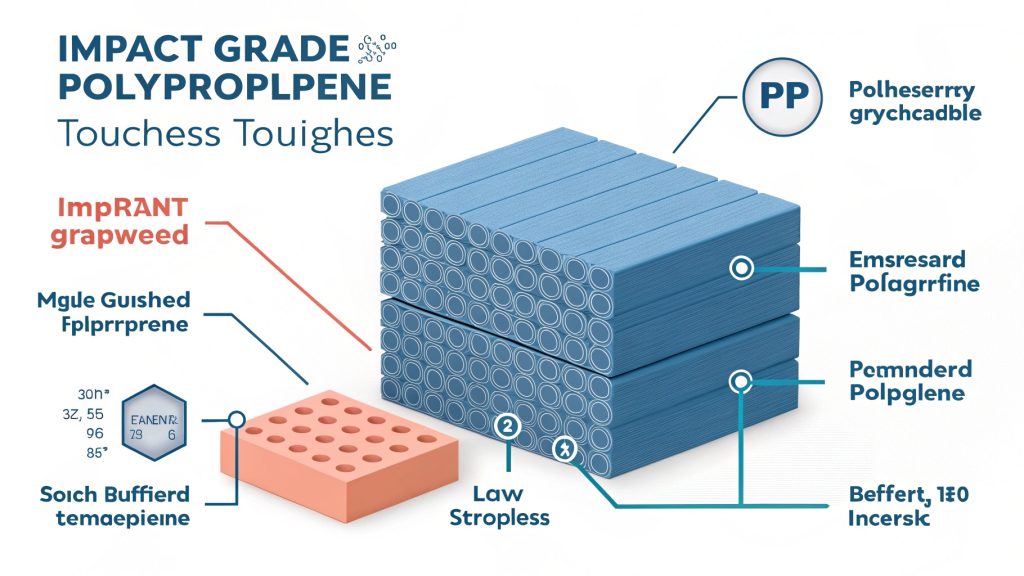
When standard polypropylene isn't tough enough, we turn to impact grade polypropylene. This usually means Polypropylene Block Copolymer (PPCP), sometimes just called PP Copolymer. I always recommend this when clients like Mark tell me their parts are failing due to brittleness or impact. This is a common pain point, especially when they've sourced parts before and experienced quality issues.
How Impact Grade PP Achieves Toughness
These grades get their improved impact strength because ethylene is incorporated into the polymer chain. This is done in a specific way to create "blocks" of ethylene-propylene rubber within the polypropylene matrix. This rubbery phase acts like an internal shock absorber.
-
Enhanced Impact Strength: It's significantly better than homopolymers. This is especially true at low temperatures, where standard PP can become very brittle.
-
Good Stiffness: While slightly less stiff than homopolymers, they still maintain good rigidity for many applications.
-
Good Chemical Resistance: This property remains similar to homopolymers, which is a plus.
Think of it like adding tiny, flexible cushions throughout the material. This makes it suitable for applications like:
- Automotive components (bumpers, dashboards, interior trim)
- Luggage and carrying cases
- Toolboxes and heavy-duty containers
- Industrial applications requiring robust parts
It's a bit of a trade-off. You gain a lot of toughness, but you might sacrifice a tiny bit of stiffness or the maximum operating temperature compared to a pure homopolymer. We at Worthy Hardware often machine parts from impact grades for clients needing robust components that can withstand demanding use.
| Feature Comparison | PP Homopolymer (Standard) | PP Block Copolymer (Impact Grade) | Why It Matters for You |
|---|---|---|---|
| Impact Strength | Lower | Higher | Parts are less likely to break |
| Stiffness | Higher | Slightly Lower | Consider if max rigidity is key |
| Low-Temp Perf. | Brittle | Better Ductility | Essential for cold environments |
What are the different types of polypropylene?
Confused by terms like homopolymer or copolymer? This variety can make choosing hard for your CNC machining needs. Let's simplify the main polypropylene types.
The main types of polypropylene are Homopolymer (PPHP), Block Copolymer (PPCP), and Random Copolymer (PPRC or RP). Each offers different properties for various application needs, from stiffness to clarity.
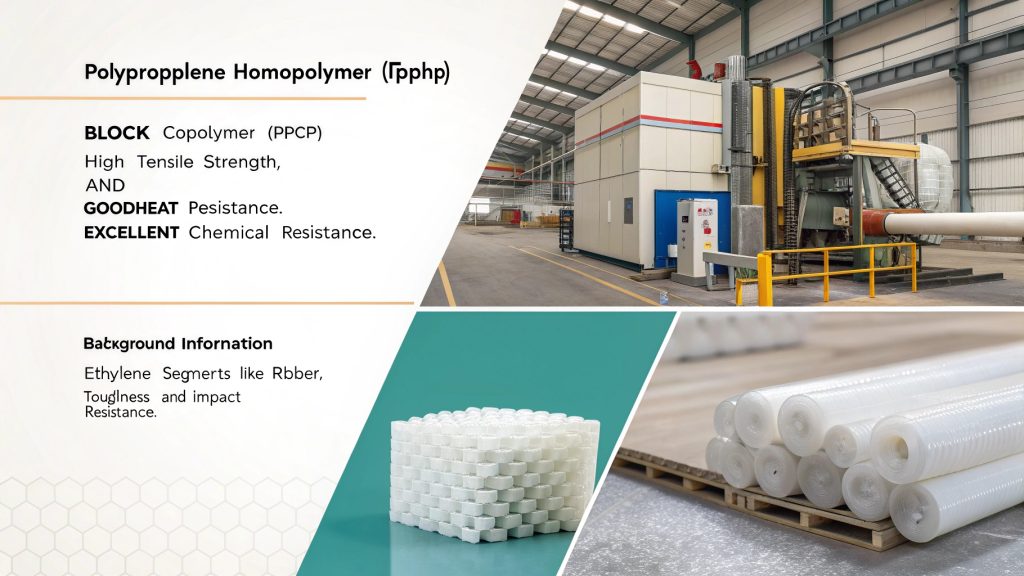
Polypropylene isn't just one material; it's a family. Understanding the main types helps a lot when you're specifying materials for your CNC machined parts. I usually explain these three to my clients:
1. Polypropylene Homopolymer (PPHP)
As we've discussed, this is often called the "standard" type. It's made purely from propylene monomer.
-
Key Strengths: Known for its good stiffness, high tensile strength, and good heat resistance. It also has excellent chemical resistance.
-
Common Uses: Rigid containers, fibers, packaging films, some automotive parts, and many general-purpose items.
-
Consideration: Its main weakness is lower impact strength, especially in the cold.
2. Polypropylene Block Copolymer (PPCP)
This is your "impact" grade, also known as PP Copolymer.
-
Key Strengths: It has propylene and ethylene units arranged in distinct blocks. The ethylene segments (acting like rubber) dramatically improve toughness and impact resistance, particularly at low temperatures.
-
Common Uses: Automotive bumpers, luggage, toolboxes, industrial containers, and any part needing high durability.
-
Consideration: Slightly less stiff than PPHP.
3. Polypropylene Random Copolymer (PPRC or RP)
Here, ethylene units (usually a small percentage, like 1-7%) are randomly inserted into the polypropylene chain.
-
Key Strengths: This random arrangement makes the material more flexible and significantly clearer than homopolymers. It also has a lower melting point, which can be beneficial for certain processing methods like heat sealing.
-
Common Uses: Clear food containers, transparent packaging, medical devices, and some types of film or pipe.
-
Consideration: Lower stiffness and melting point compared to PPHP.
Here's a quick comparison table I often share:
| Property | Homopolymer (PPHP) | Block Copolymer (PPCP) | Random Copolymer (PPRC) |
|---|---|---|---|
| Stiffness | Highest | High | Moderate |
| Impact Strength | Low (esp. at low temp) | Highest (esp. at low temp) | Moderate |
| Clarity | Translucent/Opaque | Opaque | Best (can be clear) |
| Melting Point | Highest | High | Lowest |
| Flexibility | Lowest | Moderate | Highest |
Choosing between these depends entirely on what you need the final product to do. For instance, if Mark Chen needs super clear packaging that also has some flexibility, I'd point him towards a Random Copolymer. If he needs a very rigid, low-cost structural part, PPHP might be the answer, provided impact isn't a major concern.
What grade of polypropylene is used for extrusion?
Planning to extrude polypropylene? Choosing the wrong grade can ruin your process and parts. Let's find the right PP for smooth, successful extrusion.
For extrusion, polypropylene grades with a suitable Melt Flow Rate (MFR) are key. Homopolymers and copolymers can be used, depending on if you need stiffness (fibers, sheets) or flexibility and clarity (films).
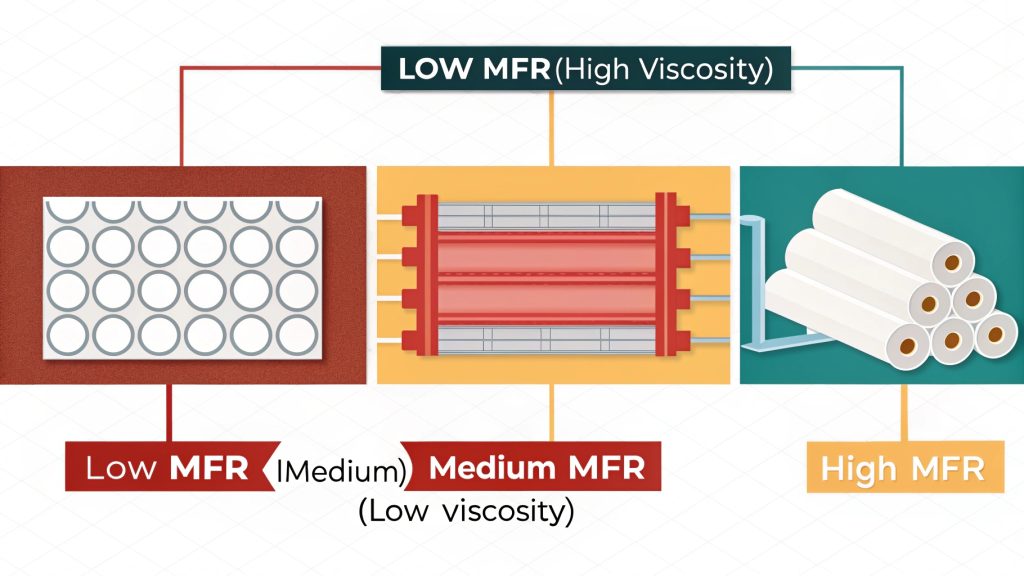
When it comes to extrusion processes – whether you're making films, sheets, pipes, or fibers – the Melt Flow Rate (MFR), also known as Melt Flow Index (MFI), of the polypropylene grade is incredibly important. The MFR value tells us how easily the molten plastic flows under specific conditions. Getting this wrong can lead to processing headaches, a common pain point for manufacturers.
MFR and Its Impact on Extrusion
The required MFR depends heavily on the specific extrusion process:
-
Low MFR (High Viscosity): These grades flow slower. They are good for processes that need high melt strength, like profile extrusion (e.g., window frames), thick sheet extrusion for thermoforming, or pipe extrusion. The material needs to hold its shape better after exiting the die.
-
Medium MFR: Often suitable for general-purpose sheet extrusion or some fiber applications.
-
High MFR (Low Viscosity): These grades flow very easily. They are suitable for applications like fiber spinning (especially for fine denier fibers) or thin film extrusion where the molten plastic needs to flow quickly and easily through small die openings.
Both homopolymers and copolymers (block and random) can be formulated with various MFRs for extrusion.
-
Polypropylene Homopolymers (PPHP) are frequently used for applications requiring stiffness and strength, such as industrial strapping, monofilaments, spunbond nonwovens, and biaxially oriented PP (BOPP) films.
-
Polypropylene Copolymers (PPCP and PPRC) can be used for films or sheets where better clarity, higher impact strength, or improved flexibility is needed.
From my experience, especially when discussing polypropylene fibers with clients, several indicators become critical. These factors directly influence the fiber's properties and, as you've noted in your insights, the significant price variations in the market, from 4000 yuan up to 14000 yuan per ton.
-
Fiber Diameter (Denier): Finer fibers generally require higher MFR polypropylene to ensure smooth processing.
-
Tensile Strength: Crucial for the fiber's end-use (e.g., ropes, textiles, concrete reinforcement). Specific homopolymer grades or special processing can achieve higher tensile strength.
-
PP Content (Purity & Additives): The base PP resin and any additives (like UV stabilizers, colorants, or fillers) will affect performance and cost. Higher purity PP often commands a higher price.
-
Moisture Content: Polypropylene itself is hydrophobic (doesn't absorb much water). However, any surface moisture on the pellets can vaporize during high-temperature extrusion. This can cause voids, splay, or degradation in the final fiber quality. Using properly dried material is essential.
So, if a customer needs strong, fine fibers for high-performance textiles, they would require a very different PP grade (likely a higher MFR homopolymer with specific additives) compared to someone making thick, coarse fibers for agricultural nets. At Worthy Hardware, while we primarily do CNC machining, we understand these material nuances as our parts often integrate with components made through other processes like extrusion.
Conclusion
Selecting the right polypropylene involves matching grade properties (homopolymer, copolymer) to your project's needs like strength, clarity, and process. This ensures optimal performance and cost-effectiveness.