
Which Composite Material Is Best For High-Temperature Applications In Manufacturing?
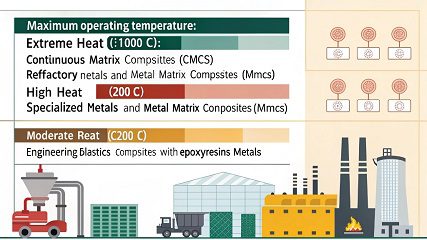
Choosing the wrong material for high-heat manufacturing jobs can cause big problems. Failures cost money and time. Understanding the best composite materials helps avoid these issues.
Ceramic Matrix Composites (CMCs) and Polymer Matrix Composites (PMCs) with high-temperature resins (like polyimides or PEEK) are often best. Metal Matrix Composites (MMCs) are another option. The ideal choice depends on the specific temperature, stress, and cost needs.
Selecting the right material is critical when things get hot. It's not just about surviving the heat, but also performing reliably under load. Let's look closer at the types of composites used and figure out which one might be right for your project. This decision impacts everything from performance to budget.
What composite is used in high temperature applications?
Are you confused about which specific composites handle serious heat? This confusion can stop projects. Let's look at the main types used successfully in demanding, hot environments.
Common high-temperature composites include Ceramic Matrix Composites (CMCs) and specialized Polymer Matrix Composites (PMCs). PMCs use heat-resistant resins like polyimides, PEEK, or certain epoxies, often reinforced with carbon or ceramic fibers.
Diving Deeper into High-Temp Composite Types
When we talk about composites for high temperatures, we usually mean materials designed to maintain their strength and shape when things really heat up. Two main families stand out:
-
Ceramic Matrix Composites (CMCs):
- What they are: These combine ceramic fibers (like silicon carbide or alumina) within a ceramic matrix. Think of it like concrete (matrix) with rebar (fibers), but made of ceramics.
- Why they work: Ceramics are naturally very heat resistant and don't easily corrode or oxidize. The fibers add toughness, preventing the brittleness often associated with monolithic ceramics. They remain stable at extremely high temperatures, sometimes over 1200°C (2200°F).
- Common Uses: Jet engine hot sections (turbines, combustors), thermal protection systems on spacecraft, industrial furnace components.
-
High-Temperature Polymer Matrix Composites (PMCs):
- What they are: These use strong fibers (like carbon, glass, or aramid) embedded in a special plastic (polymer resin) matrix that can withstand high temperatures.
- Why they work: The fibers provide strength and stiffness. The key is the resin. Standard resins soften or degrade easily with heat. High-temp resins like polyimides, PEEK (Polyether ether ketone), certain epoxies, and phenolic resins have much higher glass transition temperatures (Tg), meaning they stay rigid and strong at higher temperatures, often up to 300°C (570°F) or sometimes higher for short periods.
- Common Uses: Aerospace structural parts, automotive components near engines, downhole oil and gas equipment, demanding electronics.
Here at Worthy Hardware, while we primarily focus on machining metals and plastics like PEEK, we often create components that interface with these advanced composites. Understanding their properties helps us ensure our machined parts meet the necessary tolerances, like the +/- 0.001" we can achieve, for a perfect fit in a high-temperature assembly.
| Feature | Ceramic Matrix Composites (CMCs) | High-Temp Polymer Matrix Composites (PMCs) |
|---|---|---|
| Temp Limit | Very High (often >1200°C) | High (often up to ~300°C+) |
| Matrix | Ceramic | High-Temp Polymer (PEEK, Polyimide, etc.) |
| Key Benefit | Extreme Heat & Oxidation Resist. | Good Strength-to-Weight, Manufacturability |
| Challenge | Higher Cost, Brittleness | Temp limit lower than CMCs |
| Fibers Used | Ceramic (SiC, Alumina) | Carbon, Glass, Aramid |
Which material is preferable in high temperature applications?
Knowing the types is one thing, but choosing the best one is tricky. Pick wrong, and you waste time and money on a part that fails. Let's consider how to select the preferable material.
The "preferable" material depends entirely on the specific needs. Factors include the exact temperature, mechanical load, chemical environment, weight limits, manufacturability, and budget. CMCs excel at the highest temperatures, while high-temp PMCs offer good performance-to-cost.
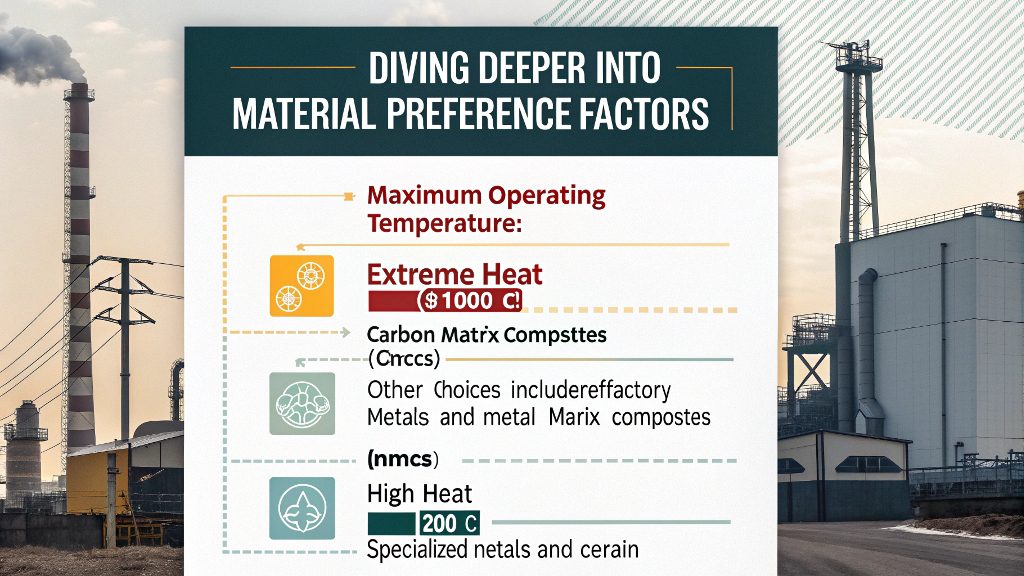
Diving Deeper into Material Preference Factors
Choosing the "best" or "preferable" material isn't about finding one single answer; it's about matching the material to the job. I remember working with a client, much like Mark Chen from Canada, who needed parts for an industrial heating process. He was cost-sensitive but couldn't afford failure. We had to carefully weigh the options. Here’s a breakdown of factors to consider:
-
Maximum Operating Temperature: This is often the first filter.
- Extreme Heat (>1000°C): CMCs are usually the primary candidates. Some refractory metals or Metal Matrix Composites (MMCs) might be considered, but CMCs often win on oxidation resistance.
- High Heat (200°C - 500°C): High-temperature PMCs (PEEK, polyimides) become very attractive. Certain MMCs or specialized metals are also options.
- Moderate Heat (<200°C): A wider range of engineering plastics, composites (like those with epoxy resins), and metals can work.
-
Mechanical Load & Stress: How much force will the part experience?
- High stress combined with high heat often points towards CMCs or MMCs.
- High strength-to-weight needs might favor carbon fiber PMCs, provided the temperature allows the resin to perform.
-
Chemical Environment: Will the part be exposed to corrosive gases, fuels, or other chemicals?
- CMCs generally have excellent chemical resistance.
- Polymers vary greatly. PEEK has broad chemical resistance, while others might be susceptible. Metals can corrode or oxidize.
-
Cost: Material cost and manufacturing cost are critical.
- CMCs are typically the most expensive to produce.
- High-temp PMCs are less expensive than CMCs but more than standard composites or metals.
- Machining costs also vary. At Worthy Hardware, we can machine complex parts from metals and many plastics, but machining CMCs requires specialized techniques we don't offer directly.
-
Weight: Is minimizing weight crucial (e.g., aerospace)?
- PMCs, especially carbon fiber reinforced ones, offer excellent strength-to-weight ratios.
- CMCs are lighter than most high-temperature metals but denser than PMCs.
- MMCs can be heavy depending on the metal matrix.
-
Manufacturability & Complexity: Can the desired shape be made efficiently?
- PMCs can often be molded into complex shapes.
- Machining CMCs is difficult.
- We find that many clients need precision-machined metal or plastic components that hold or attach to composite parts, leveraging our ability to hold tight tolerances (+/- 0.005" standard, down to +/- 0.001").
By carefully evaluating these factors, you can determine which material is truly preferable for your specific high-temperature challenge.
What type of composite material is preferred for high temperature and severe stress applications?
What if you need a material that handles both extreme heat and significant mechanical stress? This combination pushes materials to their limits. Let's pinpoint the preferred choice for these tough jobs.
Ceramic Matrix Composites (CMCs) are generally preferred for applications involving both high temperatures and severe stress. Their ceramic nature provides heat stability, while the reinforcing fibers offer toughness and load-bearing capacity under demanding conditions.
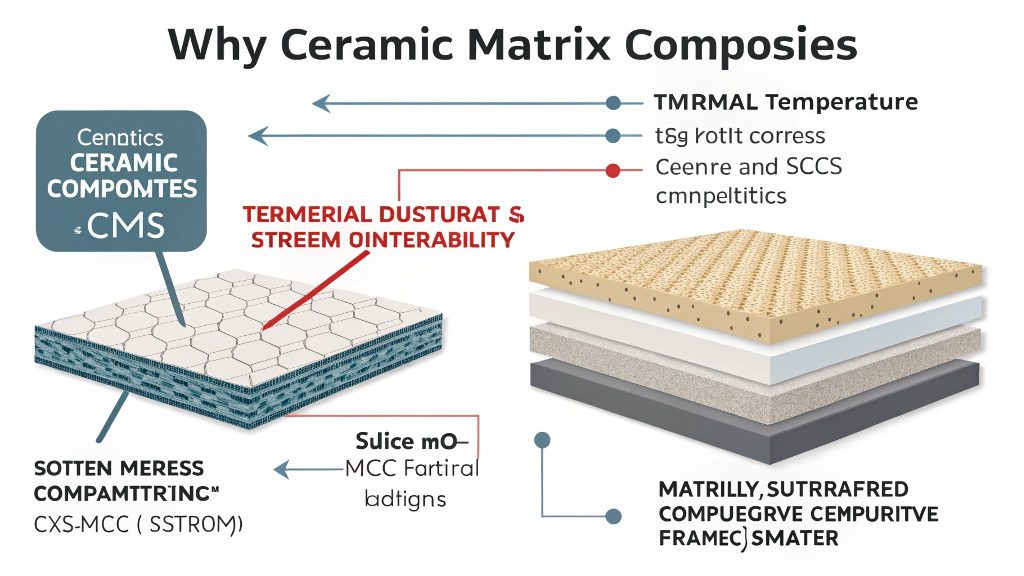
Diving Deeper into High Temp & High Stress Composites
When you combine high temperatures with severe mechanical stress, the material choice becomes much more critical. This is common in fields like aerospace (jet engines, rocket nozzles) and high-performance braking systems. In these scenarios, CMCs often rise to the top.
Why are CMCs preferred here?
- Inherent Thermal Stability: The ceramic matrix doesn't melt or drastically soften at high temperatures like polymers or even many metals. It maintains its structural integrity well above 1000°C.
- Fiber Reinforcement: The ceramic fibers (e.g., Silicon Carbide - SiC) embedded within the matrix carry the mechanical load. These fibers are incredibly strong and stiff, even at high temperatures. Crucially, they also provide toughness. Pure ceramics are brittle and can fracture easily under stress or impact. The fibers in a CMC stop cracks from spreading easily, making the material much more damage-tolerant – vital under severe stress.
- Specific Examples:
- Carbon-Carbon (C/C) Composites: Carbon fibers in a carbon matrix. Used in aircraft brakes and rocket nozzles because they get stronger at very high temperatures (in non-oxidizing atmospheres).
- Silicon Carbide-Silicon Carbide (SiC/SiC) Composites: SiC fibers in a SiC matrix. Increasingly used in jet engine hot sections (shrouds, combustor liners, turbine vanes) because they offer good oxidation resistance and retain strength at high temperatures, replacing heavier metal superalloys.
While high-temperature PMCs handle significant temperatures and stresses compared to standard materials, their polymer matrix is usually the limiting factor. The resin can soften or degrade under extreme heat, reducing its ability to transfer load effectively between fibers, especially under severe stress. MMCs can handle high stress and moderate-to-high temperatures, but CMCs typically outperform them at the highest temperature ranges combined with stress, often with lower weight.
Choosing CMCs means dealing with higher costs and manufacturing complexities. However, for applications where failure under combined heat and stress is not an option, their unique properties make them the preferred, and sometimes only viable, choice.
What material is suitable for high temperature?
Feeling overwhelmed by the choices? Need a simpler overview of materials that just work well when hot? Let's recap the general categories suitable for high-temperature environments.
Suitable materials for high temperatures broadly include Ceramic Matrix Composites (CMCs), high-temperature Polymer Matrix Composites (PMCs using resins like PEEK, polyimides), Metal Matrix Composites (MMCs), refractory metals (like tungsten, molybdenum), and certain superalloys (nickel-based, cobalt-based).
Diving Deeper into Suitable High-Temp Materials
When we look broadly at materials suitable for high temperatures, composites are a major part of the picture, but not the only part. The "suitability" really depends on how high the temperature is and what other properties are needed.
- Composites:
- CMCs: As discussed, excellent for extreme heat (often >1000°C) especially with stress. Think aerospace re-entry or turbine engines.
- High-Temp PMCs: Great for high heat (up to ~300°C+) combined with good strength-to-weight. Carbon fiber reinforced PEEK or polyimides are common examples used in automotive, aerospace, and industrial applications. We machine PEEK regularly at Worthy Hardware.
- MMCs: Metal matrix (like aluminum, titanium, or magnesium) reinforced with fibers or particles (like silicon carbide). Offer better high-temp strength than the base metal alone, good wear resistance, but can be heavy and complex to make. Suitable for moderate-to-high temperatures.
- Metals:
- Superalloys: Nickel-based, cobalt-based, or iron-nickel alloys designed specifically for high-temperature strength, creep resistance, and corrosion resistance. Used heavily in gas turbines and power plants. We machine various steels and alloys, providing parts for these industries.
- Refractory Metals: Tungsten, Molybdenum, Tantalum, Niobium. Have extremely high melting points but can be prone to oxidation at high temperatures, often requiring protective coatings or specific atmospheres. Used in vacuum furnaces, lighting, electronics.
- Titanium Alloys: Good strength-to-weight up to moderately high temperatures (around 600°C). We work with Titanium often for clients needing lightweight, strong parts.
- Stainless Steels: Certain grades offer good heat and corrosion resistance up to moderate temperatures.
- Monolithic Ceramics: Materials like Alumina, Zirconia, Silicon Nitride. Very high temperature resistance and wear resistance, but brittle. Often used as coatings or in specific components where toughness isn't the primary need.
The key takeaway is that "high temperature" covers a wide range. The suitability depends on matching the material's capabilities (temperature limit, strength, cost, weight, manufacturability) to the application's demands. For many modern manufacturing challenges requiring lightweight, strong, and heat-resistant parts, advanced composites (CMCs and high-temp PMCs) are increasingly the answer. Our experience at Worthy Hardware includes making precise metal and plastic components that integrate seamlessly into these high-temperature systems.
Conclusion
Choosing the best high-temp composite means matching the material (CMCs, high-temp PMCs) to the specific heat, stress, and cost needs of your manufacturing application. CMCs excel at extremes.
Need help machining components for your high-temperature application? We at Worthy Hardware specialize in CNC machining various metals and plastics, including high-performance ones like PEEK, to tight tolerances. Contact Sandra Gao at [email protected] or visit www.worthyhardware.com to discuss your project. We ship globally and support everything from prototypes to high-volume production.