
How to Minimize Shear Stress During High-Precision CNC Milling?

High shear stress causing part defects? This leads to wasted time and materials, hurting your bottom line. Understanding and controlling shear stress is key for better results.
To minimize shear stress in high-precision CNC milling, reduce cutting speeds, use sharp cutting tools, optimize toolpaths, and apply coolant effectively. These steps lessen the force concentration and heat generation during material removal.
Controlling shear stress is crucial for achieving the tight tolerances and smooth finishes needed in precision machining. But minimizing it requires understanding a few related concepts first. Let's explore what shear stress is and how it behaves during the milling process, so you can consistently produce high-quality parts.
How to solve for shear stress?
Calculating shear stress feels complicated? Incorrect calculations can lead to poor machining outcomes and damaged parts. The good news is, you can use a basic formula.
Shear stress (τ) is calculated by dividing the shear force (F) acting parallel to the surface by the cross-sectional area (A) over which the force acts. The formula is τ = F / A.
To understand how to solve for shear stress in CNC milling, let's break down the formula τ = F / A.
-
τ (Tau): This is the shear stress itself, usually measured in Pascals (Pa) or pounds per square inch (psi). It represents the intensity of the force distributed over the area.
-
F (Force): This is the shear force, acting parallel to the material surface being cut. In milling, this force is generated by the cutting tool as it removes material. Factors influencing this force include:
-
Material Properties: Harder materials require more force.
-
Cutting Parameters: Depth of cut, feed rate, and cutting speed directly impact force.
-
Tool Geometry: Rake angle, clearance angle, and tool sharpness affect how easily the tool cuts.
-
-
A (Area): This is the cross-sectional area resisting the shear force. In milling, this relates to the area of chip formation at the cutting edge. A sharper tool concentrates the force over a smaller area, potentially increasing stress locally, but reducing the overall force needed.
Understanding this calculation helps us at Worthy Hardware select the right parameters. For example, knowing a material's shear strength (the maximum shear stress it can withstand) helps us determine safe cutting forces and avoid tool breakage or part damage. Simulation software often performs these calculations, but knowing the basics is essential for process optimization.
| Factor | Influence on Shear Stress (τ = F/A) | How to Manage in CNC Milling |
|---|---|---|
| Shear Force (F) | Increases τ | Reduce depth of cut, feed rate; optimize speed |
| Material | Harder materials increase F, increasing τ | Select appropriate tool & parameters for material |
| Tool Sharpness | Affects F and A; dull tools increase both | Use sharp tools; monitor tool wear |
| Area (A) | Smaller contact area can increase local τ | Controlled by tool geometry & engagement |
What is the difference between shear force and shear stress?
Confused about shear force versus shear stress? This confusion makes it hard to control the machining process effectively. It's important to understand their distinct relationship.
Shear force is the total force applied parallel to a surface. Shear stress is that force distributed over the specific area it acts upon. Think of force as the push, and stress as the intensity of that push on the material.
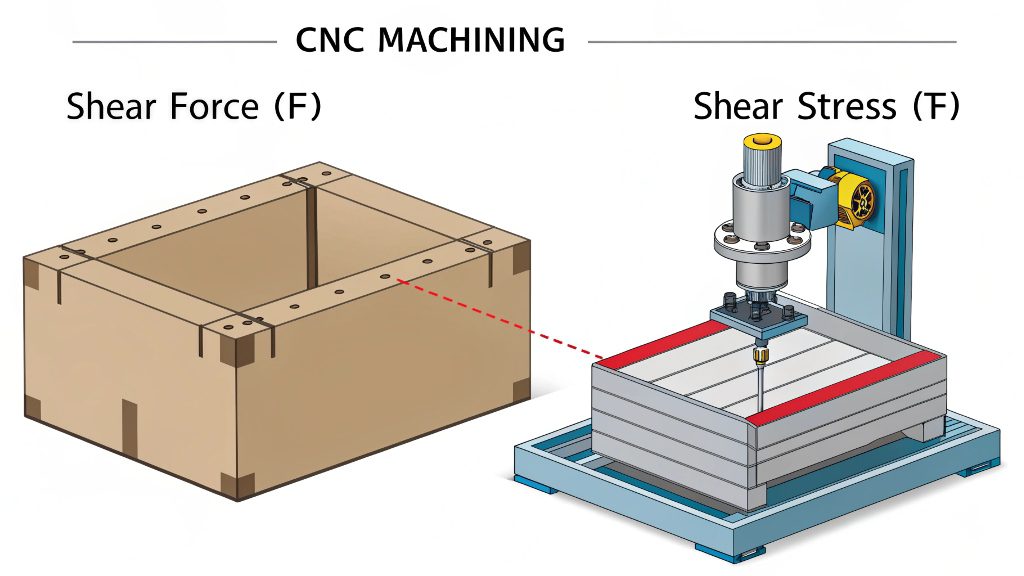
Let's dive deeper into the difference between shear force and shear stress, as it's fundamental in CNC machining.
Imagine pushing a heavy box across the floor. The total effort you exert horizontally is the shear force. Now, think about the pressure between the bottom of the box and the floor. That pressure, distributed over the contact area, is similar to shear stress.
In CNC milling:
-
Shear Force (F): This is the actual mechanical force the cutting tool exerts parallel to the cutting plane to shear the material away and form a chip. The machine's spindles and axes generate and withstand these forces. A high shear force might overload the machine or even break the cutting tool. We measure force in Newtons (N) or pounds-force (lbf).
-
Shear Stress (τ): This is the internal resistance within the material per unit area, right where the cutting edge is removing the chip. It's the force (F) divided by the shear area (A). High shear stress is what actually causes the material to yield and deform plastically (or fracture) to form the chip. Even if the total force isn't huge, if it's concentrated on a tiny area (like with a very sharp tool tip), the stress can be very high. We measure stress in Pascals (Pa or N/m²) or psi (lbf/in²).
Why does this matter for someone like Mark Chen, who needs quality parts? Controlling the force prevents machine/tool damage. Controlling the stress influences chip formation, surface finish, heat generation, and potential material deformation or work hardening.
Using sharper tools (like we prioritize at Worthy Hardware) can sometimes reduce the overall force needed, but it concentrates that force, affecting the stress right at the cutting point. Understanding both helps us fine-tune the process for optimal results.
What is the symbol for shear stress?
Not sure about the symbols used in engineering? Misreading symbols in technical documents can lead to costly mistakes. Knowing the standard symbol is essential for clear communication.
The standard symbol widely used for shear stress in engineering and physics is the lowercase Greek letter tau (τ). While other symbols might occasionally appear, τ is the most common and recognized.
The primary symbol used to represent shear stress is indeed τ (tau), a lowercase letter from the Greek alphabet. You'll find this symbol used consistently across various fields, including:
-
Solid Mechanics: Describing the internal stresses within materials under load.
-
Fluid Dynamics: Representing the frictional forces between fluid layers.
-
Materials Science: Defining material properties like shear strength and shear modulus.
-
Engineering Drawings and Specifications: Indicating stress limits or requirements.
Why is using a standard symbol like τ so important? It ensures clear and unambiguous communication. When engineers, designers, manufacturers like us at Worthy Hardware, and procurement officers like Mark Chen discuss technical requirements or analyze part specifications, using standardized symbols prevents confusion. Imagine a drawing calling for a maximum allowable stress – using τ immediately tells everyone it refers to shear stress, as opposed to σ (sigma), the common symbol for normal stress (tension or compression).
While τ is dominant, you might occasionally see 'S' or 'σ' with subscripts (like Sxy or σxy) used in specific contexts (like tensor notation) to denote shear stress components acting on particular planes. However, when referring to shear stress generally, τ is the go-to symbol. Seeing τ on a material datasheet or a simulation report instantly signals information about the material's resistance to shearing forces.
How to calculate shear rate from shear stress?
Need to connect shear stress to the speed of deformation? Ignoring shear rate can limit how much you can optimize your machining process. Understanding their relationship is key.
Shear rate (γ̇, gamma-dot) isn't usually calculated directly from shear stress alone, especially in metal cutting. For simple fluids, τ = η γ̇ (stress = viscosity shear rate). For solids, the relationship is much more complex.
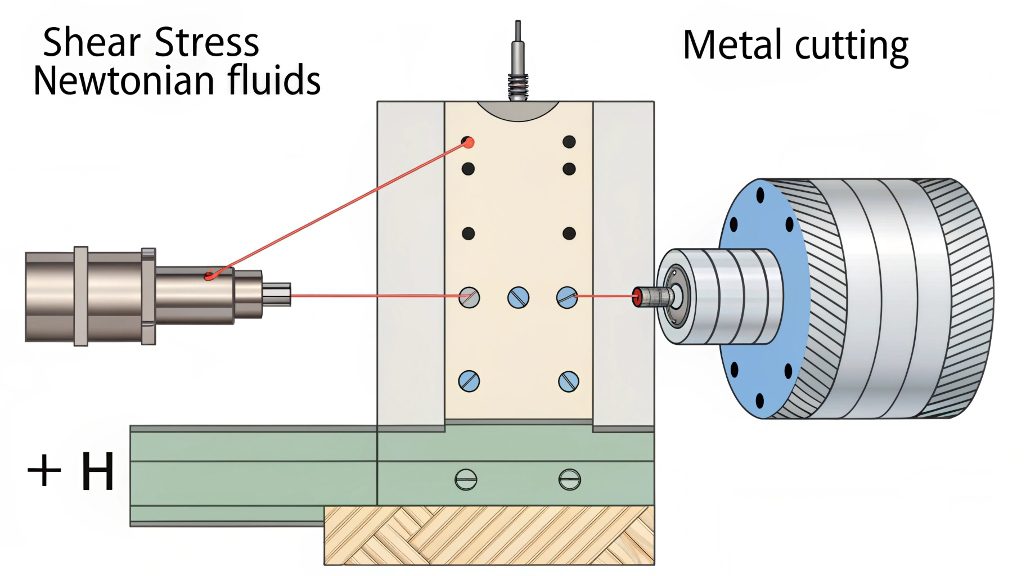
Calculating shear rate directly from shear stress in CNC milling isn't straightforward like it might be for simple liquids. Let's clarify this relationship.
Shear Rate (γ̇): This represents how quickly the material is being deformed by shearing. Think of it as the velocity gradient between layers of material sliding past each other. In milling, high cutting speeds generally lead to very high shear rates in the narrow zone where the chip is formed.
The Relationship:
-
Newtonian Fluids: For simple fluids (like oil or water under certain conditions), there's a direct linear relationship: Shear Stress (τ) = Viscosity (η) × Shear Rate (γ̇). You could calculate shear rate if you knew the stress and viscosity.
-
Metal Cutting (Solids): During the plastic deformation of metals in machining, the relationship is far more complex and non-linear. It's influenced by:
-
Material Plasticity: How the metal yields and flows under stress.
-
Strain Hardening: The material getting stronger as it deforms.
-
Temperature: Heat generated during cutting significantly affects material properties.
-
Strain Rate Sensitivity: How the material's resistance changes with the speed of deformation (shear rate).
-
Practical Implications in CNC Milling:
Instead of calculating shear rate from shear stress, we typically control parameters that influence the shear rate, primarily the cutting speed. Higher cutting speeds directly result in higher shear rates. We then observe the effects of these high shear rates and the associated shear stresses, such as:
- Chip formation type
- Tool wear
- Surface finish quality
- Heat generation
Advanced simulations use complex material models (like the Johnson-Cook model) that link stress, strain (deformation), strain rate (shear rate), and temperature. However, for practical shop-floor purposes at Worthy Hardware, we focus on adjusting cutting speed, feed rate, and tool geometry to manage the outcomes associated with shear stress and shear rate, rather than trying to calculate one directly from the other. Understanding that higher speeds mean higher rates helps us anticipate potential issues like increased heat or faster tool wear.
Conclusion
Minimizing shear stress through lower speeds and sharp tools is vital. Understanding stress, force, and rate helps achieve the precision needed for high-quality CNC machined parts consistently.
Need high-precision CNC parts with minimal stress issues? Contact me, Sandra Gao, at [email protected] or visit www.worthyhardware.com to see how Worthy Hardware in China can meet your custom machining needs, from prototypes to high-volume production.