
What Does 18/8, 18/10, and 18/0 Mean in Stainless Steel? A Complete Guide?
Confused by numbers like 18/8 or 18/0 on stainless steel? You're not alone. Let's make sense of these common labels quickly and easily right here.
These numbers tell you about the main metals mixed in the stainless steel, specifically chromium and nickel. 18/8 and 18/10 mean about 18% chromium and 8-10% nickel. 18/0 means 18% chromium and almost no nickel. This affects rust resistance, shine, and cost.
Understanding these codes is simpler than it looks. Once you know the basics, you can choose the right type of stainless steel for your needs, whether it's for kitchenware or custom parts like the ones we make at Worthy Hardware. Let's dive deeper into what each number really signifies.
What do the numbers on stainless steel mean?
Do stainless steel names like 304, 18/8, or 18/0 seem like a confusing code? Feeling unsure what they actually tell you? Let's decode these numbers simply.
The numbers show the approximate percentage of two key ingredients: chromium and nickel. The first number (like 18) is the chromium content. The second number (like 8, 10, or 0) is the nickel content. These metals give stainless steel its special properties.
Let's break this down further. These numbers are essentially a shorthand way to talk about the grade or type of stainless steel, focusing on the elements that most affect its performance, especially its ability to resist rust and corrosion.
Why Chromium (Cr)?
The "18" in 18/8, 18/10, and 18/0 refers to roughly 18% chromium content. Chromium is super important. When it's exposed to oxygen (even just the oxygen in the air), it forms a very thin, invisible, protective layer on the surface of the steel. This layer is called a passive film. It protects the iron in the steel from rusting. More chromium generally means better corrosion resistance, up to a point. This is the fundamental reason stainless steel doesn't rust easily like regular carbon steel.
Why Nickel (Ni)?
The second number (8, 10, or 0) tells you about the nickel content.
-
18/8 and 18/10: These contain about 8% and 10% nickel, respectively. Nickel significantly boosts corrosion resistance, especially against certain acids. It also makes the steel more ductile (easier to form and shape without breaking) and keeps it strong at high temperatures. Importantly, adding enough nickel typically makes the steel non-magnetic. This type falls into the Austenitic family of stainless steels.
-
18/0: This means there's virtually no nickel (less than 0.75%). Without the nickel, the corrosion resistance is good but generally not as great as 18/8 or 18/10. These steels are usually magnetic and fall into the Ferritic family. They are often less expensive due to the lack of costly nickel.
Connecting Names: 18/8 is Often 304
In the industry, especially when talking about common grades, you'll hear "18/8" used interchangeably with "304 stainless steel". They are essentially the same grade – the most widely used stainless steel in the world. As I mentioned in my insights, you might also see it designated by different standards:
-
06Cr19Ni10: Often indicates production according to Chinese GB standards.
-
304: Typically refers to the American ASTM standard.
-
SUS304: Refers to the Japanese JIS standard.
They all point to the same basic composition and properties. Knowing this helps when sourcing materials or specifying parts, like the custom CNC components we manufacture.
Here’s a quick table:
| Label | Approx. Chromium % | Approx. Nickel % | Key Feature | Common Grade Equiv. | Magnetic? |
|---|---|---|---|---|---|
| 18/0 | 18% | ~0% | Good corrosion resistance, lower cost | 430 | Yes |
| 18/8 | 18% | ~8% | Excellent corrosion resistance | 304 | No |
| 18/10 | 18% | ~10% | Enhanced corrosion resistance | 304/304L | No |
Understanding these numbers helps you grasp the basic differences in performance and cost right away.
Which is better, 18/0 or 18/10 stainless steel?
Trying to decide between 18/0 and 18/10 stainless steel? Seeing a price difference but wondering about the real-world performance? Let's compare them directly.
Generally, 18/10 stainless steel is considered better for most applications needing high corrosion resistance and durability, like cookware or food processing. 18/0 is less expensive and magnetic, making it suitable for budget items or induction cooktops.
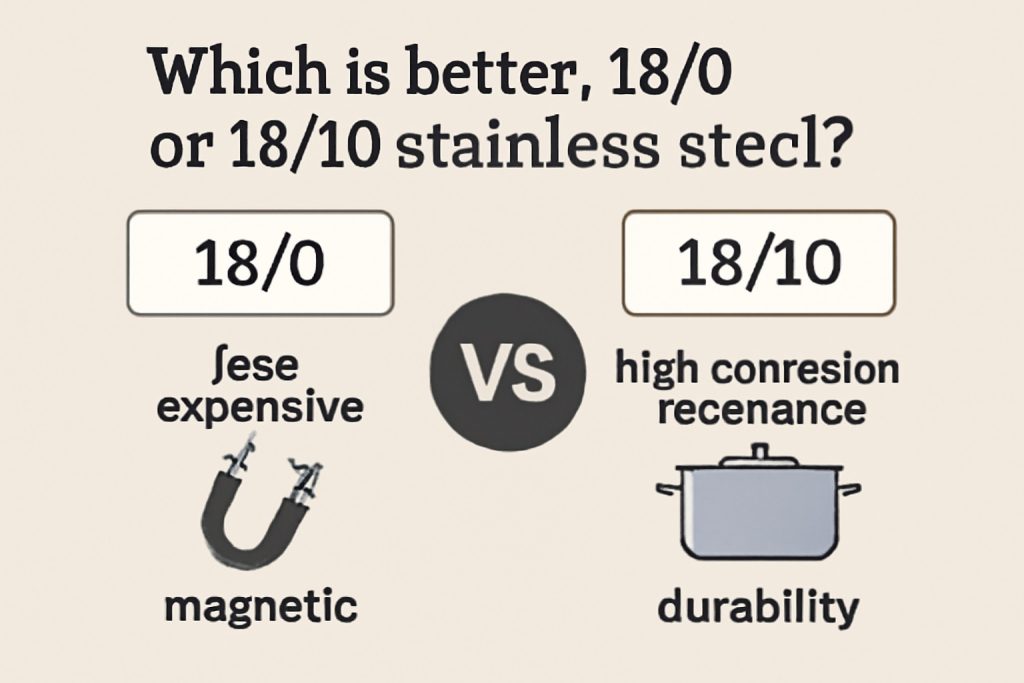
The choice isn't always about one being universally "better," but rather which one is better for a specific purpose. The key difference lies in the presence or absence of nickel and how that affects the steel's properties and cost. Let's explore these differences.
Corrosion Resistance
This is often the most critical factor. The nickel in 18/10 stainless steel (like Grade 304) significantly enhances its ability to resist rust and corrosion, particularly from food acids, cleaning solutions, and general atmospheric conditions. It provides a more robust and longer-lasting protection compared to 18/0. 18/0 stainless steel (like Grade 430) still has good corrosion resistance thanks to the 18% chromium, making it suitable for many applications, but it's generally less resistant than 18/10, especially in more demanding or acidic environments. For parts needing maximum lifespan against the elements or chemicals, 18/10 is usually the preferred choice.
Magnetism
This is a straightforward difference. 18/10 stainless steel (Austenitic structure due to nickel) is typically non-magnetic. 18/0 stainless steel (Ferritic structure, no nickel) is magnetic. This matters for certain applications. For example, if you need cookware compatible with induction stovetops, the pot base must be magnetic, so 18/0 (or a layered construction including a magnetic layer) would be necessary. If magnetism is undesirable (e.g., in some electronic or medical device components), 18/10 would be the choice.
Cost
Nickel is an expensive alloying metal. Because 18/10 contains a significant amount of nickel (8-10%) while 18/0 contains virtually none, 18/0 stainless steel is generally less expensive than 18/10. This makes 18/0 an attractive option for cost-sensitive products where the highest level of corrosion resistance isn't strictly necessary, like budget-friendly cutlery, mixing bowls, or decorative trim.
Common Uses
- 18/10 (Grade 304): High-quality cookware (pots, pans), kitchen sinks, food processing equipment, cutlery, surgical instruments, architectural trim, chemical tanks, and many custom machined parts where durability and corrosion resistance are key.
- 18/0 (Grade 430): Less expensive flatware (knives, forks, spoons), mixing bowls, automotive trim, refrigerator panels, linings for dishwashers, and applications where magnetism is required like induction cookware bases.
So, when choosing, consider: How corrosive is the environment? Does it need to be magnetic? What's the budget? Answering these helps determine if the enhanced properties of 18/10 justify its higher cost over 18/0.
What are the 3 main grades of stainless steel?
Heard terms like Austenitic, Ferritic, and Martensitic thrown around? Do they sound overly technical? Don't worry, these are just the main "families" or categories of stainless steel grades.
The three primary families of stainless steel are Austenitic (like 18/8 or 304, very common, non-magnetic, highly corrosion-resistant), Ferritic (like 18/0 or 430, magnetic, good corrosion resistance, less expensive), and Martensitic (magnetic, very strong, can be hardened, used for blades).
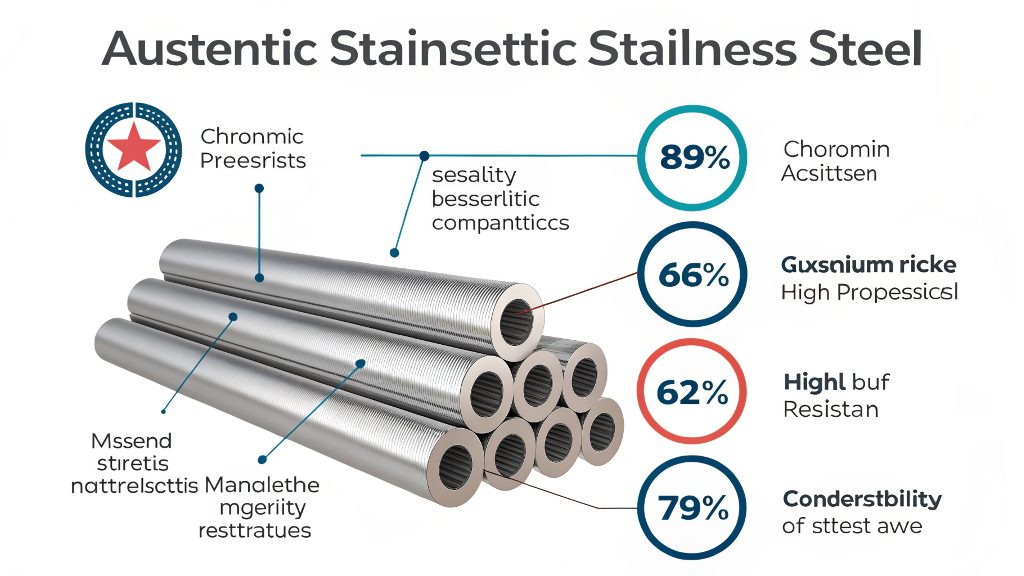
Thinking about stainless steel in these three broad groups makes it much easier to understand their general characteristics and where different grades like 18/8 or 18/0 fit in. Each family gets its properties from its specific crystal structure, which is determined by the metals added (like chromium, nickel, carbon, molybdenum) and how the steel is processed.
Austenitic Stainless Steel
This is the most common family, making up over 70% of stainless steel production.
- Key Elements: Chromium (typically 16-26%) and Nickel (typically 6-22%). Manganese can also be used.
- Properties: Excellent corrosion resistance, very formable and weldable, good strength at high and low temperatures, generally non-magnetic.
- Examples: The 18/8 and 18/10 grades we've been discussing (like 304, 304L) belong here. Other common grades include 316 (which adds molybdenum for even better corrosion resistance, especially against chlorides like salt water) and 321.
- Uses: Cookware, food processing, chemical tanks, medical implants, architectural applications, automotive components, and countless custom CNC machined parts. This is the workhorse family.
Ferritic Stainless Steel
This family is known for being magnetic and generally less expensive than austenitic grades.
- Key Elements: Chromium (typically 10.5-30%), very low carbon, and little to no nickel.
- Properties: Good corrosion resistance (though generally less than austenitic), magnetic, good ductility, not hardenable by heat treatment, lower cost than austenitic.
- Examples: The 18/0 grade (like 430) is a prime example. Other grades include 409 (often used in automotive exhaust systems) and 444.
- Uses: Automotive trim and exhaust systems, kitchen equipment like sinks and appliance panels (especially where cost is a major factor), some types of cutlery, industrial equipment.
Martensitic Stainless Steel
This family is distinguished by its ability to be hardened by heat treatment, making it very strong and hard.
- Key Elements: Chromium (typically 11.5-18%), higher carbon content than ferritic grades, sometimes small amounts of nickel or molybdenum.
- Properties: High strength and hardness after heat treatment, magnetic, moderate corrosion resistance (generally less than austenitic and ferritic).
- Examples: Grade 410 (general purpose), Grade 420 (used for cutlery, surgical instruments), Grade 440C (high carbon, very hard, used for bearings and high-quality knives).
- Uses: Knives, cutting tools, surgical instruments, fasteners, valves, turbine blades, wear-resistant parts.
There are also other categories like Duplex (a mix of austenitic and ferritic structures, offering high strength and good corrosion resistance) and Precipitation Hardening (PH) grades, but Austenitic, Ferritic, and Martensitic are the foundational three families to know.
What is the best grade of stainless steel?
Looking for the absolute "best" stainless steel grade out there? It's natural to want the top option, but finding a single answer is tricky.
There's no single "best" grade of stainless steel overall. The best grade is the one that best suits the specific requirements of your application, considering factors like required corrosion resistance, strength, operating temperature, machinability, magnetic properties, and budget.
Choosing stainless steel is always about trade-offs. What works perfectly for a high-end kitchen sink might be unsuitable for a surgical scalpel or a structural beam in a chemical plant. When we help clients at Worthy Hardware choose materials for their custom CNC machined parts, we always start by asking about the intended use. Let's look at the key factors that determine the "best" choice for a specific job.
What's the Environment Like?
This is often the primary consideration.
- Mild Environment (Indoors, Dry): A less expensive Ferritic grade like 18/0 (430) might be perfectly adequate.
- General Purpose / Food Contact: Austenitic 18/8 or 18/10 (304) is usually the go-to choice due to its excellent balance of corrosion resistance and cost.
- Harsh / Corrosive Environment (Saltwater, Chemicals): A higher grade Austenitic like 316 (with added Molybdenum) or even a Duplex stainless steel might be necessary for long-term durability.
How Strong Does it Need to Be?
Different grades offer different mechanical properties.
- General Strength / Formability: Austenitic grades (like 304) are often sufficient and easy to work with.
- High Strength / Hardness / Wear Resistance: Martensitic grades (like 420 or 440C) are designed for this, especially after heat treatment. PH grades also offer very high strength.
What's Your Budget?
Cost is always a factor in manufacturing and purchasing.
- Lower Cost: Ferritic grades (like 430/18-0) are generally the most economical.
- Mid-Range / Standard: Austenitic grades (like 304/18-8) offer a great value proposition for their performance.
- Higher Cost: Grades with more alloys (like nickel in 304/316, molybdenum in 316) or specialized grades like Duplex or Martensitic will typically cost more.
Does Magnetism Matter?
As discussed, Austenitic grades are generally non-magnetic, while Ferritic and Martensitic grades are magnetic. This can be critical for applications like induction cooking, electronic housings, or medical devices where magnetic fields could interfere.
How Easy is it to Make? (Machinability / Weldability)
Some grades are easier to machine, weld, or form than others. Austenitic grades like 303 (a variant of 304) are specifically designed for easier machining. Weldability also varies significantly between families and grades. This is crucial in manufacturing processes like CNC machining.
In summary, the "best" stainless steel is application-dependent. Grade 304 (18/8) is arguably the most versatile and widely used, making it a "best" choice for many general applications. But for specific demands like extreme corrosion resistance (316), low cost (430), or high hardness (420), other grades become the better option.
Conclusion
Understanding 18/8, 18/10, and 18/0 stainless steel is about knowing the chromium and nickel content. This affects rust resistance, magnetism, and cost, guiding you to pick the right material for your needs.