
Which Materials Work Best for 5-Axis CNC Machining?
Struggling with material choice for your complex parts? This uncertainty can lead to costly errors and project delays. You need a clear answer to move forward with confidence.
The best materials for 5-axis CNC machining are those with low thermal expansion coefficients, such as Invar or Kovar. While a wide range of metals and plastics can be used, these specialty alloys minimize heat-related deformation during complex, multi-angle cutting operations, ensuring maximum precision.
Choosing the right material is one of the most critical decisions you'll make for your project. A 5-axis machine can create almost any shape you can imagine, but the material's properties directly impact the final part's quality, durability, and cost. At our company, I've seen how the perfect material match can turn a difficult project into a huge success. We need to look at what these machines can do and which materials help them perform at their best. Let's explore the options to help you make an informed choice for your next project.
What can I make with a 5-axis CNC machine?
Struggling to imagine the complex parts you can create? You're not alone. The possibilities of 5-axis machining can seem overwhelming, which might limit your design potential.
A 5-axis CNC machine allows you to create highly complex and intricate parts. Think of aerospace components, medical implants, detailed molds, and automotive prototypes with curved surfaces and deep pockets, all produced in a single setup for superior accuracy.
The real strength of a 5-axis machine is its ability to produce parts that are simply impossible or too expensive with traditional 3-axis methods. Because the cutting tool and the part can move along five different axes simultaneously, we can create very complex shapes without having to stop and manually reset the workpiece.
I remember a project for a client in the medical industry. They needed a custom prosthetic joint with organic, curved surfaces that had to be perfectly smooth and incredibly precise. With our 5-axis machine, we machined the entire part from a single block of medical-grade titanium in one go. This not only ensured the part met the tight +/- 0.001" tolerance but also saved the client significant time and money compared to other manufacturing methods.
Here are some common examples:
-
Aerospace: Turbine blades, impellers, and structural components with complex curves.
-
Medical: Custom implants, surgical tools, and prosthetics.
-
Automotive: Engine blocks, custom wheel hubs, and prototype parts.
-
Consumer Products: Intricate molds for electronics casings and detailed product
prototypes.
What materials are used in CNC machining?
Choosing the right material feels like a huge challenge. Pick the wrong one, and your project could fail. This can cost you a lot of time and money.
CNC machining can handle a vast range of over 100 materials. We regularly work with metals like aluminum, steel, and titanium, plastics such as ABS, PEEK, and Delrin, and even specialty materials like composites and certain woods for specific applications.
At Worthy, we have experience with a huge variety of materials, so we can always find the right fit for a client's needs. The choice really depends on what the part will be used for. We have to consider factors like strength, weight, heat resistance, and cost. For 5-axis machining specifically, we also think about how the material behaves under the stress of prolonged, complex cutting paths. Some materials are easier to machine than others and produce a better surface finish. Our engineers often help customers improve their designs by suggesting a material that offers better performance or saves on cost without sacrificing quality. It’s about finding the perfect balance for your specific project.
Here is a simple breakdown of common material groups we use:
| Material Group | Common Examples | Key Characteristics |
|---|---|---|
| Metals | Aluminum, Stainless Steel, Titanium, Brass | High strength, durability, good thermal conductivity. |
| Plastics | ABS, PEEK, Polycarbonate (PC), Nylon | Lightweight, corrosion-resistant, good electrical insulators. |
| Specialty | Carbon Fiber, Invar, Wood | High strength-to-weight ratio, low thermal expansion. |
What is a 5-axis CNC machine used for?
Are you wondering if 5-axis machining is just expensive overkill? Many people believe it's only for niche industries. This thinking causes them to miss out on its benefits.
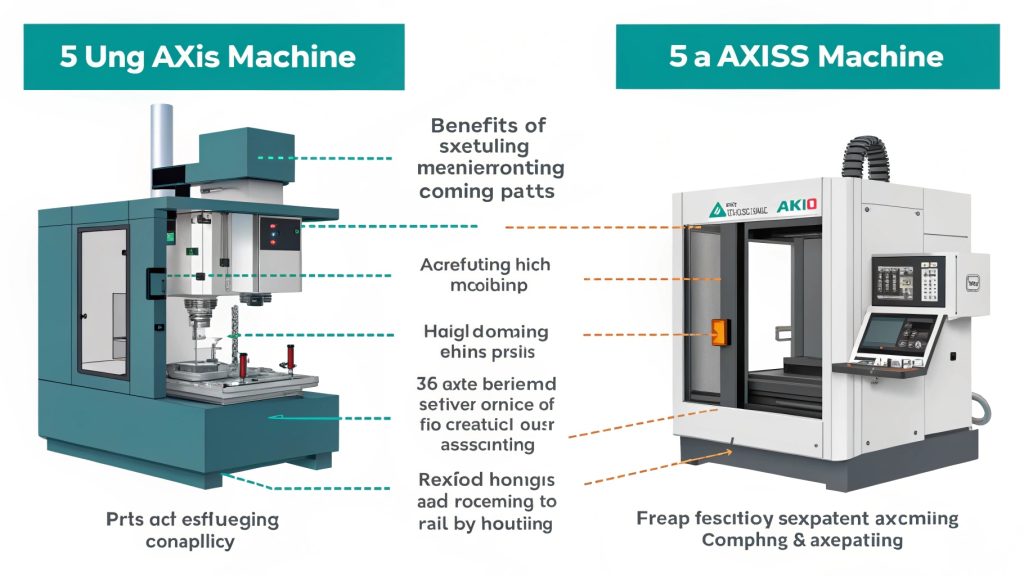
A 5-axis CNC machine is used for creating parts with complex geometries in a single setup. It's ideal for industries needing high precision and efficiency, like aerospace and medical, because it reduces machining time, minimizes errors, and improves surface finish.
The main purpose of using a 5-axis machine is to achieve higher levels of precision and efficiency on complex parts. When you machine a part on a 3-axis machine, you often have to stop the process and manually reposition the part to cut it from a different angle. Every time you do this, you introduce a small risk of error. A 5-axis machine avoids this completely.
I had a client, a startup owner like Mark Chen, who needed a complex housing for an electronic device. He was used to sourcing simpler parts and was worried about the cost of 5-axis. We showed him how we could machine his entire part, with all its undercuts and angled holes, in a single operation. This single-setup approach not only guaranteed perfect alignment but also shortened his lead time from weeks to just a few days, allowing him to get his product to market faster.
The key uses come from these advantages:
-
Machining Complex Shapes: It can create parts with deep cavities and multi-angled surfaces that are impossible with fewer axes.
-
Improving Accuracy: By completing the part in a single setup, we avoid the potential for positional errors that come from re-fixturing the workpiece.
-
Achieving Better Surface Finishes: The tool can be tilted to maintain the optimal cutting position, resulting in a smoother surface. This can often reduce the need for secondary polishing.
What are the disadvantages of a 5-axis CNC machine?
Thinking 5-axis machining is the perfect solution for everything? This assumption can lead to unexpected costs and complexities if you don't understand its drawbacks first.
The main disadvantages of 5-axis CNC machining are the higher machine cost and the more complex programming required. This makes it less cost-effective for simple parts that can be made efficiently on a 3-axis machine.

While 5-axis technology is powerful, it's not always the best tool for every job. The machines themselves are a significant investment, and the software needed to program the complex toolpaths is also more advanced and expensive. This means the overhead cost for a 5-axis job is naturally higher. It also requires highly skilled programmers and machine operators who understand the technology.
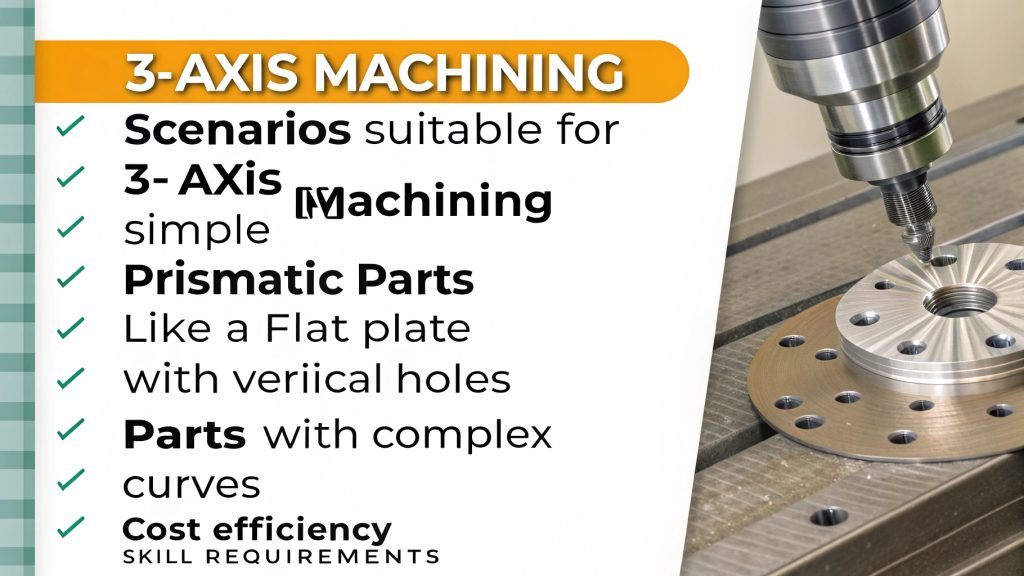
For a simple part, like a flat plate with a few vertical holes, setting up a 5-axis machine would be inefficient. A 3-axis machine can do that job faster and at a much lower cost. We are always honest with our customers about this. If a project doesn't require the complexity of 5-axis, we will recommend a more cost-effective method to save them money. It’s about using the right tool for the right job to deliver the best value.
Here's a quick guide to help you decide:
| Use 3-Axis Machining For: | Use 5-Axis Machining For: |
|---|---|
| Simple, prismatic parts | Parts with complex curves and contours |
| Parts with features on one side | Parts needing machining on multiple faces |
| Drilling, tapping, and milling flat surfaces | Impellers, turbine blades, medical implants |
| When cost is the primary driver for a simple design | When precision and single-setup efficiency are key |
Conclusion
In short, 5-axis machining handles many materials for complex parts. But choosing materials with low thermal expansion, like Invar, is key to achieving the highest precision and best results.