
What’s the Difference Between 3-Axis and 5-Axis CNC Machining?
Confused about CNC machining options for your project? The wrong choice can lead to delays and extra costs. Let's clear things up so you can choose wisely.
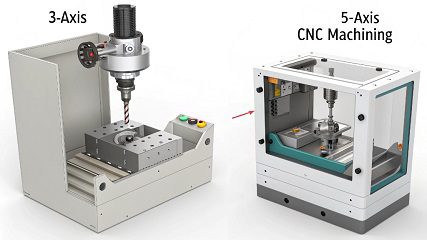
The main difference is the number of axes. 3-axis machines move on the X, Y, and Z axes. 5-axis machines add two rotational axes. This allows 5-axis machines to work on more complex parts from multiple angles in a single setup, improving accuracy and efficiency.
That's the basic answer. But the real value is in understanding when to use each one. Choosing correctly affects your budget, your timeline, and the final quality of your parts. I've seen clients save thousands just by making the right call. Let's dive deeper into what makes these two technologies so different and why it matters for your specific project.
What is the difference between 3-axis and 5-axis CNC?
The technical details can be overwhelming. Not understanding the core differences might mean you're paying for capabilities you don't actually need. Let's simplify it.
3-axis machines cut along three linear axes (X, Y, Z). 5-axis machines use these same three axes but also add two rotational axes (A and B, or B and C). This allows the cutting tool to approach the workpiece from many different directions without new setups.
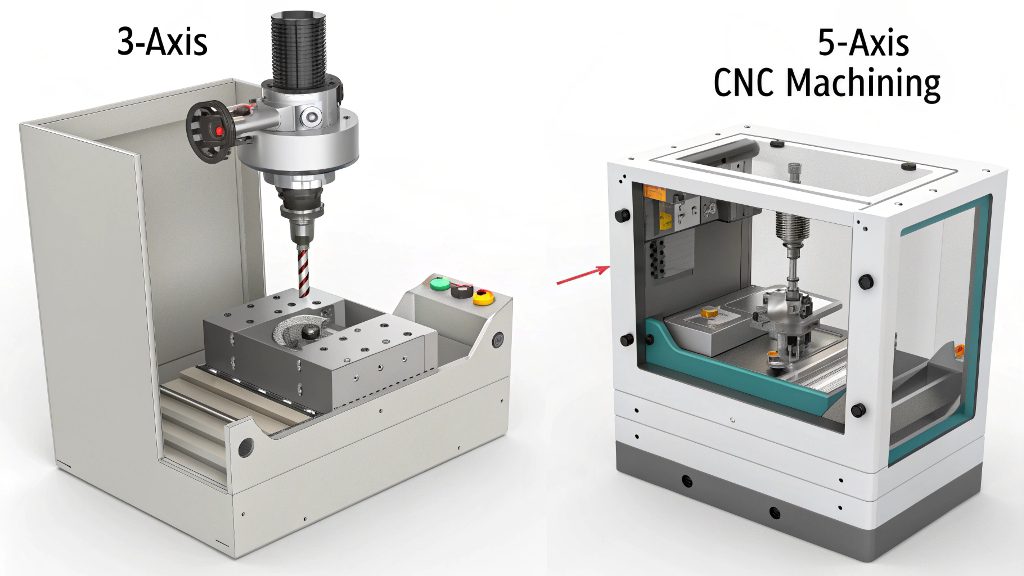
Imagine a simple box. A 3-axis machine can easily mill the top face. To work on the sides, you have to stop the machine, unclamp the box, turn it, and clamp it again. Each new setup adds time and a small risk for misalignment. Now, think about a 5-axis machine. It can work on the top and then simply rotate the tool or the part to work on the sides, all in one continuous operation. This is the fundamental difference in how they work.
Workpiece Movement and Setup
With 3-axis machining, the workpiece is fixed in place. The cutting tool moves left-right, forward-back, and up-down to remove material. For parts that have features on multiple sides, this requires me to manually stop, unclamp, and re-position the part. In contrast, 5-axis machining can move the workpiece or the tool head on two additional rotary axes. This means my team at Worthy can machine complex shapes and multiple faces in a single setup.
Comparison Table
| Feature | 3-Axis CNC Machining | 5-Axis CNC Machining |
|---|---|---|
| Axes of Motion | X, Y, Z (Linear) | X, Y, Z (Linear) + A, B/C (Rotational) |
| Best For | Simple parts, flat surfaces, drilling | Complex geometries, curved surfaces |
| Setups Required | Multiple for multi-sided parts | Often just one |
| Accuracy | Good, but risks error with re-fixturing | Very high due to single setup |
| Cost | Lower initial cost and programming | Higher initial cost and complex programming |
What are the disadvantages of a 5-axis CNC machine?
It's easy to think more axes are always better. But this assumption can lead to higher costs and complexity that your project might not even need.
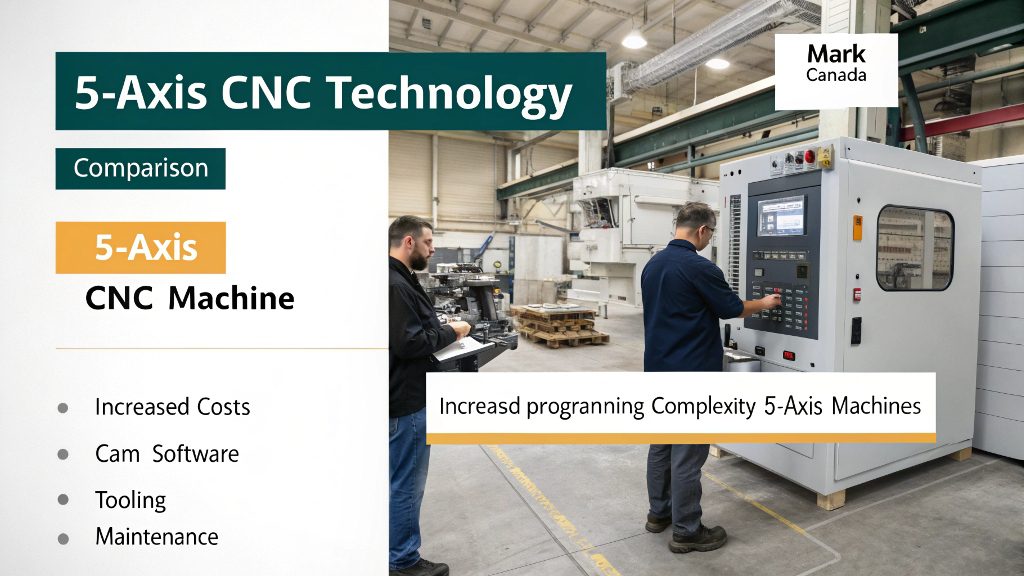
The main disadvantages are cost and complexity. 5-axis machines are more expensive to buy and maintain. Programming them requires more skilled operators and sophisticated software, which increases the overall project cost. For simple parts, this is often an unnecessary expense.
While 5-axis technology is powerful, it's not the right fit for every job. I always make this clear to my customers. The biggest barrier for many is the cost, and if your part doesn't need it, you shouldn't pay for it.
Higher Initial and Operational Costs
A 5-axis CNC machine costs a lot more than a 3-axis machine. The investment doesn't stop there. The programming software (CAM) is more advanced and expensive. Tooling can also be more specialized. Maintenance is another factor; with more moving parts and complex systems, repair and upkeep costs are higher. I always tell my clients, like Mark from Canada, that we must match the machine to the part's complexity. This ensures we deliver competitive pricing. For a simple bracket, using a 3-axis machine is faster and cheaper, and that saving is passed on to him.
Increased Programming Complexity
Creating the toolpaths for a 5-axis machine is a highly skilled task. It requires experienced programmers who understand how to avoid tool collisions with the workpiece, fixtures, or the machine itself. A small error in the code can lead to a very expensive crash. This complexity adds to the programming time and cost. It makes 5-axis less suitable for simple, high-volume parts where speed and cost-efficiency are the top priorities.
What are the advantages of a 5-axis CNC machine?
Struggling with complex parts that require multiple machine setups? Each step adds time, cost, and the potential for error. 5-axis machining offers a powerful solution.
The key advantages are improved accuracy, shorter lead times, and the ability to create highly complex shapes. By machining a part in a single setup, it eliminates errors from re-fixturing. This also allows for shorter cutting tools, which reduces vibration and improves surface finish.
The disadvantages are real, but for the right application, the advantages of 5-axis machining are game-changing. It’s all about creating better parts, faster. This is where my company, Worthy, provides incredible value to our customers.
Unmatched Complexity and Accuracy
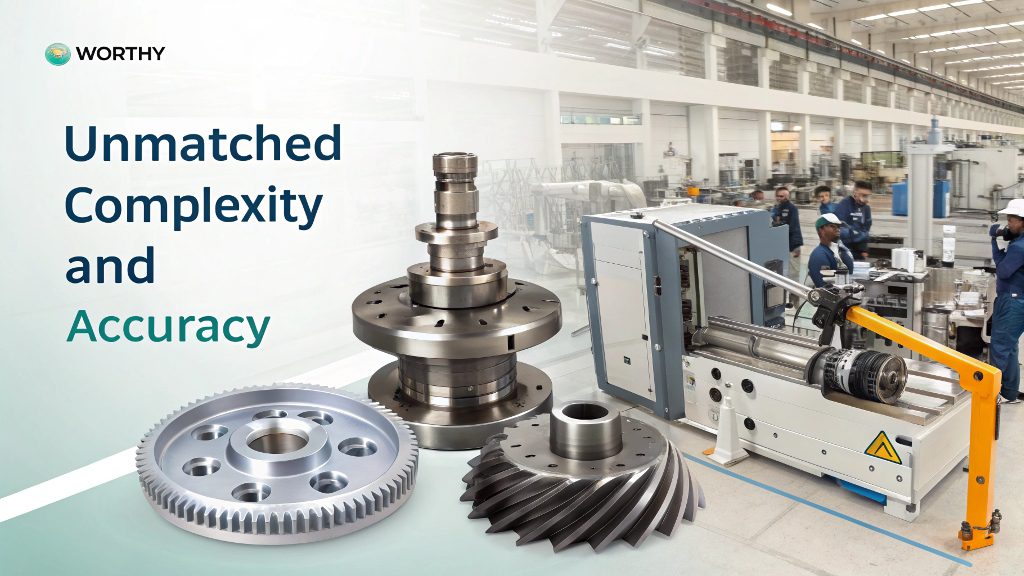
The most significant advantage is the ability to machine extremely complex shapes in a single setup. Think of aerospace components, medical implants, or molds with intricate curves. This "done-in-one" approach drastically improves accuracy because the part isn't moved between operations. Every time you re-clamp a part, you introduce a small chance of error. 5-axis machining eliminates that risk. I remember a client from North America who needed a complex housing with angled ports on five different faces. On a 3-axis machine, it was a nightmare of custom fixtures and many setups. By moving it to our 5-axis service, we reduced the lead time by 30% and improved the part-to-part consistency dramatically.
Better Surface Finish and Longer Tool Life
Because the cutting tool can be tilted, it can maintain an optimal cutting position relative to the part's surface. This allows for the use of shorter, more rigid cutting tools. A shorter tool vibrates less, resulting in a much smoother surface finish. It also reduces the stress on the tool, leading to longer tool life and saving costs in the long run.
What is 5-axis CNC machining?
You've likely heard the term "5-axis CNC," but what does it really mean? Not knowing could mean you're missing out on a superior manufacturing option for your parts.
5-axis CNC machining is a process where a cutting tool moves across five different axes simultaneously. It uses the standard X, Y, and Z linear axes, plus two rotational axes. This allows the tool to approach a workpiece from any direction to create complex parts.
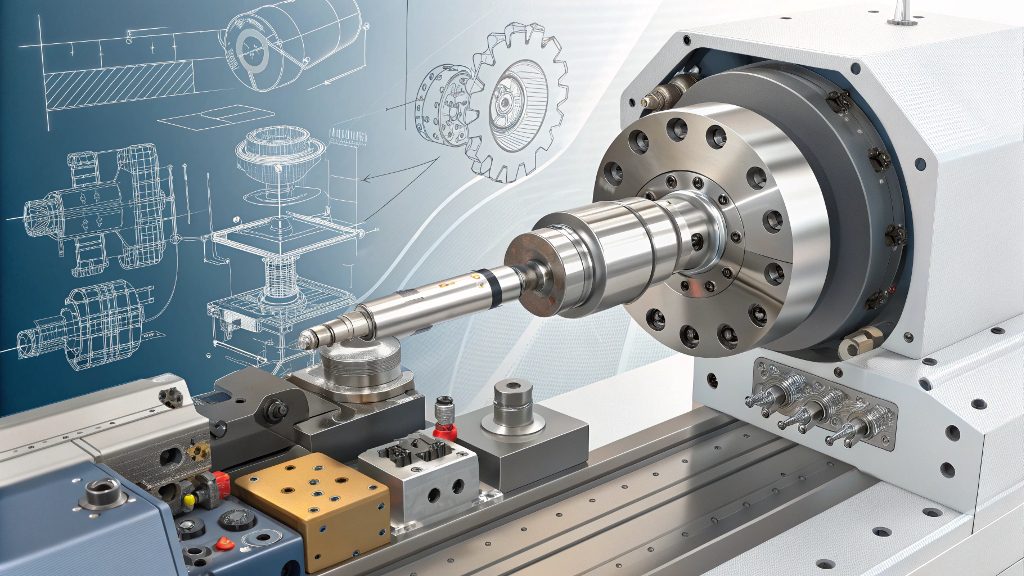
Let's get to the core of what this technology is. At its heart, it's about adding freedom of movement. A standard 3-axis machine operates on three axes, which we can call X (left-right), Y (forward-back), and Z (up-down).
The Two Additional Axes
5-axis machining adds two more rotational axes to this movement. Think of it like adding a wrist to an arm that can already move in three directions. These axes are typically named A, B, or C.
-
A-Axis: Rotation around the X-axis.
-
B-Axis: Rotation around the Y-axis.
-
C-Axis: Rotation around the Z-axis.
A 5-axis machine will have a combination of two of these rotational axes. This allows the cutting tool to stay perfectly angled to the surface of the part, even on complex curves.
How It Works in Practice
There are two main machine configurations. In one type, the worktable where the part is held rotates on two axes. In another type, the table rotates on one axis while the tool head swivels on another. Both setups achieve the same goal: providing access to nearly every surface of the part without needing to stop and reposition it. This is why at Worthy, we can confidently handle parts with intricate features and tight tolerances for industries from aerospace to medical devices.
Conclusion
Choosing between 3-axis and 5-axis depends on part complexity and budget. 3-axis is great for simple jobs, while 5-axis excels at creating complex parts with high accuracy.