
What Tolerances Can Be Achieved When CNC Machining Different Silicone Types?
Are you struggling to get precise silicone parts? Inconsistent results can ruin your project, wasting time and money. Understanding what tolerances are possible is the first step to success.
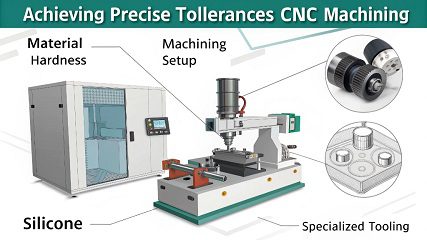
The tightest tolerance for CNC machining silicone is highly dependent on the material's hardness and the machining setup. For specific, rigid grades of machinable silicone, high-precision processes can achieve tolerances as tight as 0.002mm to 0.005mm, though this requires specialized expertise and tooling.
Getting these ultra-fine tolerances isn't a simple task. Unlike metals, silicone is soft, flexible, and can tear or deform easily during machining. This makes holding tight dimensions a real challenge for many shops. But it is possible with the right approach. It all comes down to understanding the key factors that influence precision. So, how do we manage these challenges to deliver the parts you need? Let's break down what you need to know about tolerances, materials, and the manufacturing process.
What are the tolerances for CNC machining?
Confused by the term "tolerance" in your manufacturing quotes? Misunderstanding it can lead to parts that don't fit or function correctly, causing major delays for your business.
In CNC machining, tolerance is the acceptable range of variation for a specific dimension of a part. It ensures that every piece will fit and function correctly in its final assembly. It is not a single number, but a plus/minus range from a target dimension.
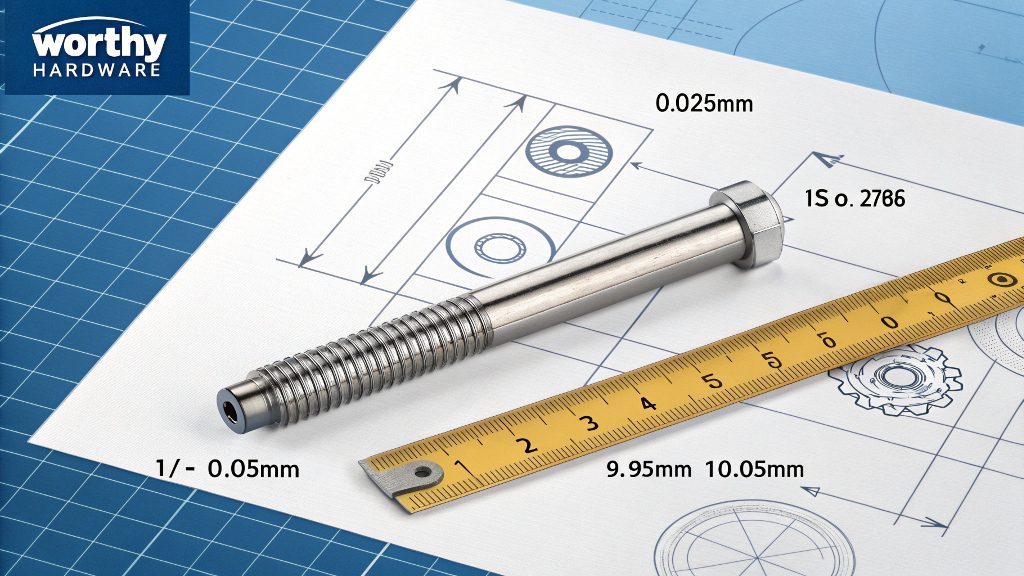
When you design a part, you specify its ideal dimensions. But in the real world, it's impossible to make every single part absolutely perfect. Tolerance defines how much that dimension is allowed to vary. For example, a shaft with a diameter of 10mm and a tolerance of +/- 0.05mm means any part between 9.95mm and 10.05mm is acceptable. At my company, Worthy Hardware, we follow general tolerance standards like ISO 2768, which for metals is typically +/- 0.127mm. However, many projects need tighter control. For critical features, we can hold much tighter tolerances, even below +/- 0.025mm, based on your drawings. The key is to specify tighter tolerances only where they are functionally necessary, as this helps control manufacturing costs and time.
What are the tolerance grades for machining?
Have you heard about "tolerance grades" but you are not sure what they mean? Choosing the wrong grade can mean paying too much for unnecessary precision or getting parts that fail.
Machining tolerance grades are standardized levels of precision, often defined by systems like ISO 286. These are called "IT" grades, ranging from IT01 (most precise) to IT18 (least precise). The lower the IT number, the smaller the tolerance range and the higher the precision.
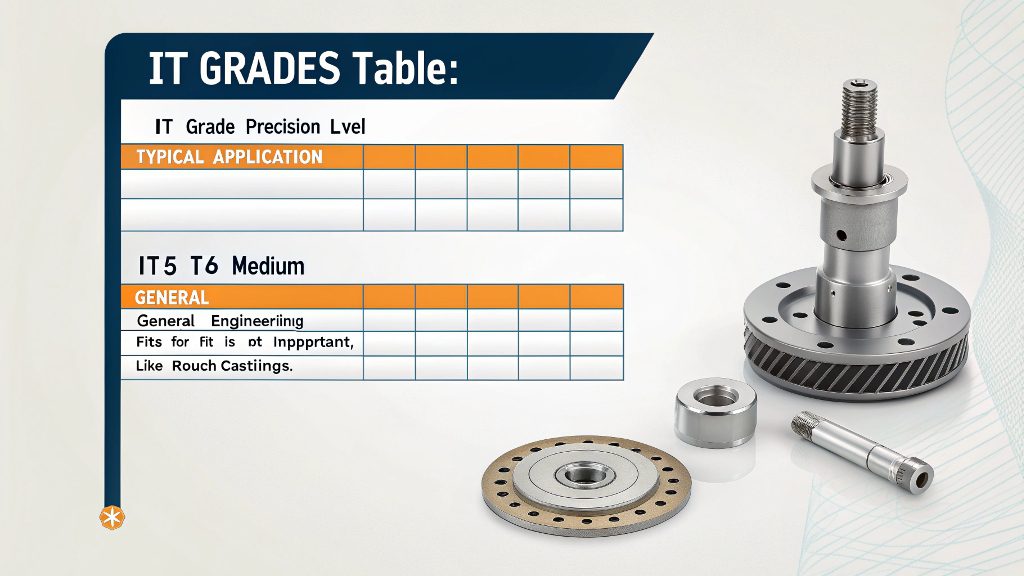
Think of IT grades as a simple language to communicate how precise a part needs to be. Instead of writing out a complex tolerance for every dimension, a designer can just specify an IT grade. This tells the machinist exactly what level of accuracy is required for a particular feature. As a manufacturer, this helps us understand the part's requirements immediately. For my customers, understanding this means they can make better decisions about their designs.
Common IT Grades and Their Uses
| IT Grade | Precision Level | Typical Application |
|---|---|---|
| IT11 - IT13 | Coarse | For parts where fit is not important, like rough castings. |
| IT7 - IT10 | Medium / General | General engineering, fits for shafts and holes in standard assemblies. |
| IT5 - IT6 | Fine | Precision parts, bearings, and close-fitting components. |
| IT2 - IT4 | Very Fine | High-precision gauge blocks and master measurement tools. |
Choosing the right grade is a balance. A grade of IT7 might be perfect for a standard assembly, but specifying IT5 when it's not needed will significantly increase the cost.
What are factors that change when CNC machining different materials?
Do you think that CNC machining is the same process for every material? Using the wrong approach for a soft material like silicone will lead to poor quality and failed parts.
The most important factors that change are material hardness, thermal stability, and tooling requirements. For soft materials like silicone, this demands using extremely sharp tools, specific cutting speeds to avoid melting, and special workholding methods to prevent the part from deforming during machining.


Every material behaves differently when it meets a cutting tool. Machining a block of aluminum is completely different from machining a piece of silicone. With metal, the challenge is cutting through a hard material. With silicone, the challenge is cutting a soft material cleanly without it tearing, melting, or squishing out of shape. This is something I always discuss with my clients, especially those new to machining softer polymers. We have to adjust our entire process, from how we hold the material to the tools we use, to get a good result.
Metal vs. Silicone Machining
| Factor | CNC Machining Aluminum | CNC Machining Silicone |
|---|---|---|
| Workholding | Standard vises and clamps work well. | Custom fixtures, vacuum chucks, or even freezing the material is often needed to hold it firmly without distortion. |
| Tooling | Standard high-speed steel (HSS) or carbide tools. | Extremely sharp, custom-ground tools are needed to slice cleanly, not tear. |
| Speeds & Feeds | Can run at high speeds to remove material quickly. | Must use lower speeds and specific feed rates to prevent heat buildup and melting. |
| Coolant | Standard flood coolant is used to cool the tool and part. | Often machined dry or with compressed air to avoid chemical reactions and keep the workpiece clean. |
What is the allowable manufacturing tolerance?
How do you decide on the "right" tolerance for your part? Specifying a tolerance that is too tight is one of the most common mistakes, and it needlessly increases your costs.
The allowable manufacturing tolerance is the widest possible tolerance a part can have while still performing its job correctly. It is determined by the part's function, its fit with other components, and the overall performance requirements of the final product, not by what is possible to achieve.
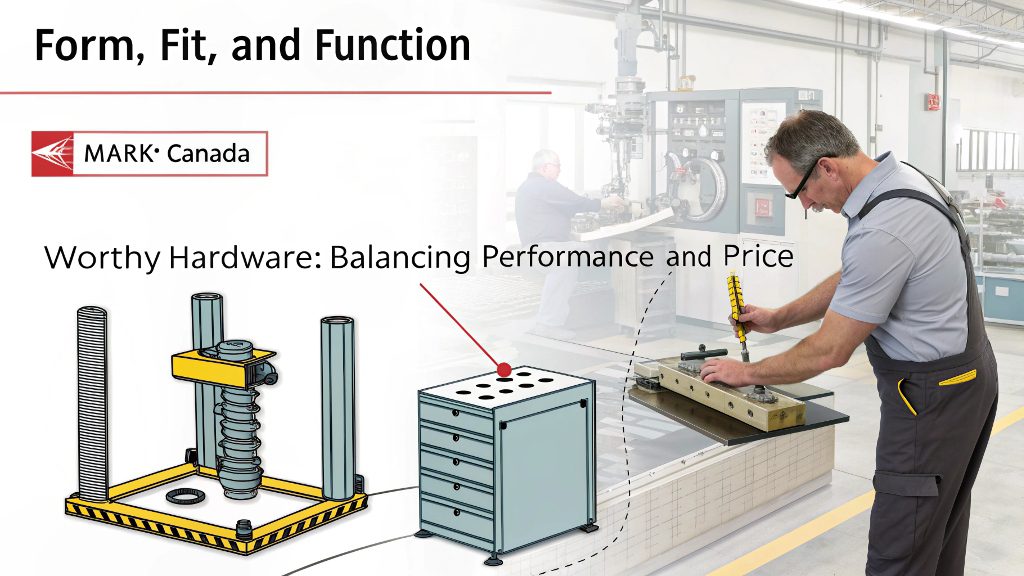
The key is to think about "form, fit, and function." Does this part need to slide into another part with a tight fit? Or is it just a cover that needs to be in the general right spot? The answers to these questions determine your allowable tolerance. Tighter tolerances should only be used on critical features. I often work with customers like Mark from Canada, who run their own businesses and need to be competitive. On one project, he specified a very tight tolerance on a silicone gasket. I asked him about its final use. We realized the surface was non-critical and a standard tolerance would work perfectly. This simple change saved him nearly 30% on the cost of the part and got it delivered faster. This is the kind of practical partnership we provide at Worthy Hardware. We help you find the perfect balance between performance and price.
Conclusion
Achieving tight tolerances on silicone is challenging but possible with the right partner. Understanding material properties and specifying appropriate tolerances is key to balancing quality and cost for your project.