
What Shore A Hardness Should You Specify for Industrial CNC Machined Components?
What is the ASTM standard for Shore hardness?
Unsure which standard governs material hardness? This confusion can lead to inconsistent quality and part failures. The ASTM D2240 standard provides the clear guidelines you need.
The primary standard for measuring Shore hardness is ASTM D2240. This method uses a durometer to test the indentation hardness of materials like elastomers, rubbers, and soft plastics. It ensures consistent and repeatable measurements across the industry.
This standard is our guide at Worthy Hardware. It is not just a suggestion; it is the language we use to guarantee quality. The standard specifies exactly how to measure hardness using different scales. Shore A is for softer, flexible materials, while Shore D is for harder plastics. When a client like Mark from Canada sends a technical drawing, he might specify "75 Shore A per ASTM D2240." This tells my engineering team exactly what is needed.
We use a calibrated tool called a durometer. It has a specific pointed indenter that we press into the material's surface with a specific amount of force. The depth it sinks into the material gives us the hardness value. Following this standard is non-negotiable for us. It guarantees that the part we produce matches the customer's design, ensuring it will work reliably as a seal, a gasket, or a vibration dampener.
What does 70 Shore hardness mean?
Is 70 Shore A hard or soft? Misunderstanding this value can lead to choosing the wrong material for your part. Let's put this common hardness value into perspective.
A 70 Shore A hardness material is a medium-soft rubber, similar to the hardness of a car tire tread or a rubber shoe heel. It is flexible but firm enough to hold its shape under moderate pressure, making it a very common choice for seals.
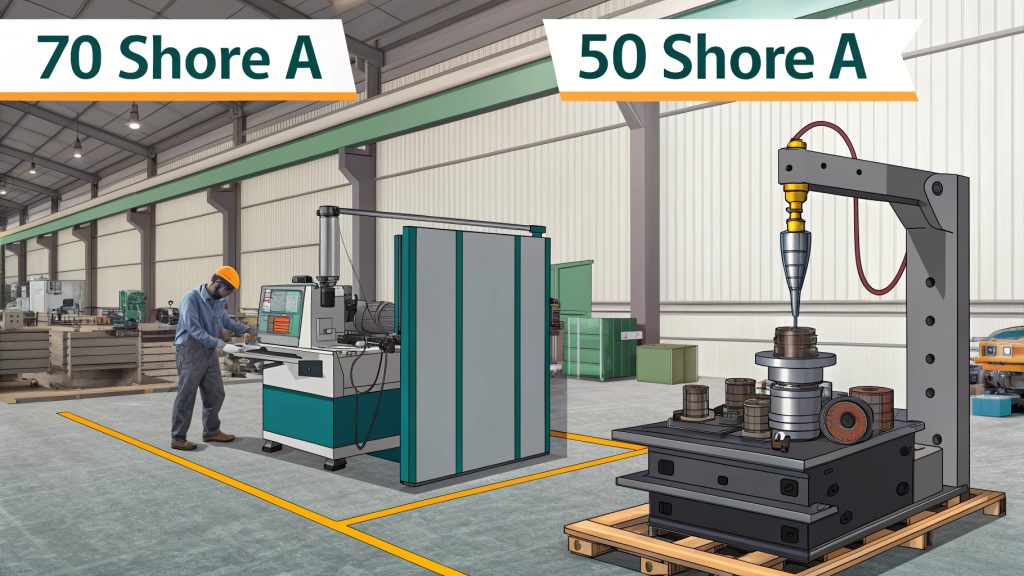
When we talk about 70 Shore A, we are describing a very popular "sweet spot" for many applications. I remember a project for an automotive client in Europe. They needed a custom gasket for a fluid line. They initially considered a softer material, around 50A, because they wanted maximum flexibility. However, my team and I advised against it. Why? While 50A is very flexible, it is often too soft for CNC machining. The material can stretch and deform under the cutting tool. This makes it almost impossible to achieve precise dimensions and a clean surface finish.
A 70A material provided the perfect balance. It was flexible enough to create a tight seal against the engine block. At the same time, it was firm enough for us to machine precise holes and slots. At Worthy, this machinability is key. We can hold tight tolerances on a 70A material, which is very difficult to do with anything softer. It's a versatile choice for many industrial parts.
What is the difference between 70 and 90 Shore hardness?
Choosing between 70A and 90A feels like a small detail. But making the wrong choice can cause your part to fail completely in its application. Let's compare them directly to clarify.
The main difference is flexibility versus rigidity. A 70 Shore A material is flexible like a car tire. A 90 Shore A material is much harder and less flexible, feeling more like a plastic shopping cart wheel. Choose 70A for sealing and 90A for impact resistance.
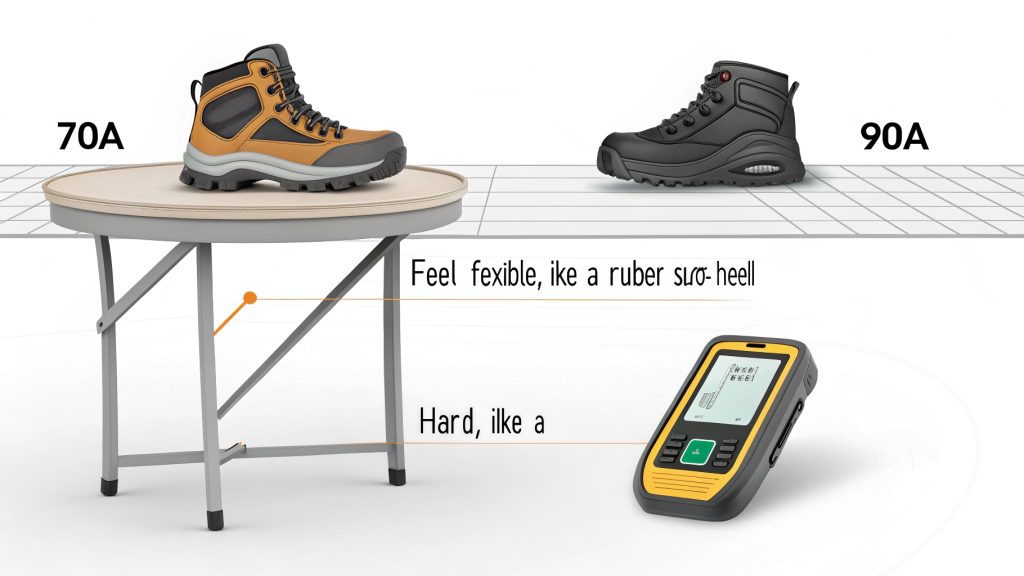
The jump in properties from 70A to 90A is significant, and the right choice depends completely on the part's job. A client in the consumer electronics industry needed a protective boot for a rugged handheld device. They needed something that could absorb the shock of being dropped but also be rigid enough to hold its shape and not feel "gummy" or cheap. We made two prototypes for them, one in a 70A polyurethane and one in a 90A polyurethane. The 70A material was too flexible. It protected against bumps, but it did not provide enough structural support and felt flimsy. The 90A material was perfect. It was tough, durable, and still had enough give to absorb impacts.
Here is a simple table to help you decide:
| Feature | 70 Shore A | 90 Shore A |
|---|---|---|
| Feel | Flexible, like a rubber shoe heel | Hard, like a skateboard wheel |
| Best Use | Gaskets, seals, vibration dampeners | Bumpers, impact pads, structural parts |
| Flexibility | High | Low |
| Abrasion Resistance | Good | Excellent |
| CNC Machinability | Good, but requires care | Excellent, easier to hold tolerance |
How to specify Shore hardness?
You know the hardness you need for your part. But if you specify it incorrectly on your drawing, you might get the wrong part after weeks of waiting. Let me show you the clear, simple way.
To specify Shore hardness correctly on a technical drawing or purchase order, state the value, the scale, and the standard. For example, write "Hardness: 70 Shore A per ASTM D2240." This removes all ambiguity.

Clear communication is everything in manufacturing. I have seen many orders get delayed because of a simple, unclear note on a drawing, like "Hardness: 70." Seventy what? Shore A? Shore D? Based on what standard? This creates confusion and requires my team to send emails back and forth with the customer. This wastes valuable time.
As a business owner, I know that these delays hurt my customers. People like Mark in North America have their own production schedules to meet. A delay from us can cause a bigger problem for them. That is why my engineers and I always insist on clear specifications from the start. On your 2D drawing or in your Request for Quote (RFQ), you must always include three key pieces of information:
-
The Number: The actual hardness value (e.g.,
70,80,90). -
The Scale: The Shore scale you are using. This is most commonly
Shore Afor flexible materials orShore Dfor hard plastics. -
The Standard: The testing method, which should always be
ASTM D2240.
A perfect specification looks like this: Material: Polyurethane, Hardness: 90 Shore A per ASTM D2240. This simple line tells my team everything we need to know. We can select the right material and verify its properties, ensuring we deliver a perfect part on the first try.
Conclusion
Choosing the right Shore A hardness, typically 70A to 90A, and specifying it clearly using ASTM D2240 is critical for successful CNC machined components. Get it right from the start.