
What Is G10/FR4 Garolite And Why Is It Used In CNC Machining?

Need a material that's strong, stable, and electrically insulating for your CNC project? Many options fall short. G10/FR4 Garolite delivers this unique combination, making it ideal for demanding applications.
G10/FR4 Garolite is a high-pressure thermoset laminate made from woven glass fabric and epoxy resin. It's used in CNC machining for its excellent mechanical strength, dimensional stability, low moisture absorption, great electrical insulating properties, and good machinability, especially the FR4 variant which is flame retardant.
Choosing the right material is crucial for any machining project. When requirements include electrical insulation alongside mechanical toughness, the choices narrow significantly. Let's explore why G10/FR4 Garolite is often the perfect fit, especially when processed using CNC machines. We'll break down what it is, where it's used, and the key difference between G10 and FR4. Understanding these details helps ensure you select the best material for your specific needs.
What is garolite G10 FR4?
Confused by the different names like G10, FR4, and Garolite? This can make material selection tricky. Let's clarify exactly what this versatile composite material is.
Garolite G10/FR4 is a composite material. It's made by layering woven glass fabric sheets and bonding them together with an epoxy resin under high pressure and heat. This creates a strong, rigid laminate with excellent electrical insulating properties.
Garolite itself is often used as a trade name, but it typically refers to a family of glass-epoxy laminates. G10 and FR4 are specific grades designated by NEMA (National Electrical Manufacturers Association). The core construction involves stacking multiple layers of glass cloth saturated with epoxy resin. This stack is then pressed under intense heat and pressure. This process cures the epoxy and fuses the layers into a single, dense sheet or rod.
The result is a material known for its impressive strength-to-weight ratio, far exceeding many plastics. It maintains its shape well under stress (dimensional stability) and absorbs very little water, which is vital for electrical applications. From my experience at Worthy Hardware, its consistent structure makes it reliable for precision CNC machining.
| Property | Description | Benefit in CNC Machining |
|---|---|---|
| Base Material | Woven Glass Fabric | High Strength, Rigidity |
| Resin Binder | Epoxy | Strong Bond, Chemical Resistance |
| Manufacturing | High Pressure & Heat Lamination | Dense, Stable Structure |
| Key Feature | Excellent Electrical Insulation | Use in Electronic Components |
| Moisture Absorpt. | Very Low | Maintains Electrical Properties |
| Dimensional Stab. | High | Holds Tight Tolerances |
What is G10 material used for?
Wondering where a strong, insulating material like G10 actually fits in? Its unique properties make it suitable for very specific tasks. G10 is widely used across various demanding industries.
G10 material is used for applications requiring high strength, stiffness, dimensional stability, and electrical insulation. Common uses include electrical insulators, printed circuit board (PCB) substrates, structural components, terminal boards, jigs, fixtures, and even knife handles.
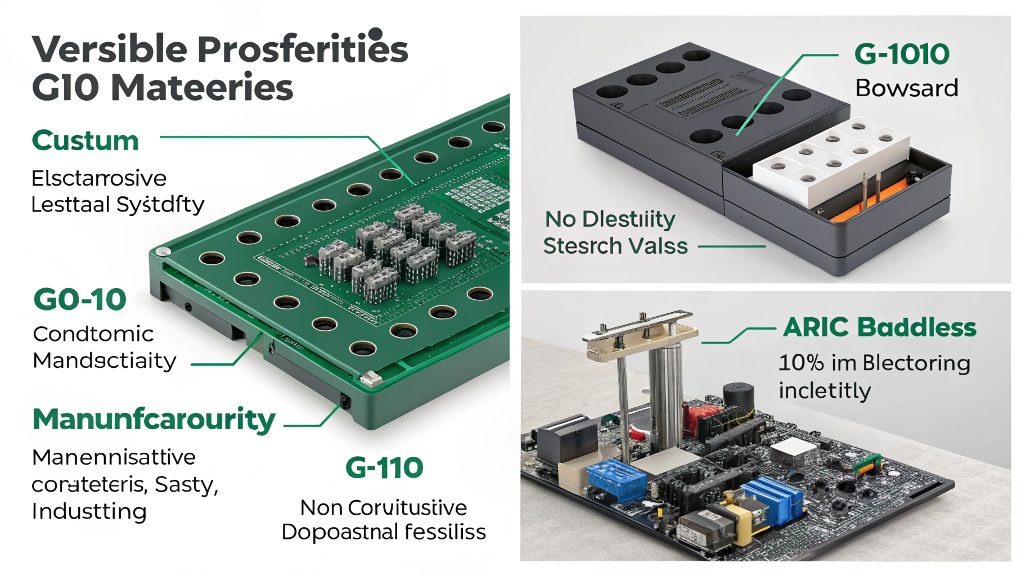
The versatility of G10 stems from its balanced properties. In the electronics world, it's a go-to material for terminal boards, insulating washers, and structural supports within electrical equipment because it doesn't conduct electricity and resists electrical arcing. Its mechanical strength allows it to serve as structural components where metal might be too heavy or conductive.
In manufacturing, we often machine G10 at Worthy Hardware to create custom jigs and fixtures. Why? Because it's strong enough to hold parts securely during production, dimensionally stable enough not to warp over time or with temperature changes, and relatively easy to machine into complex shapes. Its durability also lends itself to high-wear applications like tough, non-conductive handles for tools or knives, providing a secure grip and electrical safety.
| Application Area | Specific Use Examples | Key Property Leveraged |
|---|---|---|
| Electrical/Electronics | Terminal Boards, Insulators, PCB base | Electrical Insulation, Stability |
| Manufacturing | Jigs, Fixtures, Tooling Plates | Strength, Machinability, Stability |
| Mechanical | Structural Components, Wear Pads | Strength-to-Weight, Durability |
| Consumer Goods | Knife Handles, Tool Grips | Durability, Grip, Insulation |
What is garolite used for?
Still thinking about where Garolite fits in specifically? Is it just another name, or are its uses distinct? Garolite, especially G10/FR4, serves many practical industrial roles.
Garolite, particularly the G10/FR4 grade, is used similarly to G10: for electrical insulation parts like terminal strips and boards, structural elements needing strength and low weight, and stable, machinable tooling like jigs and fixtures in manufacturing.

Think of "Garolite" as a broader family name, with G10 and G10/FR4 being very common members. Its uses directly reflect the properties we've discussed. Because it's an excellent electrical insulator, you'll find Garolite G10/FR4 forming the backbone of many electrical assemblies. It acts as barriers, supports, and mounting plates where preventing electrical current flow is essential. Its mechanical strength makes it suitable for gears, spacers, or support brackets in machinery where metal isn't ideal due to weight or conductivity concerns.
In our CNC machining shop, we frequently work with Garolite G10/FR4 to create precise components for our customers. Its stability ensures that parts hold their dimensions accurately, which is critical for complex assemblies or for tooling that needs to perform reliably over many cycles. It machines well, though tool wear can be higher than with some plastics due to the abrasive glass content.
What is the difference between G10 and FR4 material?
You hear G10 and FR4 mentioned, often together. Are they interchangeable? Using the wrong one could impact safety or compliance, so knowing the difference matters.
The primary difference is flame retardancy. FR4 meets the UL94 V-0 flammability standard, meaning it self-extinguishes quickly if ignited. Standard G10 does not meet this standard. Otherwise, their mechanical and electrical properties are very similar.

Think of FR4 as G10 with added fire safety. The "FR" in FR4 literally stands for Flame Retardant. The "4" designates its specific NEMA grade category (woven glass reinforced epoxy). To achieve this flame retardancy, bromine compounds are typically added to the epoxy resin formulation. This addition allows FR4 to pass the UL94 V-0 test, a critical safety standard for many electrical and electronic applications, especially those within enclosed spaces or consumer devices.
Standard G10, while strong and insulating, will continue to burn if ignited. Because the base materials (glass fabric and epoxy) and manufacturing process are otherwise the same, both G10 and FR4 offer comparable high mechanical strength, low moisture absorption, excellent electrical insulation, and good machinability. In practice, much of the "G10" readily available today is actually dual-rated G10/FR4, meaning it meets the requirements for both grades.
However, if an application specifically requires certified flame retardancy for safety or regulatory reasons, specifying FR4 is essential. If flame retardancy isn't a concern, standard G10 might be slightly less expensive, although the dual-rated material is very common.
| Feature | G10 (Standard) | FR4 | Key Takeaway |
|---|---|---|---|
| Flame Retardancy | No (will burn) | Yes (Meets UL94 V-0) | FR4 is the fire-safe option |
| Base Material | Woven Glass Fabric | Woven Glass Fabric | Same |
| Resin Binder | Epoxy | Epoxy (with flame retardants) | Similar, FR4 has additives |
| Mechanical Strength | Excellent | Excellent | Comparable |
| Electrical Insul. | Excellent | Excellent | Comparable |
| Machinability | Good | Good | Comparable |
| Common Use | General Purpose, Cost-sensitive | Electronics, Safety-critical | Choose based on fire reqs |
Conclusion
G10/FR4 Garolite is a strong, stable, insulating composite ideal for CNC machining. FR4 adds crucial flame retardancy, making it essential for many electrical and safety-focused applications.
Need precision CNC machined G10/FR4 parts? I'm Sandra Gao from Worthy Hardware in China. We offer expert CNC machining services, including milling and turning, for materials like G10/FR4. We handle everything from prototypes to high-volume production, ensuring quality with 100% inspection and tight tolerances down to +/- 0.001". Contact me at [email protected] or visit www.worthyhardware.com to discuss your project.