
What Is Anodizing: Complete Guide to Aluminum Surface Treatments?

Plain aluminum looks dull. You want vibrant, lasting colors and better protection for your parts. Anodizing is the key solution.
Anodizing is an electrochemical process. It creates a strong, decorative, and corrosion-resistant oxide layer on aluminum. This layer can be dyed many colors, making your aluminum parts look great and last longer.
So, you've heard about anodizing, and it sounds promising for your aluminum parts. But what exactly does it mean, and how can it benefit your projects? Let's explore this fantastic surface treatment. You'll want to understand how this process works and what it can do for you.
What is anodized aluminum surface treatment?
Confused about what anodizing truly is? You need a clear, simple explanation for this surface treatment. It's a protective and beautifying coating.
Anodized aluminum surface treatment is an electrochemical process. It converts the metal surface into a durable, corrosion-resistant, anodic oxide finish. This finish is integral to the aluminum, not just a coating.
Anodized aluminum surface treatment is a popular choice for many industries. I see it used a lot for aerospace, automotive, and consumer electronics. The main reason is that it improves the properties of aluminum. Think of it as giving aluminum a super-strong skin. This "skin," the anodic oxide layer, is much harder than raw aluminum. It protects the metal from scratches and wear. It also provides excellent corrosion resistance. This means your parts won't easily rust or degrade, even in harsh environments. Plus, the porous nature of the oxide layer before sealing allows it to be dyed. This gives us a huge range of color options.
We often use different types of anodizing, like Type II (decorative and corrosion resistance) and Type III (hardcoat, for extreme wear). For example, a customer once needed parts for outdoor equipment. We recommended Type II anodizing with a specific color, and they were very happy with the durability and look.
| Feature | Description | Benefit for You |
|---|---|---|
| Process Type | Electrochemical | Controlled, consistent results |
| Layer Type | Aluminum Oxide (integral to the metal) | Won't chip or peel like paint |
| Key Benefit | Increased hardness, corrosion & wear resistance | Longer lasting parts, less maintenance |
| Appearance | Can be clear or colored, matte or bright | Improved aesthetics, brand customization |
| Common Uses | Aerospace, automotive, electronics, consumer goods | Versatile for many applications |
This treatment really enhances the aluminum. It's not just about looks; it's about performance too.
What is the anodizing process for aluminium?
The anodizing process sounds complex. You might worry about understanding all the steps involved. It's actually a well-defined, manageable procedure.
The anodizing process for aluminum involves several key stages. First, cleaning the aluminum. Then, submerging it in an electrolytic bath (often sulfuric acid). An electric current passes through, forming an oxide layer. Finally, it's often dyed and sealed.
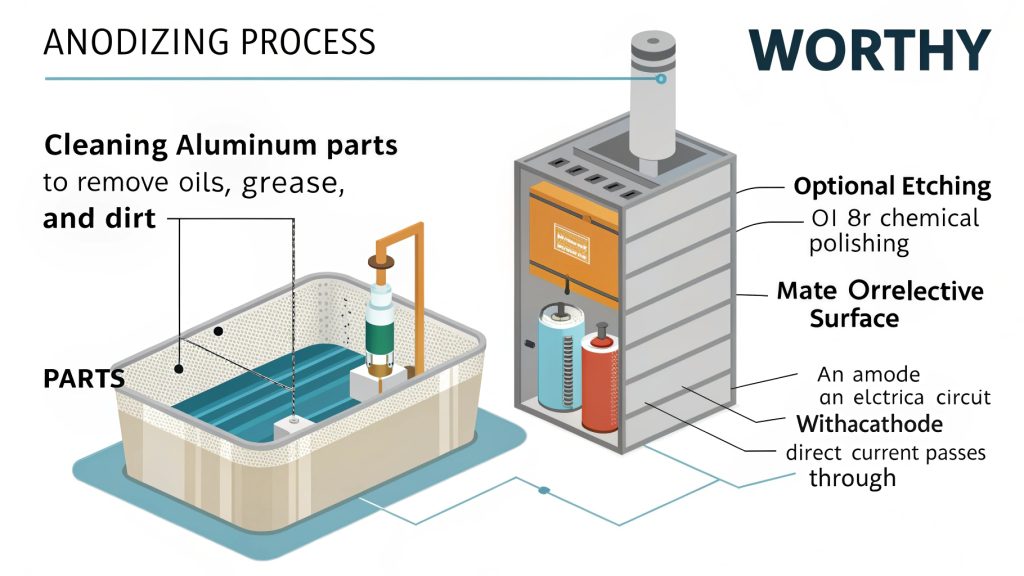
I've been working with anodizing for years at Worthy, and the process is quite fascinating. It's a precise sequence.
First, we meticulously clean the aluminum parts. This means removing any oils, grease, or dirt. If the surface isn't perfectly clean, the anodizing won't be even.
Next comes an optional step called etching, or sometimes chemical polishing. Etching creates a matte finish by removing a very thin layer of aluminum. Chemical polishing gives a bright, reflective surface.
After rinsing, the parts go into the anodizing tank. This tank contains an electrolyte solution, usually sulfuric acid. The aluminum part becomes the anode (positive electrode) in an electrical circuit. A cathode (negative electrode) is also in the tank. When we pass a direct current through this setup, an electrochemical reaction occurs. Oxygen is released at the anode and combines with the aluminum to form a layer of aluminum oxide. This layer grows into and out of the surface.
If a color is desired, the parts are then immersed in a dye bath. The porous oxide layer absorbs the dye.
The final crucial step is sealing. We usually use hot water or chemical sealants. Sealing closes the pores of the oxide layer. This locks in the dye and greatly improves corrosion resistance. It’s a bit like closing tiny doors to protect what's inside. Each step must be carefully controlled for temperature, time, and chemical concentration to get high-quality results.
Here’s a simplified breakdown:
-
Pre-treatment:
- Degreasing & Cleaning: Removes contaminants.
- Rinsing: Essential between steps.
- Etching/Brightening (Optional): Modifies surface texture.
- Desmutting (If etched): Removes alloying element residues.
-
Anodizing:
- Electrolytic Bath: Part is anode, current applied.
- Oxide Layer Formation: Controlled growth of Al₂O₃.
-
Post-treatment:
- Rinsing.
- Coloring (Optional): Immersion in dye.
- Rinsing.
- Sealing: Closes pores, enhances protection.
This systematic approach ensures we deliver consistent quality for all our CNC machined parts that require anodizing.
What is anodizing surface finish of aluminium?
Unsure about the final look and feel of anodized aluminum? You want to know what to expect. It offers a unique, desirable appearance.
Anodizing surface finish on aluminum is hard, durable, and wear-resistant. It has a distinct metallic sheen, even when colored. The finish is integral to the metal, providing excellent protection and aesthetic appeal.

"Anodized Aluminum Finish Samples")
When customers ask me about the anodizing surface finish, I tell them it’s one of the best options for aluminum. The first thing you notice is its appearance. It’s not like paint. The color is in the surface, giving it a rich, metallic luster. We can achieve a wide range of colors, from vibrant reds and blues to subtle blacks and grays, or even a clear coat that just enhances the natural aluminum look while protecting it.
My insight on how this color is achieved is quite simple. The anodizing process creates an oxide film on the aluminum surface. This film has countless tiny pores, invisible to the naked eye. These pores are like little sponges that can absorb dye molecules. After dyeing, we perform a sealing process. Sealing closes up these tiny pores, trapping the dye inside and making the color permanent. That’s why aluminum alloys can have so many beautiful, lasting colors.
Beyond color, the finish is incredibly hard and durable. It’s much more resistant to scratches and wear than untreated aluminum. This is a big plus for parts that will be handled a lot or exposed to friction. It also offers excellent corrosion resistance. The sealed anodic layer acts as a barrier against moisture and other corrosive elements. Another interesting property is that the anodic coating is an electrical insulator. This can be very useful in electronics applications. The texture can also be controlled, from matte to bright, depending on the pre-treatment steps we use.
| Characteristic | Description | Advantage for You |
|---|---|---|
| Appearance | Metallic luster, wide color range, clear option, matte or bright | High-end look, customization, brand consistency |
| Durability | Very hard, scratch and wear-resistant | Longer product life, maintains appearance |
| Corrosion Resist. | Excellent, especially when sealed | Protects against rust and environmental damage |
| Color Method | Dye absorbed into porous oxide layer, then sealed | Deep, long-lasting color that won't easily flake |
| Feel | Smooth, often slightly different texture than raw aluminum | Premium tactile quality |
| Electrical Prop. | Insulator | Useful for specific electronic applications |
This finish truly transforms aluminum, making it both more beautiful and more robust.
What is the principle of anodizing?
The science behind anodizing seems complex. You want to grasp the fundamental concept easily. It’s all about controlled, accelerated oxidation.
The principle of anodizing is an electrochemical process. Aluminum is made the anode in an electrolytic cell. This forces its surface to convert into a stable, thicker, and more uniform layer of aluminum oxide than what forms naturally.
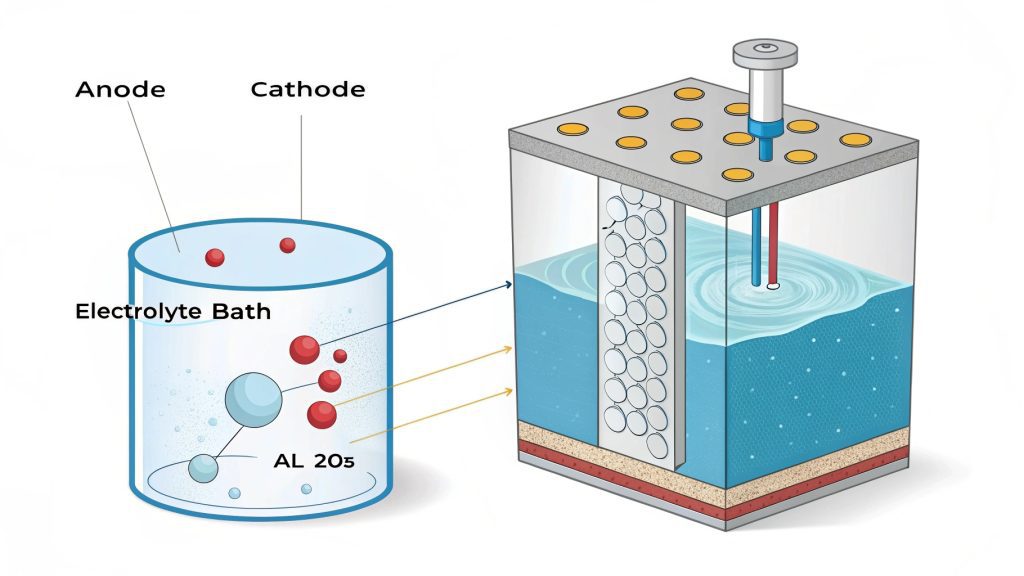
I find the science behind anodizing quite neat. At its core, anodizing is an electrochemical process that deliberately accelerates and controls the natural oxidation of aluminum. Aluminum naturally forms a thin, passive oxide layer when exposed to air. This layer offers some protection. However, anodizing creates a much thicker, denser, and more structured oxide layer.
Here’s how it works: We place the aluminum part (the anode, or positive electrode) into an acidic electrolyte bath, like sulfuric acid. Another conductor, usually lead or aluminum, acts as the cathode (negative electrode). When we apply a DC voltage, an electric current flows. Water in the electrolyte is split (electrolysis). Oxygen ions are attracted to the positively charged aluminum anode. These oxygen ions react with the aluminum on the surface, forming aluminum oxide (Al₂O₃).
The beauty of this process is that the oxide layer grows in a very organized way, with microscopic pores. As I mentioned before, these pores are key. My insight here is crucial: this porous structure of the oxide film is why we can get so many colors. The oxide film has countless tiny pores, invisible to our eyes. These small pores can absorb dye molecules. Then, we do a sealing treatment, which fills up these small pores.
The aluminum part then takes on the color of the dye. This is the secret behind the vibrant, colorful finishes we can achieve on aluminum alloys. The thickness and properties of this oxide layer can be precisely controlled by adjusting the electrolyte, temperature, current density, and time. This control allows us to create different types of anodic coatings, from decorative Type II to super-hard Type III.
| Aspect | Explanation | Implication |
|---|---|---|
| Nature | Electrochemical process | Controlled and predictable oxidation |
| Role of Part | Anode (positive electrode) | Site of oxidation reaction |
| Electrolyte | Conductive acidic solution (e.g., sulfuric acid) | Provides ions for the reaction, carries current |
| Reaction | Aluminum + Oxygen (from H₂O electrolysis) → Aluminum Oxide (Al₂O₃) | Formation of a hard, protective layer |
| Porous Layer | Microscopic pores form during oxide growth | Allows for dye absorption for coloring |
| Sealing | Closes pores after dyeing | Locks in color, enhances corrosion resistance |
Understanding this principle helps us at Worthy to optimize the anodizing process for various customer needs, ensuring top quality and performance.
Conclusion
Anodizing transforms aluminum. It creates a hard, colorful, and corrosion-resistant surface, making your parts better and last longer.