
What Are The Most Cost-Effective Materials For Large Volume Metal Stamping?

Struggling to keep production costs down on high-volume orders? Choosing the wrong material can destroy your budget, forcing you to sacrifice quality or profit. Let's fix that.
For large-volume metal stamping, carbon steel is overwhelmingly the most cost-effective material. Its low purchase price, combined with excellent strength and durability, makes it the go-to choice for industries needing reliable parts at a competitive cost. It is the workhorse of high-quantity production runs.
While carbon steel is the clear champion for cost, the "best" material truly depends on the specific demands of your project. Things like corrosion resistance, weight, and electrical conductivity all play a huge role. I've seen many clients, like Mark from Canada, focus only on the raw material price without considering the full picture. The key is to find the perfect balance between price and performance for your application. Let's dive deeper into the options so you can choose wisely and confidently for your next big project.
What is the best material for metal stamping?
Feeling overwhelmed by the sheer number of metal choices? A wrong decision can lead to part failure, project delays, and expensive rework. Let's match the right material to your needs.
There is no single "best" material. The ideal choice depends on your part's function. Carbon steel is best for low cost. Stainless steel is best for fighting rust. Aluminum is best for lightweight parts. Your application dictates the optimal material.
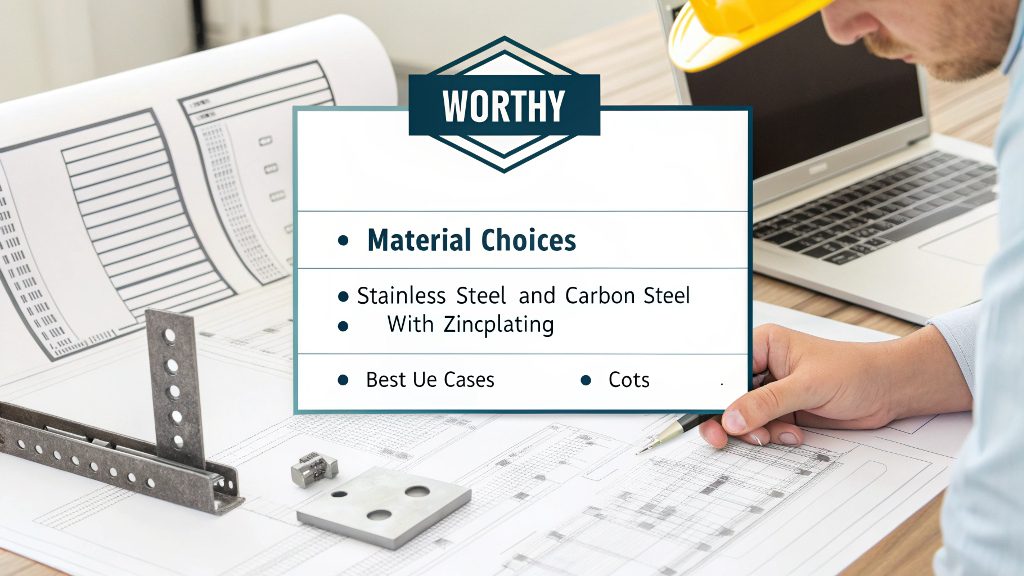
The "best" material is the one that meets all your project's requirements at the lowest possible cost. At my company, Worthy, we work with over 100 different materials because every job is unique. A client recently came to us for a consumer electronics bracket. They initially specified stainless steel, but their main concern was cost. After talking with them, we realized corrosion resistance was not a major factor for their indoor product. We suggested a specific grade of carbon steel with a protective zinc plating. This change saved them nearly 30% on material costs without affecting the part's function. Our four engineers specialize in this kind of design optimization. It's about looking beyond the initial drawing and understanding the final goal.
Here is a simple breakdown to guide your choice:
| Material | Key Properties | Best For | Relative Cost |
|---|---|---|---|
| Carbon Steel | Strong, durable, highly formable | Structural parts, brackets, general use | Low |
| Stainless Steel | Excellent corrosion resistance, hygienic | Medical devices, food equipment, exteriors | High |
| Aluminum | Lightweight, good corrosion resistance | Aerospace, electronics, automotive panels | Medium |
| Copper/Brass | Excellent electrical & thermal conductivity | Terminals, connectors, clips, contacts | High |
Which material is often used for stamping?
Are you wondering what the industry standard materials are? Using an unusual metal can cause supply chain headaches and drive up your costs. Let's look at the most common choices.
Steel, in its many forms like carbon steel and stainless steel, is the most frequently used material for metal stamping. Its unmatched versatility, strength, and global availability make it the foundational metal for countless industries. Aluminum is another popular choice, particularly for lightweight applications.
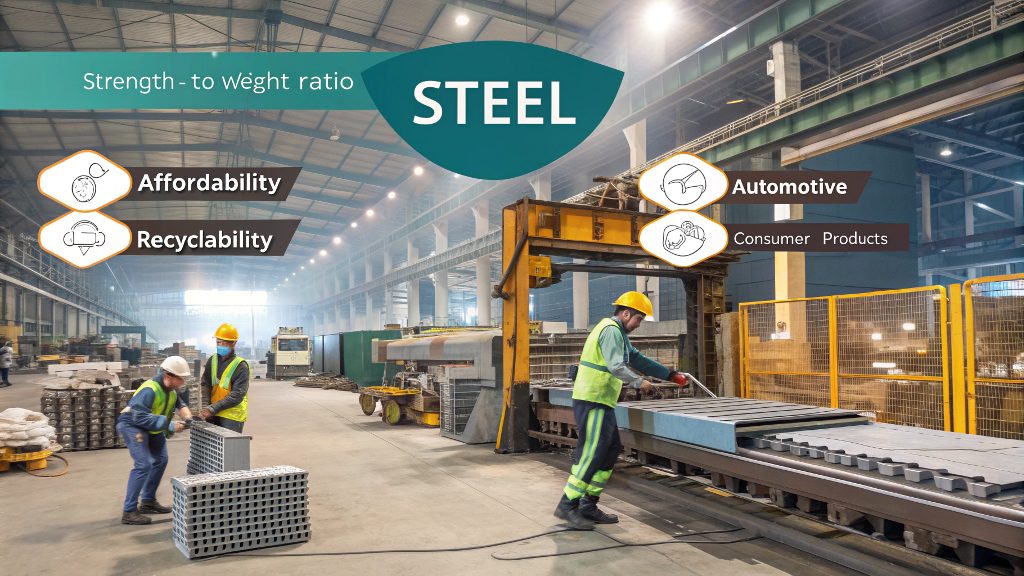
Steel is the king of metal stamping for good reason. I see it every day in our facility. It's affordable, it's strong, and it can be formed into incredibly complex shapes. This is why it's the backbone for so many of the parts we ship to North America, Europe, and Japan.
Why Steel is So Popular
Steel has a fantastic strength-to-weight ratio. It's also easy to work with, which is crucial for processes like progressive die stamping and fourslide stamping that we specialize in. At Worthy, we handle all kinds of steel, both ferrous and non-ferrous. Its versatility means we can use it to make simple brackets or complex electronic shields. Plus, it’s highly recyclable, which is an increasingly important factor for many of our customers in the automotive and consumer products sectors.
Common Steels and Their Uses
- Carbon Steel: This is the workhorse. We use it for automotive brackets, industrial mounting plates, and machinery components where strength and cost are the most important factors.
- Stainless Steel: When a part is exposed to moisture or needs to be sterile, stainless steel is the answer. We produce many medical parts and clips for outdoor use with it.
What are the four types of metal stamping?
Confused about which stamping process is right for your part? Choosing the wrong method can inflate tooling costs and slow down production. Let's break down the main types.
The four main types of metal stamping are progressive die, fourslide, deep draw, and transfer die stamping. Each process is designed for different part shapes, production speeds, and volumes. Matching your part to the right process is key for efficiency and cost-effectiveness.
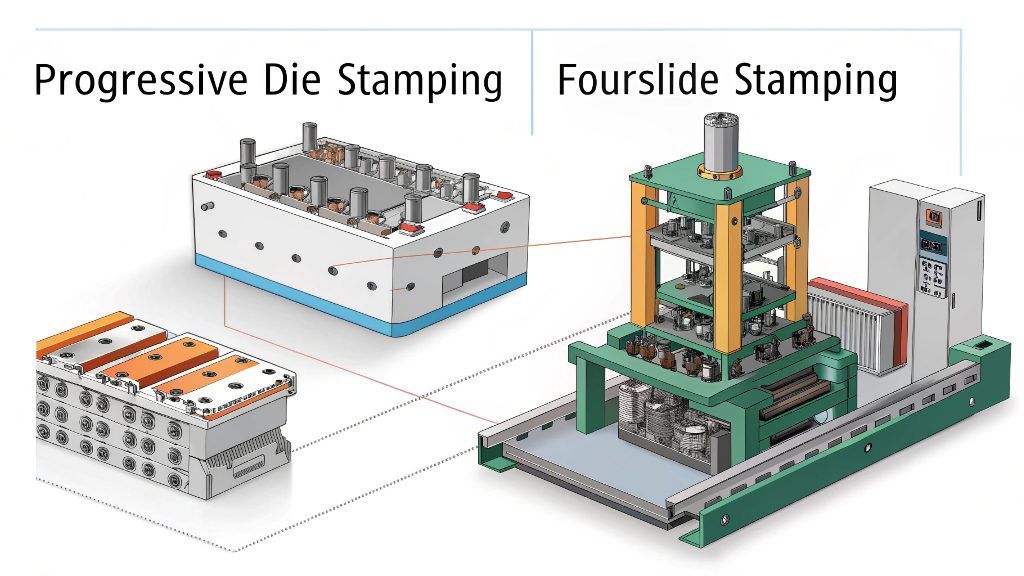
Understanding these processes is vital because it directly impacts your tooling investment and part cost. As a B2B supplier, we always discuss these options with customers to ensure we're using the most efficient method. Here at Worthy, progressive die and fourslide stamping are two of our core capabilities.
A Closer Look at Stamping Types
- Progressive Die Stamping: This is for high-volume, complex parts. A coil of metal is fed through a single die with multiple stations. Each station performs a different cut, bend, or punch. The part remains attached to the metal strip until the final station. It's fast and highly repeatable, perfect for terminals, contacts, and shields.
- Fourslide Stamping: Also called multislide, this is my specialty. It's perfect for parts with complex bends, like clips and flat springs. Instead of one vertical ram, it uses four sliding tools to shape the part from four sides. This is often more cost-effective for intricate, smaller parts.
- Deep Draw Stamping: This process forms sheet metal into deep, cup-like shapes. Think of cans, pots, or enclosures. It stretches the metal rather than just cutting and bending it.
- Transfer Die Stamping: This is used for large parts. The part is separated from the metal strip early and then moved from station to station by a mechanical transport system.
| Process | Best For | Speed | Tooling Cost |
|---|---|---|---|
| Progressive Die | High-volume, complex flat parts (terminals) | Fast | High |
| Fourslide | Intricate bent parts (clips, springs) | Fast | Medium |
| Deep Draw | Cup-shaped parts (housings, cans) | Medium | Medium-High |
| Transfer Die | Large parts (automotive frames) | Slow | Very High |
What is the best gauge for metal stamping?
Are you having trouble choosing the right material thickness? Picking a gauge that's too thin can cause part failure, while too thick is just wasting money. Let's find the right balance.
There is no single "best" gauge. The right thickness depends completely on the part's job. Thinner gauges save money and weight but are weaker. Thicker gauges add strength and durability but also increase cost and weight. The best gauge balances function with material cost.
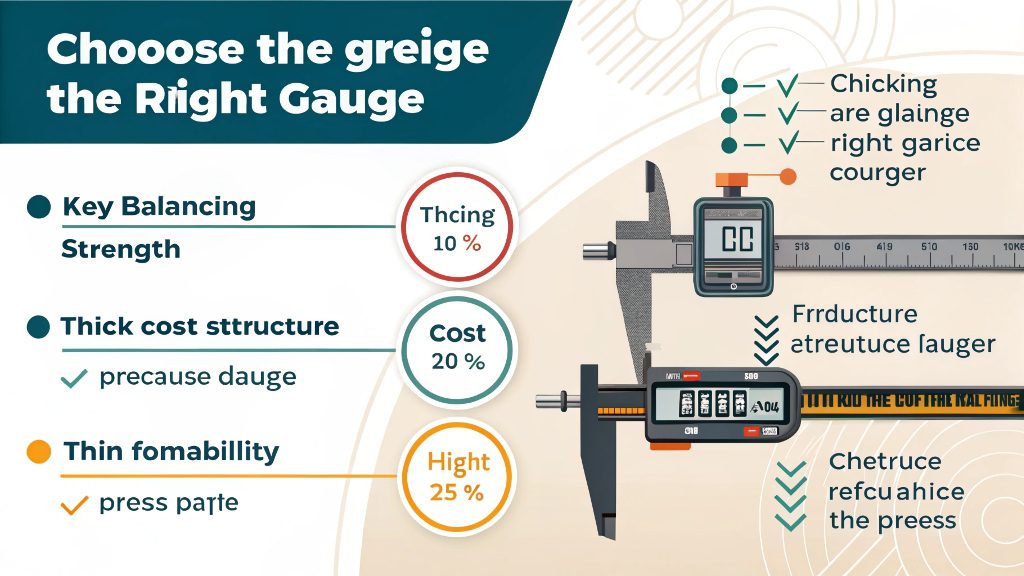
Choosing the right gauge is a critical design decision. I've had many customers, especially from hardware startups and design agencies, send us drawings where the material is over-specified. They choose a thick gauge to be safe, but it makes the part unnecessarily expensive and heavy. A big part of our job is to help customers avoid this. We can manufacture parts with incredibly tight tolerances, down to .001" (.025mm), so precision is key.
Balancing Strength, Function, and Cost
The conversation about gauge is really a conversation about trade-offs.
- Strength vs. Cost: A thicker gauge provides more structural integrity, which is essential for load-bearing brackets or mounting plates. But every bit of thickness adds to the material cost, which multiplies quickly over a large production run.
- Formability: Thinner materials are generally easier to cut and bend. Thicker gauges require more force, which means we need to use our higher-tonnage presses (we have up to 500-ton capacity). This can affect tooling design and production speed.
One of our customers in Australia needed a retainer clip. Their initial design used a thick piece of standard steel. Our engineers analyzed the stress points and suggested a design change. By adding a small rib for reinforcement, we were able to use a thinner gauge of a slightly stronger alloy. The final part was lighter, just as strong, and cost them 15% less to produce. This is the value an experienced supplier brings.
Conclusion
Choosing cost-effective carbon steel for high volumes is a great start. But true success comes from matching the right material, process, and gauge to your specific needs for optimal results.