
What Are The Design Considerations For CNC Machining Aluminum Parts?

Designing aluminum parts without thinking about the machining process? This can lead to high costs and poor quality. Following a few simple rules makes everything smoother, faster, and cheaper.
Key design considerations for CNC aluminum parts include selecting the right alloy, keeping wall thickness in mind, and avoiding deep pockets or sharp internal corners. Using correct tolerances is also crucial. These steps ensure your part is manufacturable, cost-effective, and works as intended.
Getting your design right from the very beginning is the most important part of the process. I have seen countless projects where the initial design choices determined its success or failure. It saves so much time and money down the line. Let's look closer at the specific details that really matter. These ideas will help you avoid common problems and get the best possible results for your aluminum parts.
What are the design considerations for the design of machined parts?
Are you struggling to make your designs easy to manufacture? Your ideas might be great, but they become very difficult to produce. This leads to endless emails with machinists and project delays.
When designing machined parts, always focus on manufacturability. This means using simple shapes, avoiding thin walls and deep pockets, and specifying realistic tolerances. This simple approach will reduce your machining time and cost a lot.
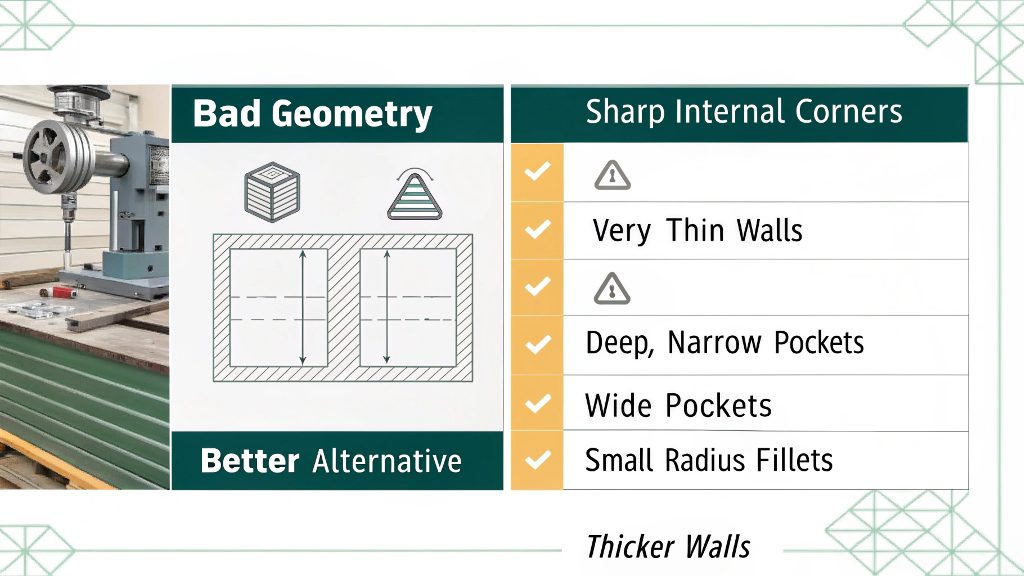
To make a part easy to machine, you need to think like a machinist. In my experience, the biggest cost drivers are almost always related to geometry that is difficult for a cutting tool to create. We want to avoid anything that slows down the machine or requires special tools.
Key Geometric Considerations
The three most common issues I see are sharp internal corners, very thin walls, and deep, narrow pockets. A standard milling tool is round, so it naturally leaves a rounded internal corner (a fillet). Creating a perfectly sharp 90-degree internal corner is very expensive and often requires a separate process. It's much better to design a small radius in every internal corner.
Thin walls are another problem. They can vibrate during machining, which leads to a poor surface finish and inaccurate dimensions. They can also warp from the heat and stress of cutting. Deep pockets are hard because chips can get stuck, and the tool can break.
Here is a simple table to guide you:
| Bad Practice | Good Practice | Why it Matters |
|---|---|---|
| Sharp internal corners | Internal radii/fillets | Allows standard tools, faster machining, lower cost. |
| Very thin walls (<1mm) | Thicker, uniform walls | Reduces vibration, warping, and tool breakage. |
| Deep, narrow pockets | Wider, shallower pockets | Better chip evacuation, less tool wear, faster cycle time. |
What are the parameters for machining aluminium?
Are your finished aluminum parts showing poor surface finishes or wrong dimensions? This wastes material and money. It can even damage the expensive CNC equipment that is used to make the parts.
Key parameters for machining aluminum include high cutting speeds and feed rates, a suitable depth of cut, and the constant use of coolant. The exact numbers depend on the specific aluminum alloy, the cutting tool, and the machine itself. Getting these right is vital for efficiency.
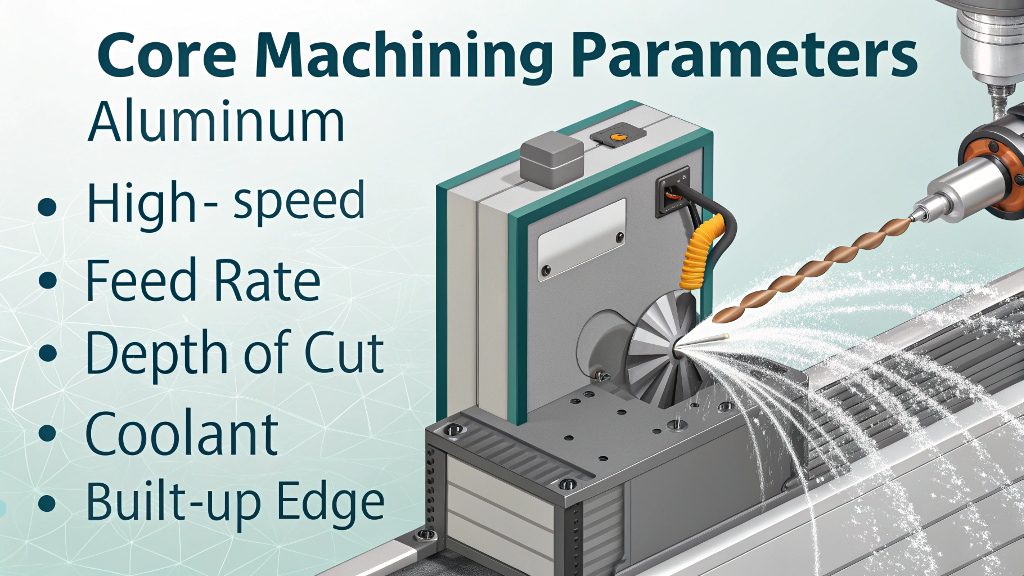
Aluminum is a fantastic material to machine, but it has its own personality. It’s soft and conducts heat very well. This means we can cut it very fast. However, it can also get "gummy" and stick to the cutting tool if you don't use the right approach. This is why the machine parameters are so important. We adjust them to get a clean cut and a great finish.
Core Machining Parameters Explained
There are three main settings we control: speed, feed, and depth of cut. Think of them like this: cutting speed is how fast the tool spins, feed rate is how fast it moves across the part, and depth of cut is how much material it removes in one pass. For aluminum, we generally use high speeds and feeds.
The most critical factor, however, is coolant. This is the fluid that floods the part during machining. For aluminum, coolant is not optional. It prevents the soft aluminum chips from welding themselves onto the hot cutting tool. This problem is called "built-up edge," and it ruins the surface finish and destroys tools. Proper coolant washes away chips and keeps everything cool.
| Parameter | Why It's Important for Aluminum | General Guideline |
|---|---|---|
| Cutting Speed | High thermal conductivity allows for faster heat removal. | High (but depends on alloy and machine rigidity). |
| Feed Rate | Softness allows for aggressive material removal. | High, balanced with speed for good chip formation. |
| Coolant | Prevents material from welding to the tool (BUE). | Essential. Use flood coolant or similar methods. |
How to design parts for CNC?
Do you find that CNC shops often reject your part designs or quote them at a very high price? This can stop your project in its tracks and make you feel frustrated with the design process.
To design for CNC, you must prioritize simplicity. Use standard tool sizes for features like holes and corner radii. Add generous fillets to all inside corners. Avoid complex surfaces that are not necessary. Also, only define tight tolerances where they are truly critical.
Over the years, I've learned that the best designs are often the simplest. When I help customers improve their designs, we usually look for ways to make them easier to manufacture. This is often called Design for Manufacturability, or DFM. It’s all about removing anything that adds complexity and cost without adding real value to the part's function. By thinking this way, you can dramatically lower your costs.
A Practical Checklist for CNC Design
Here is a simple checklist I use when reviewing a customer's design.
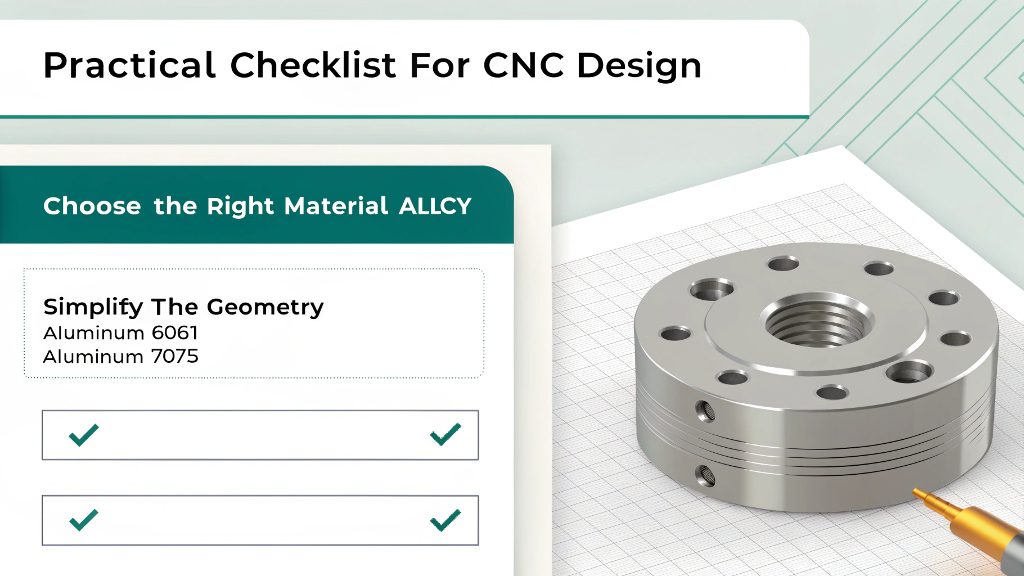
- Choose the Right Material Alloy: "Aluminum" is not specific enough. For example, Aluminum 6061 is very common, affordable, and easy to machine. Aluminum 7075 is much stronger but also more expensive and harder to cut. Choosing the right alloy is the first step.
- Simplify the Geometry: Ask yourself if every curve and feature is truly needed. Can a complex surface be made from several flat surfaces instead? Sometimes breaking one very complex part into two simpler parts that are bolted together is cheaper.
- Think About Tool Access: A CNC machine uses physical cutting tools. You have to make sure a tool can actually reach all the surfaces you designed. Avoid creating areas that are blocked or too deep for a standard tool.
- Plan for Workholding: The raw material block must be held securely in the machine. Your design needs to have stable, flat surfaces for clamping. If not, the part might move during machining, ruining it.
- Specify Tolerances Wisely: Tolerances tell the machinist how precise a dimension must be. Tighter tolerances require more time, more careful measurements, and better tools, which all add cost. Our standard tolerance is +/- 0.127 mm, which is great for most applications. Only specify tighter tolerances, like +/- 0.025 mm, on critical features.
What are some of the characteristics that CNC produced parts should have?
Do you know what to look for in a high-quality CNC part? It is easy to receive a part that looks fine on the surface but might fail when you use it. This is a big risk.
Quality CNC parts must have a consistent surface finish that matches the specification. They must be free of all burrs and meet every dimensional tolerance on the drawing. All sharp edges should be broken, and there should be no signs of machine chatter or burn marks.
As a supplier, my reputation depends on the quality of the parts I deliver. For my customers, like Mark in Canada, quality is everything. A bad part can cause a product to fail, which hurts his business. That is why we have a very strict inspection process. Knowing what to look for is key for both the manufacturer and the buyer.
Hallmarks of a High-Quality CNC Part
When we inspect a finished part, we are looking for a few key things. These are the signs of professional, high-quality work.
- Surface Finish: The surface should be uniform and match the requirement on the drawing. The standard "as-machined" finish we provide is 125 Ra or better. A lower Ra number means a smoother finish. There should not be random scratches or marks.
- Dimensional Accuracy: This is the most important part. The part must match the drawing dimensions perfectly, especially where tolerances are tight. This is why we perform a 100% inspection on all parts.
- No Burrs or Sharp Edges: A burr is a small, sharp piece of metal left on an edge after cutting. All burrs should be removed. By default, we also break all sharp edges to make the part safe to handle and prevent stress fractures.
- Absence of Machining Defects: Look closely at the surface. You should not see wavy patterns, which indicate "tool chatter" from vibration. You also should not see any discolored or burn marks, which means the tool was running too hot. These are signs of poor machining control.
Conclusion
Proper design is the foundation for successful aluminum CNC machining. By considering manufacturability from the start, you ensure higher quality, lower costs, and faster delivery for your parts.