
What Are the Critical Design Parameters for Successful Metal Stamping Projects?

Bad designs cause stamping project failures, costing you time and money. These delays frustrate suppliers and customers. Following key design parameters ensures success and avoids these costly headaches.
For successful metal stamping, focus on material choice, die design, and part geometry. Critical parameters include material thickness, bend radii, hole spacing, and drawing depth ratios. Getting these right early in the design stage is key to preventing costly production issues and ensuring part quality.
Those are the high-level points, but real success is in the details. As an engineer with years of experience at Worthy, I've seen how small design choices make a huge difference in a final product's quality and cost. I help customers like Mark from Canada optimize their designs every day to avoid delays and quality problems. Let's break down exactly what you need to know to make your next project a success.
What are the 7 steps in the stamping method?
The metal stamping process seems complex. This confusion leads to miscommunication with suppliers and bad parts. Let me break down the seven core steps for you simply.
The stamping method involves seven main steps: blanking/shearing, piercing, drawing, bending, forming, coining, and trimming. Each step shapes the metal sheet, progressively transforming it from a flat blank into the final, precise component. Understanding this flow is crucial for troubleshooting production issues.

Understanding these steps helps you communicate better with your supplier. When you know the process, you can have more informed conversations about your design. For example, knowing the difference between drawing and bending helps you specify your requirements more clearly. At my company, we encourage our clients to understand this process because it makes collaboration smoother and prevents mistakes. A well-informed customer is our best partner.
A Breakdown of the Stamping Process
| Step | Description |
|---|---|
| 1. Blanking/Shearing | Cutting the initial shape, or "blank," from a larger metal sheet or coil. This is the first step. |
| 2. Piercing | Punching holes, slots, or other cutouts into the blank. This is done before forming to avoid distortion. |
| 3. Drawing | Stretching the metal over a die to create deep, cup-like shapes. The metal flows and thins out. |
| 4. Bending | Folding the metal along a straight line to create angles, like in brackets or clips. |
| 5. Forming | Creating more complex curves and features that aren't just simple bends or draws. |
| 6. Coining | Compressing the metal in a die to create fine details, add strength, or achieve tight tolerances. |
| 7. Trimming | Cutting away excess material from the formed part to achieve the final, clean outline. |
What is the rule of thumb for metal stamping?
You need clear rules for your design to work, but online guides are often too technical. This makes it hard to create a manufacturable part, leading to redesigns.
The most important rule of thumb is to keep the design simple. Specifically, ensure bend radii are at least the material's thickness, and corner radii for drawn parts are at least three times the material's thickness. This prevents cracking and ensures structural integrity during production.
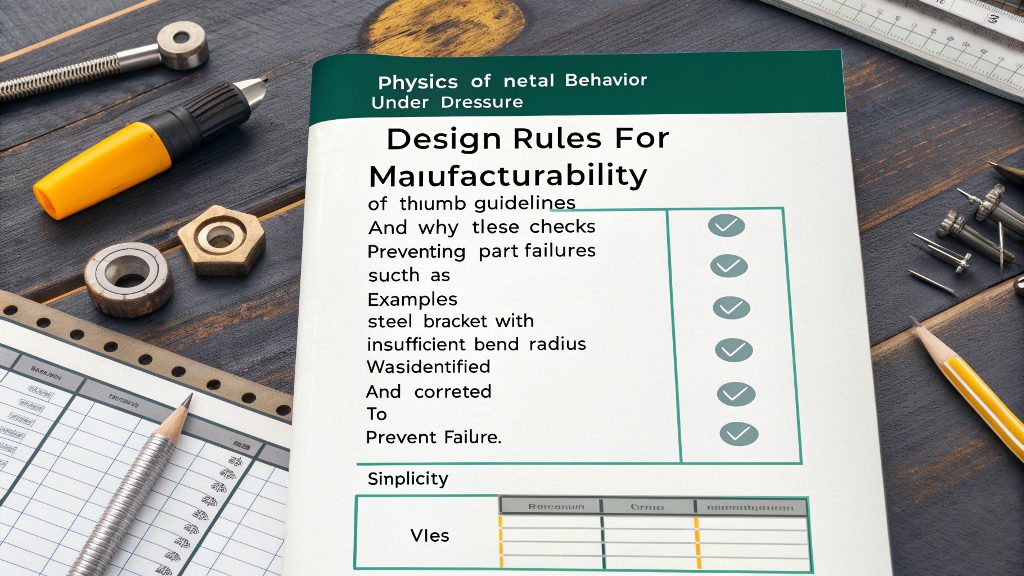
These rules are not just suggestions; they are based on the physics of how metal behaves under pressure. When I work with clients, these are the first things I check on a technical drawing. Ignoring them is the most common reason for part failure, especially cracks and fractures. For example, a customer once sent a design for a steel bracket with a bend radius that was only half the material thickness. We knew immediately it would fracture. By advising them to increase the radius, we saved them the cost and delay of a failed production run. It's a simple check that avoids major headaches.
Key Design Rules for manufacturability
| Design Parameter | Rule of Thumb Guideline | Why It's Important |
|---|---|---|
| Simplicity | Keep the overall part geometry as simple as possible. | Reduces tool complexity, lowers costs, and improves production speed. |
| Bend Radius (Bending) | Inner radius ≥ 1x material thickness (1T). | Prevents material from cracking or fracturing at the bend line. |
| Corner Radius (Drawing) | Corner radius ≥ 3x material thickness (3T). | Allows material to flow smoothly during drawing, preventing tears. |
| Hole to Edge Distance | Distance from hole edge to part edge ≥ 1x thickness (1T). | Stops the material from bulging or tearing around the hole. |
| Hole to Hole Distance | Distance between holes ≥ 2x material thickness (2T). | Maintains material strength between the holes, preventing breakage. |
| Draw Depth Ratio | Depth-to-diameter ratio ≤ 0.7 for a single draw. | Ratios higher than this require multiple drawing steps, increasing cost. |
What are the techniques of metal stamping?
You hear terms like "progressive" and "fourslide" but don't know what they mean. This makes it hard to know if your supplier is using the best, most cost-effective method.
The main techniques are progressive die stamping, transfer die stamping, and fourslide stamping. Progressive die is best for high-volume, complex parts. Fourslide is ideal for clips and bent-wire forms. Transfer die is for large parts that can't be made in a progressive die.

Choosing the right technique is critical for balancing cost, speed, and quality. I often have conversations with procurment officers like Mark about this. For a simple clip he needed in high volumes, we recommended fourslide stamping. It has lower tooling costs and is very fast for that type of part. For another, more complex terminal, we used a progressive die. The tooling was more expensive upfront, but the price per piece was very low, saving him money on the large order. The key is to match the part's geometry and order quantity to the right technique.
Comparing Stamping Techniques
| Technique | What It Is | Best For | Key Benefit |
|---|---|---|---|
| Progressive Die | A metal coil feeds through a long die with multiple stations. Each station performs one or more operations. | High-volume production of complex parts like terminals and shields. | Very high speed and low cost per part for large runs. |
| Transfer Die | The part is separated from the metal strip early and moved between stations by a mechanical "transfer" system. | Large parts that are difficult to manage in a continuous strip, like deep-drawn shells. | Good for large or bulky components. |
| Fourslide / Multislide | Uses four sliding tools to shape the part from different directions. Excellent for creating bends. | Small, intricate parts with multiple bends, like clips, springs, and clamps. | Lower tooling costs and high speed for specific parts. |
What is the best metal for metal stamping?
Choosing the wrong material for your project can cause huge problems. It might be too brittle, too soft, or corrode easily, leading to complete part failure after production.
There is no single "best" metal; the best choice depends on your application's needs for strength, conductivity, corrosion resistance, and cost. Steel offers strength and low cost. Aluminum is lightweight and corrosion-resistant. Copper and brass are excellent for electrical conductivity.
![]()![]()![]()![]()
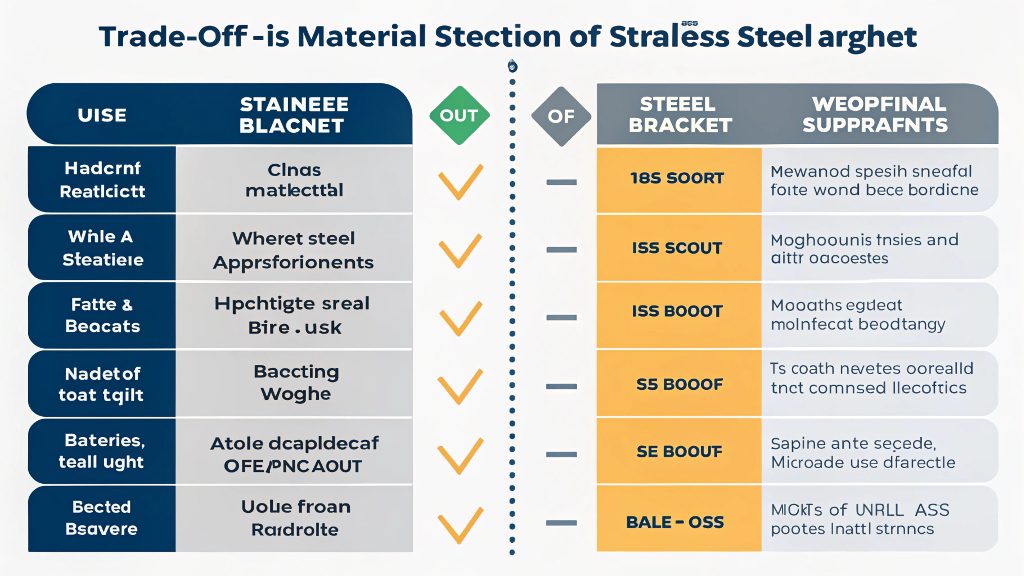
The material choice is a trade-off. A client once wanted to make a bracket from stainless steel for its strength. However, the part needed to be very lightweight for an aerospace application. We discussed the requirements and suggested using a high-strength aluminum alloy instead. It provided enough strength while significantly reducing the weight and meeting their project goals. You must balance the ideal properties with the practical needs and cost of your project. We can stamp over 100 different materials, so we always find a solution.
Common Metals and Their Applications
| Material | Key Properties | Common Applications | Considerations |
|---|---|---|---|
| Steel | High strength, durability, low cost. | Automotive brackets, industrial hardware, structural components. | Can be heavy, may require plating to prevent rust. |
| Stainless Steel | Excellent corrosion resistance, high strength, clean look. | Medical devices, food-grade equipment, consumer electronics. | More expensive and harder to work with than carbon steel. |
| Aluminum | Lightweight, good strength-to-weight ratio, corrosion resistant. | Aerospace components, electronic enclosures, consumer products. | Softer and less strong than steel. |
| Copper & Brass | Excellent electrical and thermal conductivity, corrosion resistant. | Electrical terminals, connectors, heat sinks, decorative hardware. | Generally more expensive and softer than steel. |
Conclusion
Following critical design rules for radii, holes, and drawing depth is key. Choosing the right material and stamping technique ensures your project is successful, on time, and within budget.