
How To Select The Right Composite Material For Your Engineering Project?

Choosing composites feels complex. A wrong pick can ruin your project. This guide simplifies your material selection process for success.
Selecting the right composite material hinges on understanding your project's specific application, performance needs like strength and environmental resistance, and budget. While carbon fiber is a top choice for many, glass fiber often provides excellent performance at a more accessible cost.
Picking the best composite for your engineering work can seem like a big task. There are many options out there. Each one has its own good points and not-so-good points. You want to make sure you get it right. So, let's break down how to choose wisely. This will help your project succeed from the start.
How are the materials for a composite selected?
So many composite materials exist. Picking one can feel overwhelming. Choose incorrectly, and your project might suffer. Let's look at the selection steps.
Materials for a composite are chosen by first clearly defining the project’s mechanical, thermal, and chemical needs. Then, potential fiber and matrix combinations are carefully checked against these requirements and overall cost.
When we talk about selecting materials for a composite, we are essentially looking at two main parts: the reinforcement and the matrix. The reinforcement, usually fibers like carbon or glass, provides the strength and stiffness. The matrix, often a resin like epoxy or polyester, binds these fibers together, gives the composite its shape, and helps distribute the load among the fibers. The magic happens when these two work together.
Key Factors in Composite Material Selection
-
Defining Project Needs: The first step is always to understand what your part needs to do.
-
Load Requirements: Will it face tension, compression, or bending forces? How much force? This helps decide the type and amount of fiber. For example, a part needing high stiffness might lead us to carbon fiber.
-
Operating Environment: What temperatures will it see? Will it be exposed to chemicals or moisture? This affects the choice of matrix material. Some resins handle heat or chemicals better than others. As I often tell my clients at Worthy, like Mark who procures parts for various applications, understanding the end-use environment is critical.
-
Manufacturing Process: How will the part be made? Some composites are easier to shape or cure using certain methods. This can influence material choice too.
-
Cost: Of course, budget is a big factor. High-performance materials often cost more. We need to find a balance.
-
At Worthy, we frequently help customers navigate these choices. We consider their design and the intended application to suggest suitable composite options that we can then machine to their exact specifications.
What are the selection criteria for material for engineering materials?
Not sure what really matters when picking engineering materials? Overlook key criteria, and you might face big issues later. Let's explore the essential points.
Key selection criteria for engineering materials, especially composites, include mechanical properties like strength and stiffness. Physical properties like density and thermal expansion are also important. Don't forget environmental resistance, manufacturability, and overall cost-effectiveness.
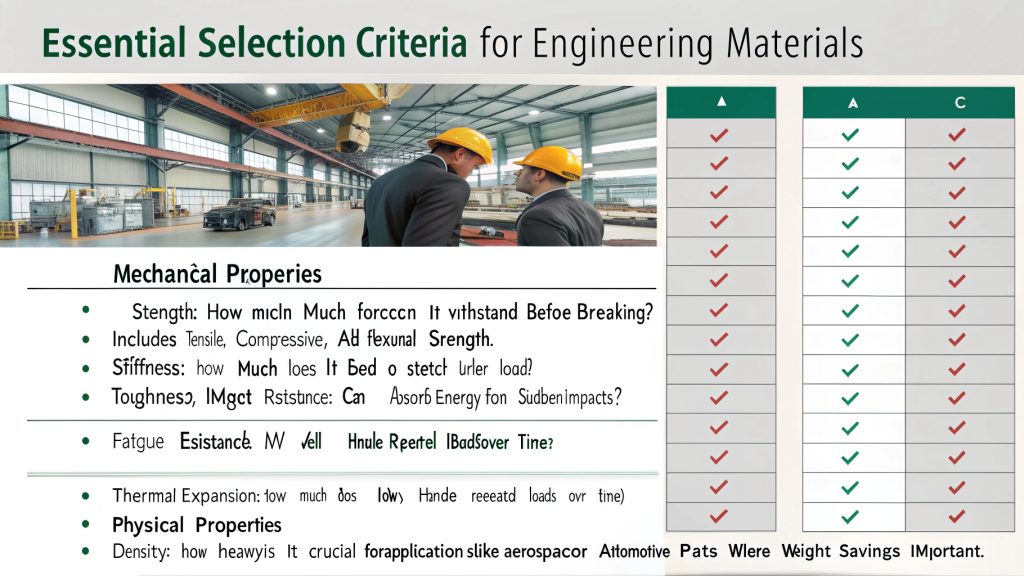
When choosing any engineering material, and this is especially true for composites, we need a clear set of criteria. These help us compare options fairly. I always run through these with my clients.
Essential Selection Criteria
-
Mechanical Properties: This is often the first thing engineers look at.
- Strength: How much force can it take before breaking? This includes tensile (pulling), compressive (pushing), and flexural (bending) strength.
- Stiffness (Modulus): How much does it bend or stretch under load?
- Toughness/Impact Resistance: Can it absorb energy from a sudden impact?
- Fatigue Resistance: How well does it handle repeated loads over time?
-
Physical Properties: These relate to the material's basic characteristics.
-
Density: How heavy is it? This is vital for aerospace or automotive parts where weight saving is key.
-
Thermal Expansion: How much does it expand or contract with temperature changes? I often mention that glass fiber has a desirably low coefficient of thermal expansion.
-
Thermal/Electrical Conductivity: Does it need to conduct or insulate against heat or electricity?
-
-
Environmental Resistance: How does it hold up in its working conditions?
- Corrosion/Chemical Resistance: Will it degrade when exposed to certain chemicals or salty water? Glass fiber, for instance, is known for good corrosion resistance.
- UV Resistance: Will sunlight break it down over time?
- Moisture Absorption: Does it soak up water, which could change its properties?
-
Manufacturability: Can it be made into the desired shape easily and economically?
-
Cost: This includes the price of raw materials, manufacturing, and even the part's lifetime cost. My customer Mark is always keen on finding a good balance here. He needs quality but also competitive pricing.
How do I choose the right material?
Still feeling unsure about the final material choice? Making a mistake here can be very expensive. Let's follow a clear path to select wisely.
To choose the right material, first list your project's absolute needs. Then, compare possible materials against these needs. Weigh performance against cost, always thinking about the specific use.
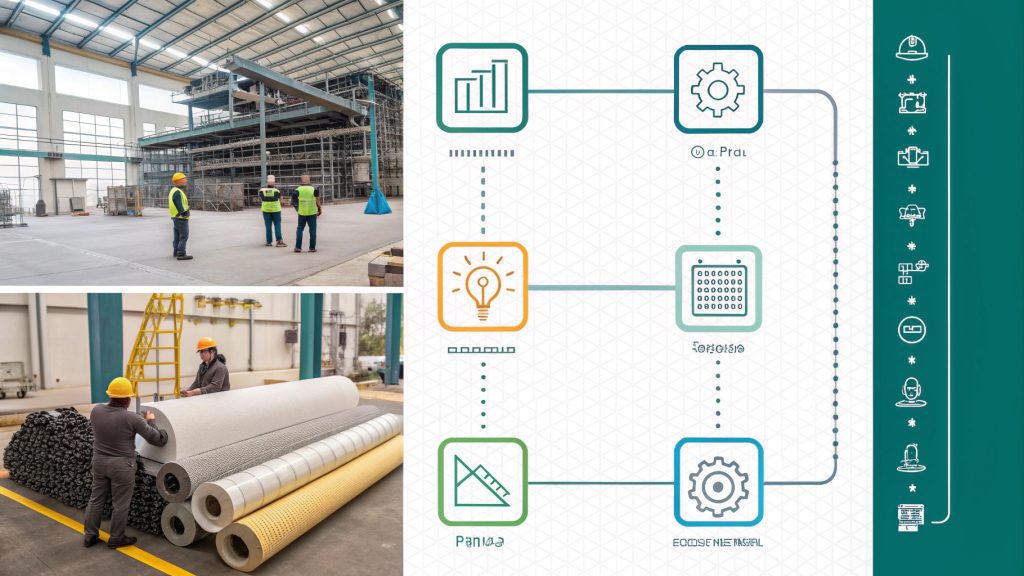
Choosing the right material is a process. It's not just about picking the strongest or the cheapest. It's about finding the best fit for your specific job. Here’s how I usually approach this with my team at Worthy when advising clients.
A Step-by-Step Approach to Material Selection
-
Define Your Application's Core Requirements:
- What job will this part do? Is it structural, aesthetic, or both?
- What kinds of forces will it face? Are they constant or changing?
- What is the working environment like? Temperature, chemicals, moisture?
- Are there limits on weight or size?
- What is the target lifespan for the part?
-
Identify Potential Candidate Materials:
Based on your needs, make a list of materials that could work. For composites, this means thinking about different fibers (carbon, glass, aramid) and matrix systems (epoxy, polyester). For instance, if weight is critical and high strength is needed, carbon fiber composites will be on the list. If cost is a major driver but good strength is still required, glass fiber composites become very attractive.
-
Evaluate Against Your Criteria:
Use the criteria we discussed earlier (mechanical, physical, environmental, cost). You can even make a simple chart to compare them side-by-side. Assign scores or ratings if that helps
Feature Carbon Fiber Composite Glass Fiber Composite Strength-to-Weight Very High Good Stiffness Very High Moderate Cost High Low to Medium Corrosion Resistance Good Excellent Impact Resistance Moderate Good -
Balance Performance and Cost:
This is often the toughest part. My insight is that while carbon fiber is an amazing material, it's not always the necessary choice. I've seen many projects where glass fiber provides more than enough performance for the application, and at a much lower cost. It has excellent tensile strength and resists corrosion and weathering very well. For clients like Mark, who are quality-sensitive but also need competitive pricing, this balance is key.
-
Prototype and Test:
If possible, make prototypes from your top choices. At Worthy, we offer CNC machining for prototypes from a wide range of materials, including composites. Testing can reveal issues you didn't expect. It’s better to find out with a prototype than with a full production run.
What are the composite materials in engineering?
Not quite sure what "composite materials" are? This gap in knowledge can limit your design options. Let's learn about common engineering composites.
Composite materials in engineering combine two or more different materials. Usually, these are a reinforcement (like strong fibers) and a matrix (like a binding resin). The goal is to get properties better than what each material could offer alone.
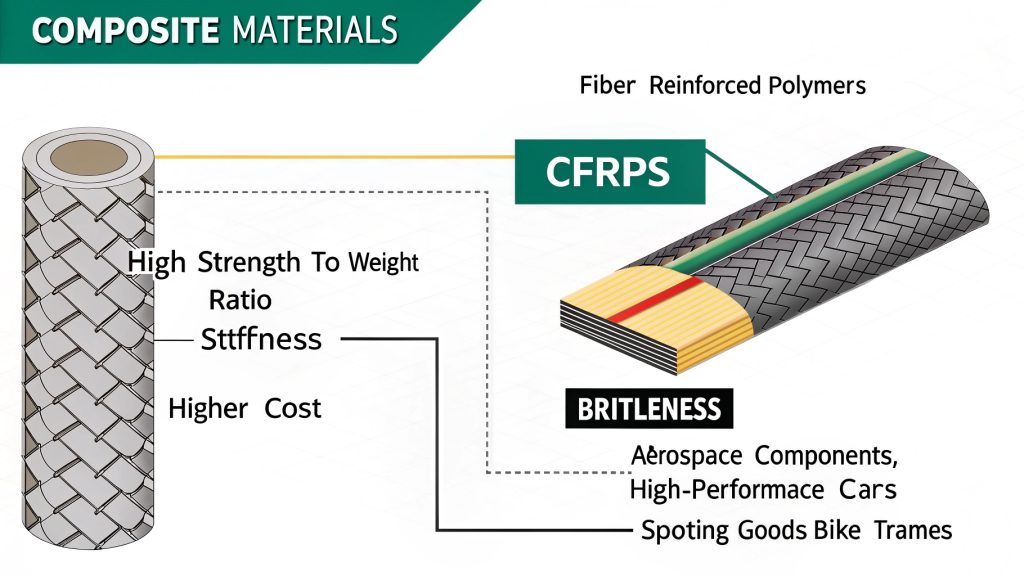
Composite materials are truly fascinating. They are engineered materials made from two or more constituent materials with significantly different physical or chemical properties. When combined, they produce a material with characteristics different from the individual components. The key is that the individual components remain separate and distinct within the finished structure at a macroscopic level.
Common Types of Engineering Composites
The most common composites we see in engineering, and certainly at Worthy when we are doing CNC machining, are Fiber-Reinforced Polymers (FRPs).
-
Carbon Fiber Reinforced Polymers (CFRPs):
-
Often just called "carbon fiber." These use carbon fibers for reinforcement.
-
Pros: Extremely high strength-to-weight ratio, very stiff, good fatigue resistance.
-
Cons: More expensive than other composites, can be brittle.
-
Applications: Aerospace components, high-performance cars, sporting goods (like bike frames or tennis rackets), robotics. We machine many custom carbon fiber parts for these industries.
-
-
Glass Fiber Reinforced Polymers (GFRPs):
- Commonly known as "fiberglass." These use glass fibers.
- Pros: Good strength and stiffness (though less than carbon fiber), excellent electrical insulation, high corrosion resistance, and significantly lower cost. As I mentioned, its good ultimate tensile strength and low thermal expansion are big pluses.
- Cons: Heavier than carbon fiber for the same strength.
- Applications: Boat hulls, automotive panels, pipes, storage tanks, building materials, and many consumer products. It’s a very versatile material.
-
Aramid Fiber Reinforced Polymers (AFRPs):
- Kevlar® and Twaron® are common brand names for aramid fibers.
- Pros: Very high impact resistance, good toughness, low density.
- Cons: Can be difficult to machine, sensitive to UV light, relatively expensive.
- Applications: Ballistic protection (bulletproof vests), ropes, aerospace components where impact resistance is critical.
While FRPs are most common, there are also:
-
Metal Matrix Composites (MMCs): Reinforcements (like silicon carbide particles or ceramic fibers) are embedded in a metal matrix (like aluminum or titanium). Used for high-temperature applications or where wear resistance is key.
-
Ceramic Matrix Composites (CMCs): Fibers (often carbon or ceramic) are in a ceramic matrix. These can withstand extremely high temperatures.
Understanding these types helps my clients select the best path for their machined parts. It ensures they get the performance they need for their specific engineering challenge.
Conclusion
Choosing the right composite involves matching project needs with material strengths. Consider performance, environment, and cost for the best outcome and project success.