
How to Choose the Right Metal Materials for Your Sheet Metal Project?

Struggling to pick the right metal for your sheet metal project? The wrong choice can be costly and delay production. I'll help you navigate the options to find the perfect material.
To choose the right metal, you must consider your project's specific needs. Think about strength, corrosion resistance, weight, and cost. For example, stainless steel is great for durability, while aluminum is lightweight and excellent for heat dissipation. Each material has unique benefits for your design.
Choosing the right material is a big decision. I've seen clients like Mark from Canada save thousands just by switching from one steel to another. The details really matter. So, let's break down the common options you'll encounter. It's important to understand what makes each material unique before you place an order with a supplier like me.
How to select material for sheet metal?
Feeling overwhelmed by material options for your sheet metal parts? This confusion can delay your project. I will guide you through the key factors to consider for a smart choice.
Select your sheet metal material by evaluating four key factors: application environment (will it get wet?), mechanical requirements (does it need to be strong?), weight limitations, and your budget. Balancing these points ensures you get a material that performs well and is cost-effective for your needs.
Let's go deeper into this selection process. It is not just about picking from a list; it is a strategic decision that impacts your product's success.
First, think about the Application Environment. Will the part be used indoors or outdoors? Will it be exposed to moisture, salt, or harsh chemicals? This question points you toward materials with natural corrosion resistance, like stainless steel, aluminum, or galvanized steel.
Next, consider the Mechanical Properties. Does the part need to support a heavy load? Does it need to bend multiple times without breaking? This is about strength and toughness. For instance, hot-rolled steel is very strong but has a rougher finish than the more ductile cold-rolled steel. I always ask my clients these questions first.
Finally, we must look at Weight and Budget. Aluminum is very lightweight, but it can be more expensive than steel. Your target cost per part will often narrow down the choices. It's always a balancing act. Here is a simple table to help you think through it.
| Factor | Key Question to Ask | Example Materials to Consider |
|---|---|---|
| Environment | Will it get wet or be exposed to chemicals? | Stainless Steel, Galvanized Steel, Aluminum |
| Mechanical | How strong or flexible does it need to be? | Cold-Rolled Steel (precision), Hot-Rolled Steel (strength) |
| Weight | Is being lightweight a critical feature? | Aluminum, Titanium |
| Budget | What is the target cost per part? | Carbon Steel (lower cost), Stainless Steel (higher cost) |
How to choose the right metal?
Choosing between similar metals like aluminum and steel feels difficult. This uncertainty can lead to over-engineering and higher costs. Let me simplify the comparison to make your decision easy.
To choose the right metal, compare their core properties directly. Steel offers superior strength and is often more cost-effective. Aluminum is lightweight, naturally corrosion-resistant, and a great thermal conductor. Your choice depends on which of these features is most critical for your product's function.
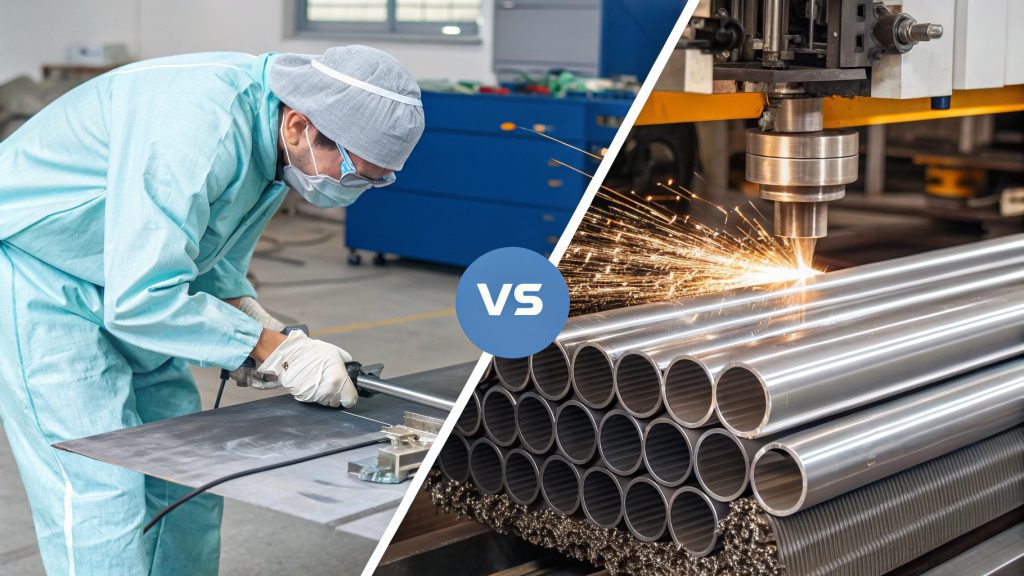
Let's get practical here. The most common choice my customers have to make is between steel and aluminum. They are both excellent materials, but they serve different purposes. I remember a client who was making enclosures for electronic equipment. He initially chose steel for its strength and low price. But during testing, his product was overheating. I suggested we make a prototype using an aluminum alloy. Why? Because aluminum is fantastic at dissipating heat. It solved his overheating problem instantly and was still strong enough for the enclosure. This is a perfect example of choosing based on function, not just cost.
Steel vs. Aluminum
Steel is the industry workhorse. It is strong, durable, and generally cheaper. But it is heavy and will rust if it is not plated or painted. Stainless steel is a brilliant upgrade. It contains chromium, which makes it highly resistant to rust and corrosion. This makes it perfect for medical equipment, kitchen applications, and outdoor hardware.
Aluminum is the lightweight champion. It is about one-third the weight of steel. It naturally forms a protective oxide layer on its surface, so it resists corrosion very well on its own. It is also a great conductor of heat and electricity, as my client discovered. This makes it ideal for electronics, automotive parts, and aerospace components.
| Feature | Steel (Carbon/Stainless) | Aluminum |
|---|---|---|
| Strength | Very High | Good, but lower than steel |
| Weight | Heavy | Lightweight (1/3 of steel) |
| Corrosion Resistance | Low (Carbon), High (Stainless) | Very High |
| Cost | Lower (Carbon), Higher (Stainless) | Moderate to High |
| Best For | Structural parts, high-stress applications | Lightweight parts, electronics, rust-proof uses |
What is the best material for sheet metal?
Everyone wants to find the single "best" material for their project. But this search can be misleading and frustrating. The truth is, there is no single best material for every application.
The "best" material for sheet metal is simply the one that perfectly matches your project's requirements for function, lifespan, and budget. For structural strength, steel is often best. For lightweight and corrosion resistance, aluminum or stainless steel might be the superior choice.
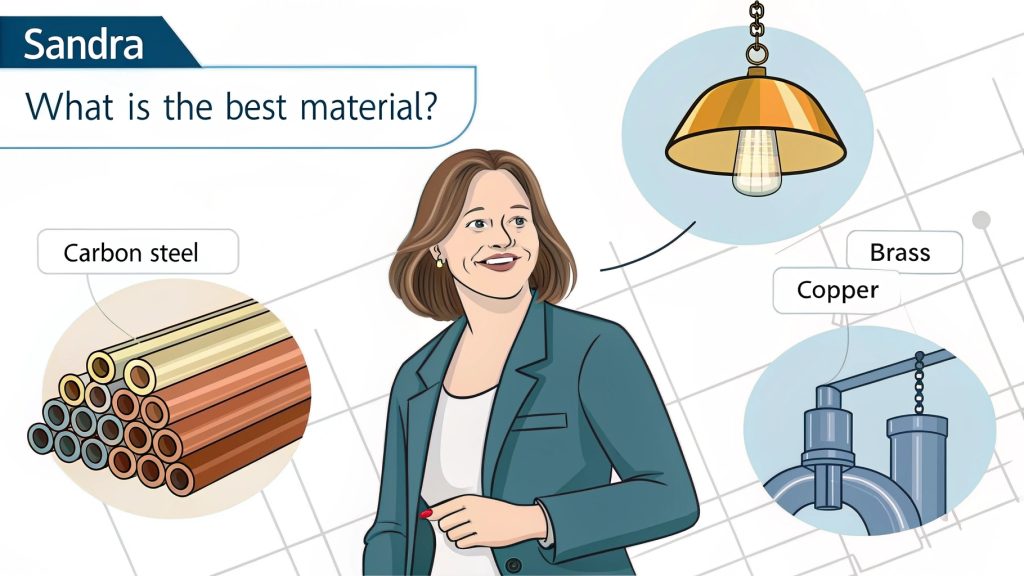
I get this question almost every day: "Sandra, what is the best material?" My answer is always the same: "It depends on what you are making." There is no single "best" material, only the "best fit" for your specific needs. If you are making a strong, simple bracket for an industrial machine, basic carbon steel is probably your best choice because it is strong and very affordable. But if you are designing a high-end decorative lamp, you might want the unique color and finish of brass or copper. Let's look beyond just steel and aluminum for a moment.
Exploring Other Metals
-
Copper: It is highly conductive of electricity and heat. It also has a beautiful, distinctive reddish-brown color that changes over time. It's great for electrical components, busbars, and decorative items, but it is more expensive.
-
Brass: This is an alloy of copper and zinc. It looks like gold, resists corrosion well, and is easy to work with. You see it often in plumbing fittings, musical instruments, and decorative hardware.
-
Titanium: This is a premium choice. It has an incredible strength-to-weight ratio and is extremely resistant to corrosion. It's used in aerospace, racing, and high-performance medical implants, but it comes with a high price tag.
The "best" material is always a compromise between ideal performance and your budget.
| If your main priority is... | Then the "best" material might be... |
|---|---|
| Maximum Strength at a Low Cost | Carbon Steel (e.g., Hot-Rolled Steel) |
| Corrosion Resistance & Hygiene | Stainless Steel |
| Being Lightweight & Dissipating Heat | Aluminum |
| Electrical Conductivity & Appearance | Copper or Brass |
| The Best Strength-to-Weight Ratio | Titanium |
What are the materials required for sheet metal working?
Starting a new sheet metal project? It can be confusing to know which raw materials are commonly available and workable. Choosing an uncommon material can stop your production before it even starts.
The most common materials for sheet metal working are various steels (cold-rolled, hot-rolled, stainless, galvanized), aluminum, copper, and brass. These metals offer a great balance of formability, strength, and availability, making them suitable for processes like cutting, bending, and welding.
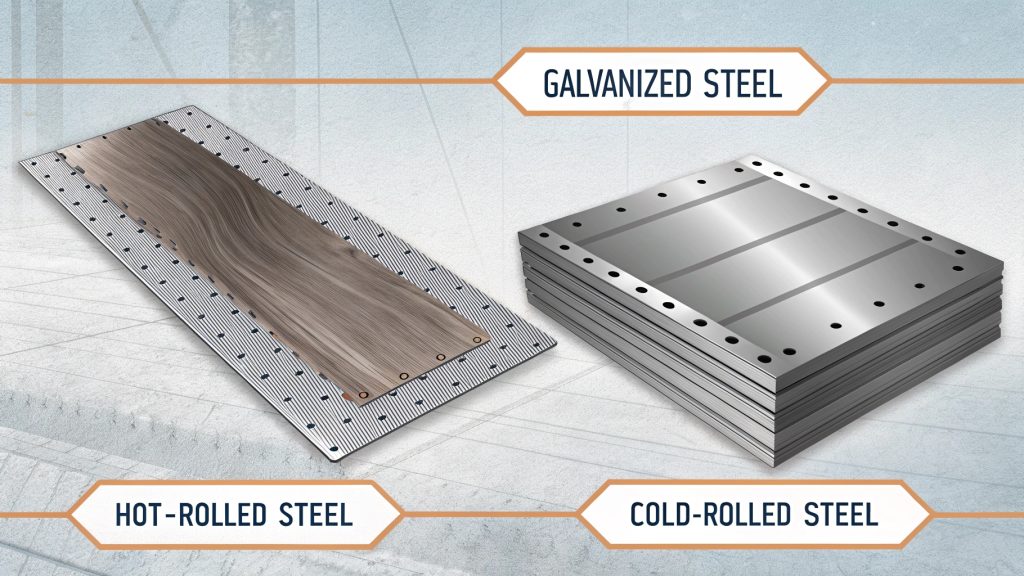
When we say "sheet metal," we are talking about metal that has been formed into thin, flat pieces. But these sheets come in many different types. At my company, Worthy Hardware, we can source and work with over 100 different materials, but a few core types make up most of our projects. It is very helpful to know the basic categories.
Common Sheet Metal Stock
-
Hot-Rolled Steel: This steel is rolled at very high temperatures. It is less expensive but has a rougher surface finish and less precise dimensions. It is great for structural parts where looks do not matter as much.
-
Cold-Rolled Steel: This is hot-rolled steel that goes through more processing at room temperature. This gives it a much smoother surface and tighter, more accurate tolerances. It is perfect for parts that need precision and a nice finish, like car bodies and electronics enclosures.
-
Galvanized Steel: This is regular steel that has been coated with a thin layer of zinc. The zinc acts as a protective barrier, sacrificing itself to protect the steel from rust. It is an ideal, low-cost choice for anything used outdoors.
-
Aluminum: This comes in many different alloys, and each one has different properties. For example, the 5052 alloy is great for forming and corrosion resistance, while the 6061 alloy is stronger and better for structural parts.
Knowing these basic types helps you have a more productive conversation with your supplier. We can always help you choose the exact grade and thickness you need for your design.
| Material Type | Key Feature | Common Use Case |
|---|---|---|
| Hot-Rolled Steel | Low cost, high strength | Structural components, industrial brackets |
| Cold-Rolled Steel | Smooth finish, tight tolerances | Computer cases, appliance panels, car parts |
| Galvanized Steel | Excellent corrosion resistance | Outdoor hardware, roofing, automotive parts |
| Stainless Steel | Corrosion/heat resistant, hygienic | Food equipment, medical devices, chemical tanks |
| Aluminum | Lightweight, corrosion resistant | Electronics, aerospace parts, road signs |
Conclusion
Choosing the right metal involves balancing function, environment, and budget. By understanding the core properties of each material, you can make a smart, cost-effective choice for your sheet metal project.