
How Does Polyamide Perform In High-Temperature CNC Machining Applications?

Need plastic parts that can handle high heat? The wrong material will fail, costing you time and money. Polyamides are a reliable solution for tough, high-temperature CNC machined parts.
Polyamides, especially high-performance grades like PA46 and PA6T, are excellent for high-temperature CNC machining. They keep their strength and shape at continuous temperatures over 200°C. This makes them perfect for automotive and industrial parts that get very hot.
I often talk with customers who need parts for hot environments. They have tried other plastics, but the parts warp or break down. It causes major problems for their production lines. They need a material they can trust. Polyamide is often the answer, but it's important to know which kind and why.
So, let's look closer at how this material works. Understanding the details will help you decide if it is the right choice for your next project.
What Is the High Temperature of Polyamide?
Confused by "high-temperature" claims for plastics? Vague specs can lead to part failure. We need to define exactly what high-temperature means for polyamides so you can choose correctly.
The term "high temperature" for polyamide depends on the specific type. Standard grades are good up to 150°C. But special grades like PA46 and PA6T can work continuously at temperatures over 200°C. They offer great stability for extreme heat applications.
When we talk about "high temperature," it is not a single number. Different polyamides have different heat limits. The standard polyamides, like PA6 and PA66, are workhorses. They handle heat well, but they have their limits. For most industrial uses, their continuous service temperature is around 80°C to 150°C. This is fine for many applications.
But some projects need more. I have a client who makes parts for turbocharger systems. The temperatures there can get extremely high. For them, we use high-performance polyamides. My insight is that grades like PA46 and PA6T are in a different class. These materials were designed specifically for extreme heat. They can operate without losing their structural integrity at temperatures well above 200°C. This is because their chemical structure is more stable and rigid.
Here is a simple table to show the difference.
| Polyamide Grade | Continuous Use Temperature (Approx.) | Key Feature |
|---|---|---|
| PA6 | 85°C | Toughness, good for general purpose |
| PA66 | 105°C | Higher strength and stiffness |
| PA46 | 150°C+ | Excellent high-temperature performance |
| PA6T | 160°C+ | Superior heat and chemical resistance |
Choosing the correct grade is the most important step. You must match the material's temperature rating to your product's operating environment.
What Are the Applications of Polyamide Material?
Wondering where polyamide fits in your products? Using the wrong plastic is a costly error. You can discover the wide range of uses where polyamides are the best choice.
Polyamides are used in tough jobs because of their strength and heat resistance. You can find them in car engine parts, electrical connectors, industrial gears, and medical tools. Their versatility makes them a top material for parts that must be strong and reliable.
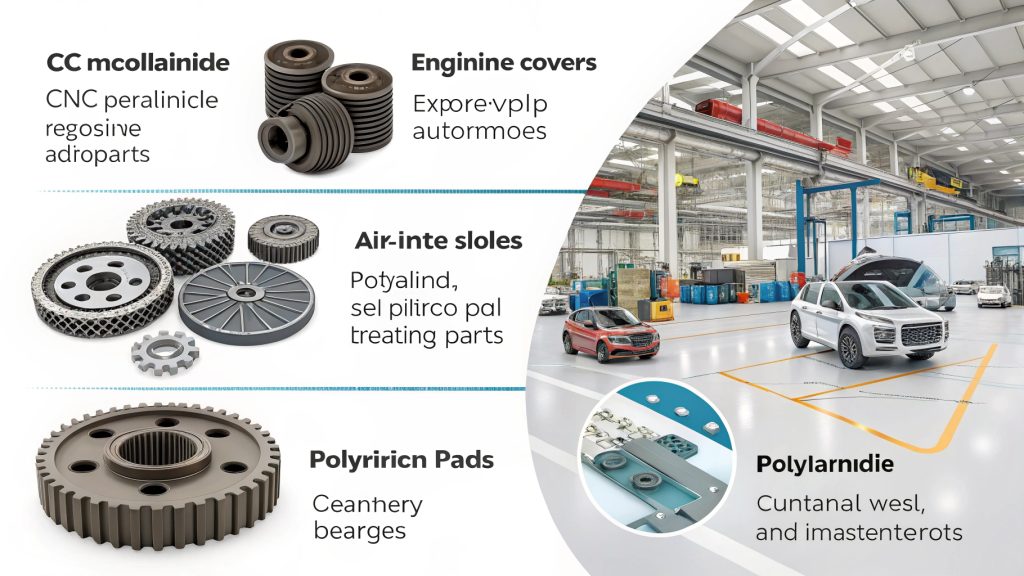
Because polyamide is so versatile, I see it used in almost every industry we serve. Its unique combination of mechanical strength, low friction, and resistance to heat and chemicals makes it a problem-solver. Many of my clients, from North America to Europe, rely on it for their most critical components.
Here are some of the most common areas where we supply CNC machined polyamide parts:
Automotive Sector
This is a huge market for high-temperature polyamides. They are used for under-the-hood components like engine covers, air intake manifolds, and radiator end tanks. The parts must survive constant heat, vibration, and exposure to oil and fuel. PA46 and PA6T are especially popular here.
Industrial Machinery
In factories, polyamide is machined into gears, bearings, and wear pads. Its low-friction surface means machines run smoothly with less wear. It is also much quieter than metal-on-metal parts. We make many custom gears for clients who need to reduce noise and maintenance.
Electronics and Electrical
Polyamide is a great electrical insulator. It is used to make connectors, terminal blocks, and housings for sensitive electronics. It protects the components from heat and short circuits.
Consumer Products
You can find polyamide in high-end power tools, kitchen appliances, and sporting goods. Its toughness and light weight make the products durable and easy to handle.
Is Polyamide Machinable?
Worried about machining plastics? Bad machinability ruins parts and wastes time. Polyamide is very machinable, but you need to know some key things for perfect results every time.
Yes, polyamide is very machinable. It can be easily CNC milled, turned, and routed. But, its low melting point means you must control cutting speeds to prevent melting. Using sharp tools and coolant is key to getting tight tolerances and a smooth finish.

I always tell my customers that polyamide is great to machine, but it’s not metal. You cannot treat it the same way. The biggest challenge is heat. If too much heat builds up during cutting, the plastic can melt onto the tool. This ruins the surface finish and the part's accuracy. A client once had this problem before coming to us. They were using the wrong settings and getting poor results.
We helped them by sharing our best practices. The key is to manage heat and chip removal. You need to get the plastic chips away from the cutting area quickly before they can melt. This means using very sharp tools, preferably ones designed for plastics. It also means using the right speeds and feeds. We often use a lower spindle speed but a higher feed rate. This creates thicker chips that carry heat away. Using a coolant, like compressed air or a water-based fluid, is also very important.
Here is a simple guide I share with my team and customers for CNC machining polyamide:
| Best Practice (Do) | Common Mistake (Don't) |
|---|---|
| Use sharp, plastic-specific tools | Use dull or worn-out tools |
| Apply coolant (air or liquid) | Machine dry at high speeds |
| Use a high feed rate | Use a low feed rate that causes rubbing |
| Clear chips constantly | Let chips build up and melt |
Following these simple rules makes machining polyamide easy and gives you precise, high-quality parts every time.
Is Polyamide Better Than Nylon?
Confused by material names like polyamide and nylon? Choosing the wrong one because of the name can be a big mistake. Let's make this common point of confusion clear.
This is a trick question. "Polyamide" is the technical name for the family of polymers more commonly known as "Nylon." They are the same material. Nylon is just a trade name for a type of polyamide, first created by the company DuPont.
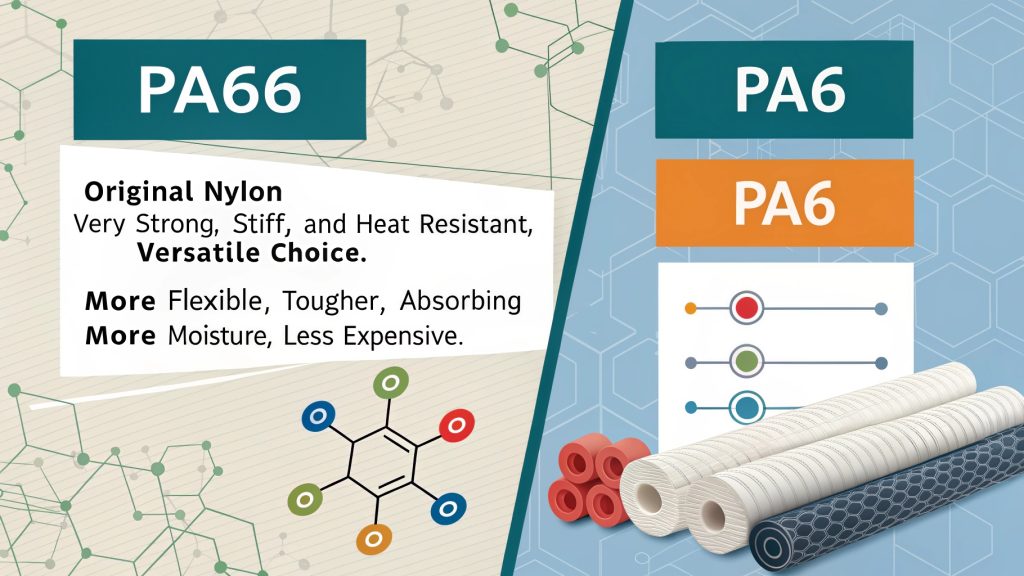
This is one of the first things I clarify with new customers. Many people think polyamide and nylon are two different materials competing with each other. But they are not. "Polyamide" (PA) is the scientific name for a whole family of plastics. "Nylon" was the original brand name given to the first commercially successful polyamide, PA66, by DuPont back in the 1930s. The name became so famous that people now use it for all polyamides.
So, the real question is not about polyamide versus nylon. The real question is: "Which type of polyamide is right for my application?" There are many different grades, and they have different properties.
Here is a quick breakdown of the most common types:
-
PA66: This is the original Nylon. It is very strong, stiff, and has good heat resistance. It's a great all-around choice.
-
PA6: This type is slightly more flexible and tougher than PA66. It absorbs a little more moisture, which can affect its dimensions. It is often a bit less expensive.
-
PA12: This grade is known for its very low moisture absorption. It stays stable in wet environments. It is also more flexible, making it good for things like tubing.
-
PA46 & PA6T: As we talked about, these are the high-temperature champions. They are used when parts must survive extreme heat.
So, when you are sourcing parts, don't just ask for "Nylon." Be specific. Tell your supplier if you need PA66 for strength, or PA46 for high-heat performance. This helps us provide the perfect part for your needs.
Conclusion
Polyamides are a top choice for high-heat CNC parts. Special grades offer superior performance. Understanding the types and correct machining methods ensures success for your projects.