
How to compare quotes for carbon steel machining services?

Struggling to make sense of different quotes? You get varied prices, but it's unclear what you're actually paying for. This makes choosing the right partner a real gamble.
To compare carbon steel machining quotes, look beyond the final price. Analyze the cost breakdown, including material, machine time, labor, and finishing. Check the specified tolerances, lead times, and quality inspection processes to ensure you're comparing equivalent services and true value.
Comparing quotes can feel like comparing apples to oranges. You might get one price that seems too good to be true and another that feels way too high. The secret isn't just looking at the number at the bottom of the page. It's about understanding what goes into that number. I've seen many clients, like Mark from Canada, get frustrated because they can't see the full picture from a simple price. They need to know if they are paying for quality, speed, or just a supplier's high overhead. Let's break down how you can dig deeper into these quotes to find a partner who offers real value, not just a low price. This guide will help you ask the right questions and spot the best deal for your project.
What is the most accurate machining process?
Finding a process that hits your exact specifications is tough. A small error can ruin an entire batch. You need consistent precision, but not all methods deliver the same results.
The most accurate common machining process is 5-axis CNC machining combined with precision grinding. This combination allows for creating highly complex geometries with extremely tight tolerances, often reaching +/- 0.001" (0.025 mm) or even tighter on critical features.
When customers ask me about accuracy, the conversation always turns to capabilities. While many processes exist, 5-axis CNC machining is a game-changer for complex parts. It moves a part or the cutting tool along five different axes at the same time. This means we can machine intricate shapes in a single setup. Fewer setups mean less chance for human error and better alignment between features. For example, we regularly produce aerospace and medical components that require this level of detail. But the machine is only part of the story. To achieve the highest accuracy, we often combine it with secondary processes.
Here’s a breakdown of what contributes to top-tier accuracy:
| Factor | Description | Why It Matters for Accuracy |
|---|---|---|
| Machine Type | 5-axis CNC machines offer superior access to the workpiece. | Reduces the need to re-fixture the part, minimizing tolerance stack-up and ensuring feature-to-feature accuracy. |
| Tolerances | The allowable deviation for a specific dimension. | We can hold tolerances down to +/- 0.001". This is crucial for parts that need to fit together perfectly. |
| Finishing Process | Post-machining steps like precision grinding or lapping. | Grinding can smooth surfaces and refine dimensions beyond what milling or turning alone can achieve, getting us to sub-micron levels of precision. |
| Inspection | Using CMMs (Coordinate Measuring Machines) for verification. | Our 100% inspection process ensures every part meets the drawing's specifications and GD&T callouts before it ships. |
So, when you see a quote, don't just look for "CNC machining." Ask if they use 5-axis machines for complex parts and what their standard and precision tolerances are. This tells you if they can handle your most demanding projects.
How do you calculate CNC machining cost per hour?
You get a final price but don't know the breakdown. This makes it hard to see if the cost is fair or if you can reduce it. You need to understand the hourly rate.
To calculate CNC machining cost per hour, you combine the machine's hourly rate, the operator's labor rate, and a portion of the factory's overhead costs. This total hourly rate is then multiplied by the time it takes to machine one part.
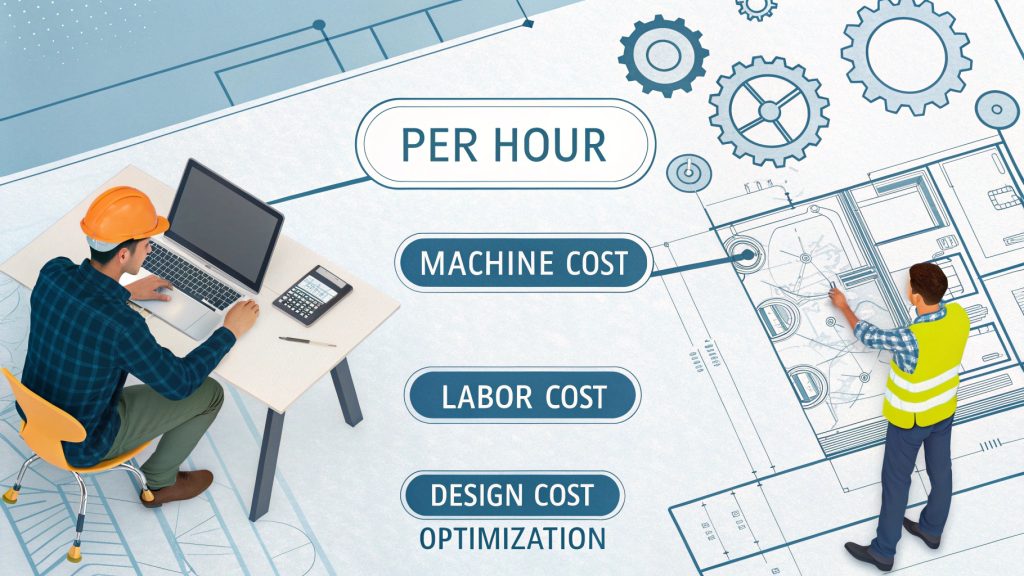
Calculating the true cost per hour is something we do for every project. It’s more than just running a machine; it's a mix of several important factors. When I prepare a quote, I'm not just guessing. I'm breaking down the entire production process to give you a clear and fair price. This transparency helps you understand where your money is going and where we might be able to find savings. For instance, sometimes a small design change can dramatically cut down on machining time, which directly lowers your cost. My goal is to work with you, not just for you. As an engineer myself, I enjoy helping customers optimize their designs for better efficiency and lower costs.
Let's look at the key elements that make up the hourly cost:
-
Machine Cost: This is the depreciation of the CNC machine itself, plus maintenance. A high-end 5-axis machine costs more per hour to run than a simpler 3-axis machine because the initial investment is much higher.
-
Labor Cost: This includes the salary of the skilled machinist who sets up, operates, and oversees the machine. Their expertise is critical for quality, especially on complex jobs.
-
Overhead Costs: These are the hidden costs of running a facility. It includes rent, electricity, tooling, software licenses, quality control equipment, and administrative staff salaries. We spread these costs across all the operating hours of our machines.
-
Setup Time: For every new job, a machinist must program the machine, prepare the fixtures, and run a first-article inspection. This setup cost is divided by the number of parts in the order. This is why prototypes are more expensive per piece than mass production runs.
Understanding this calculation helps you see why a quote might be higher or lower. A shop with brand-new machines and extensive quality control might have a higher hourly rate, but they also deliver better reliability and tighter tolerances.
How much does a CNC cost per hour?
You need a budget, but CNC machining rates seem all over the place. Without a baseline, you can't tell if a quote is competitive or overpriced. This makes financial planning difficult.
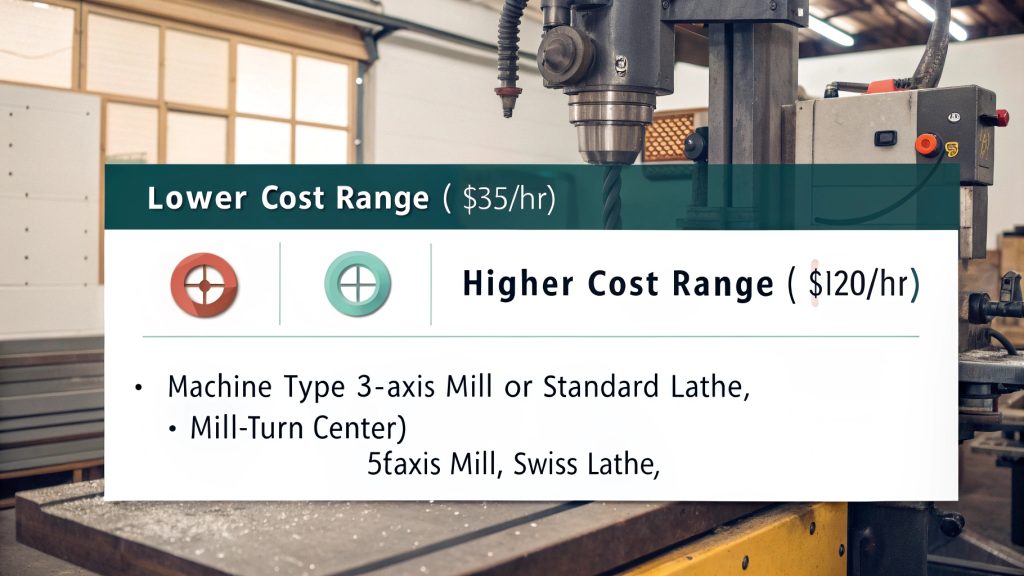
A typical CNC machining cost per hour ranges from $35 to $120. The rate depends heavily on the machine's complexity (3-axis vs. 5-axis), the geographic location of the shop, and the volume of the order. Chinese suppliers often fall in the $35-$50 range.
When I talk to new customers, this is one of the first questions they ask. The answer is, "it depends." I know that's not what people want to hear, but it's the truth. A simple 3-axis job in our shop will have a much lower hourly rate than a complex aerospace part on our 5-axis machine. The location is also a huge factor. A shop in North America or Europe has higher labor and overhead costs, so their rates might start at $75 and go up. As a manufacturer in China, we can offer more competitive rates, typically in the $35 to $50 range, without sacrificing quality. This is a key reason why experienced buyers like Mark Chen source parts from us. They get the quality they need at a price that works for their business model.
Here is a simple table to show how these factors influence the hourly rate:
| Factor | Lower Cost Range (~$35/hr) | Higher Cost Range (~$120/hr) |
|---|---|---|
| Machine Type | 3-Axis Mill or Standard Lathe | 5-Axis Mill, Swiss Lathe, Mill-Turn Center |
| Location | China, Southeast Asia | North America, Western Europe |
| Volume | High-volume production (1,000+ units) | Prototyping (1-10 units) |
| Material | Aluminum, Plastics, Mild Steel | Titanium, Inconel, Hardened Tool Steel |
| Complexity | Simple geometries, open tolerances | Complex shapes, tight tolerances (+/- 0.001") |
So when you get a quote, consider what you're asking for. If you need a simple bracket made from aluminum, you should expect a lower hourly rate. If you need a complex medical device component from titanium, the rate will naturally be higher. Our strength at Worthy is providing that high-end capability at a competitive price point.
What is the best steel for machining?
Choosing the wrong steel can cause production delays and increase costs. Some steels wear out tools quickly, while others are difficult to hold to tight tolerances. You need a reliable material.
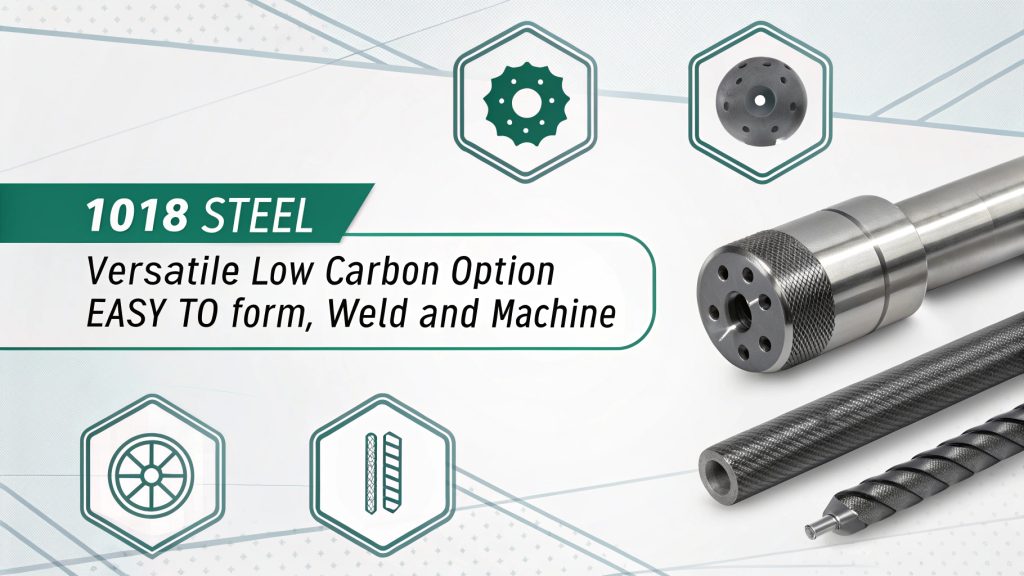
For general-purpose machining, 12L14 steel is often considered the best due to its excellent machinability and smooth finish. For applications needing more strength and weldability, 1018 carbon steel is a versatile and cost-effective choice that still machines well.
The "best" steel really depends on the final application of your part. I always ask my clients two questions: "What is this part for?" and "What properties does it need?" The answers help us choose the perfect material. For example, a customer making simple industrial fixtures doesn't need the high strength of an alloy steel. We can use a free-machining steel like 12L14 to produce their parts quickly and at a lower cost. However, for an automotive component that needs to handle stress, we might recommend something stronger like 4140 alloy steel. At Worthy, we work with over 100 materials, so we have the experience to guide you to the right choice that balances performance, cost, and machinability.
Here’s a quick guide to some common carbon steels we machine:
-
1018 Steel: This is my go-to for many projects. It's a low-carbon steel that is easy to form, weld, and machine. It's not extremely strong, but it's tough and very economical. It's great for parts like pins, shafts, and mounting plates.
-
1045 Steel: This is a medium-carbon steel. It's stronger and harder than 1018, and it can be heat-treated to increase its strength even more. It's a bit tougher to machine, which can slightly increase costs, but it's necessary for parts like gears, axles, and studs that require higher wear resistance.
-
A36 Steel: This is a common structural steel. It's mainly used for structural applications like building frames and supports. It's easy to weld and has good strength, but it's not designed for high-precision machining. We often use it for larger, less critical components.
When you're comparing quotes for carbon steel machining, make sure the supplier has specified the exact grade of steel they plan to use. A quote using 1018 steel should be more affordable than one using 1045. If a quote just says "carbon steel," ask for clarification. This small detail can make a big difference in both the price and the performance of your final part.
Conclusion
Comparing carbon steel quotes effectively means looking past the price. You must analyze the process accuracy, hourly cost calculation, and the specific steel grade used to find true, reliable value.