
How Does Deep Draw Stamping Work for Automotive Parts?
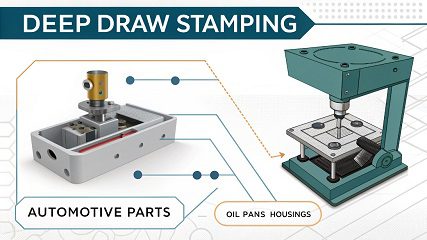
Struggling to source complex automotive parts with consistent quality? Production delays from faulty components can hurt your business. Deep draw stamping provides a reliable, precise, and efficient manufacturing solution.
Deep draw stamping works by using a mechanical punch to force a flat sheet metal blank into a forming die cavity. This transforms the blank into a three-dimensional, hollow shape without welding or seams. It is a critical process for creating strong automotive parts like oil pans and housings.
Now you have the basic concept of deep draw stamping. However, the real advantage comes from understanding how each step contributes to the final part's quality and cost-effectiveness. The success of your automotive projects depends on getting this process right, from the initial blank to the finished component. Let’s dive deeper into the mechanics to help you make better procurement decisions.
What is the process of deep draw stamping?
Confused by the technical details of the drawing process? Misunderstanding the steps can lead to material tearing, defects, and wasted money. Knowing the core process ensures you get high-quality parts.
The process of deep draw stamping begins by securing a sheet metal blank over a die. A punch then descends, pushing the metal into the die cavity. This controlled action forces the material to flow and form into a seamless, cup-like shape, often done in multiple stages.
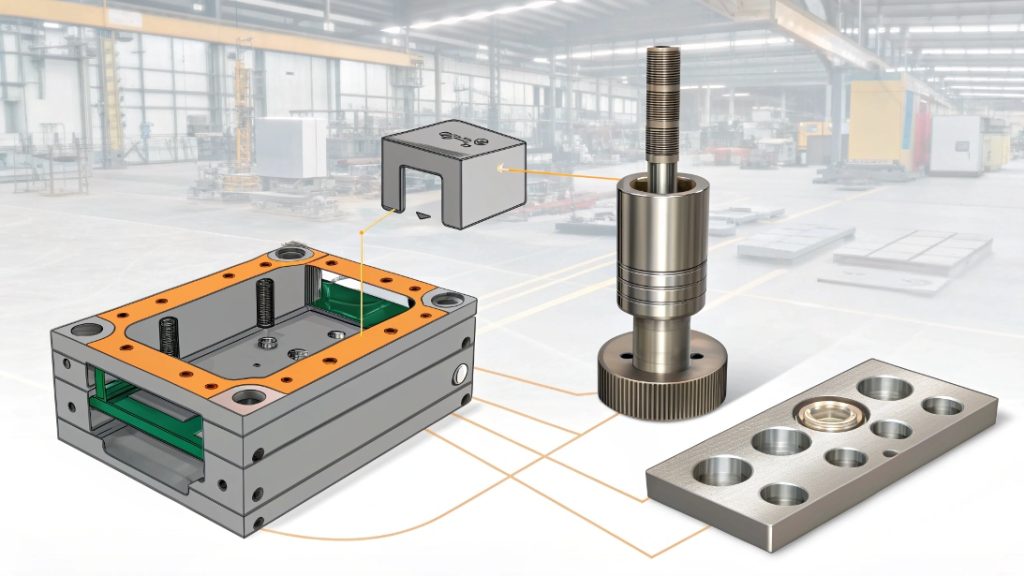
The Key Players: Punch, Die, and Blank Holder
At its heart, the deep draw stamping process is a carefully controlled interaction between three main components. The quality of the final automotive part is entirely dependent on how these elements work together. I've found that when clients like Mark from Canada have issues with parts from other suppliers, it's often because one of these elements wasn't optimized.
| Component | Function |
|---|---|
| The Punch | This is the tool that pushes the metal. Its shape defines the inner dimensions of the final part. |
| The Die | This is the cavity that the punch pushes the metal into. It forms the outer shape of the part. |
| The Blank Holder | This applies pressure to the edges of the metal sheet, or "blank," during the draw. |
The blank holder is especially critical. Without the right amount of pressure, the metal can wrinkle as it's drawn into the die. Too much pressure, and the material can tear. At Worthy, we use electronic tool and press monitoring systems to apply the exact pressure needed, ensuring a smooth, defect-free flow of material every time.
What is the process of stamping in the automotive industry?
The automotive supply chain is unforgiving. A single out-of-spec part can stop an entire assembly line. You need a proven process that delivers millions of identical parts with absolute precision.
Stamping in the automotive industry is a high-volume manufacturing method using presses and custom dies. It rapidly cuts, bends, and forms sheet metal into everything from body panels and doors to small, critical brackets and terminals. It is valued for its speed, repeatability, and cost-effectiveness.
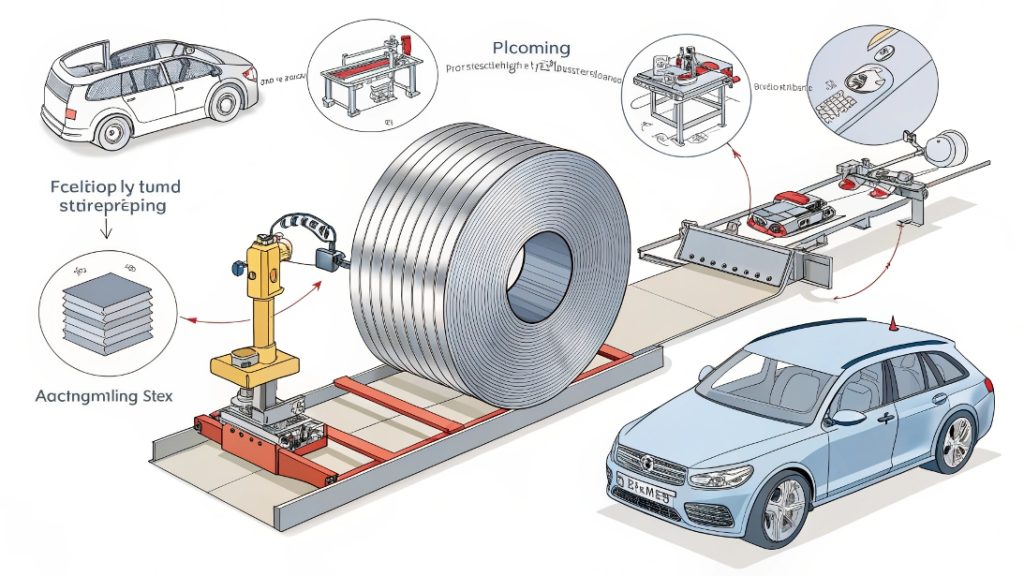
From Metal Coil to Car Part
When we talk about automotive stamping, it's a much broader category than just deep drawing. It's a family of processes designed to efficiently produce the huge variety of metal parts a vehicle needs. I remember a project for a client who needed a series of complex clips for a new vehicle model. We didn't use a single process; we used a progressive die that combined several stamping operations into one continuous sequence. This approach is very common in the automotive sector.
Beyond Deep Drawing: A Family of Processes
The process starts with a large coil of metal, which is fed into a press. A series of operations then takes place.
| Stamping Process | Automotive Application |
|---|---|
| Blanking | Cutting the initial flat shape from the coil. The first step for almost any part. |
| Piercing | Punching holes for screws, clips, or wiring. |
| Bending | Creating angles and flanges, used for brackets and reinforcements. |
| Deep Drawing | Forming deep, cup-like shapes like oil filters or sensor housings. |
| Coining | Creating fine details or strengthening specific areas. |
This combination allows for the creation of complex geometries that are both lightweight and incredibly strong. At my company, we design our tooling to handle these different processes in the most efficient order, saving our customers time and money on their high-volume orders.
What are the 7 steps in the stamping method?
Want to manage your project timeline effectively? Not knowing the key production stages can leave you guessing. Understanding these 7 steps gives you clear visibility and control over quality.
A standard stamping project follows 7 key steps: part design and simulation, tool and die manufacturing, material selection and preparation, blanking the initial shape, the stamping or forming operation, secondary operations like trimming, and finally, quality inspection and finishing before shipment.
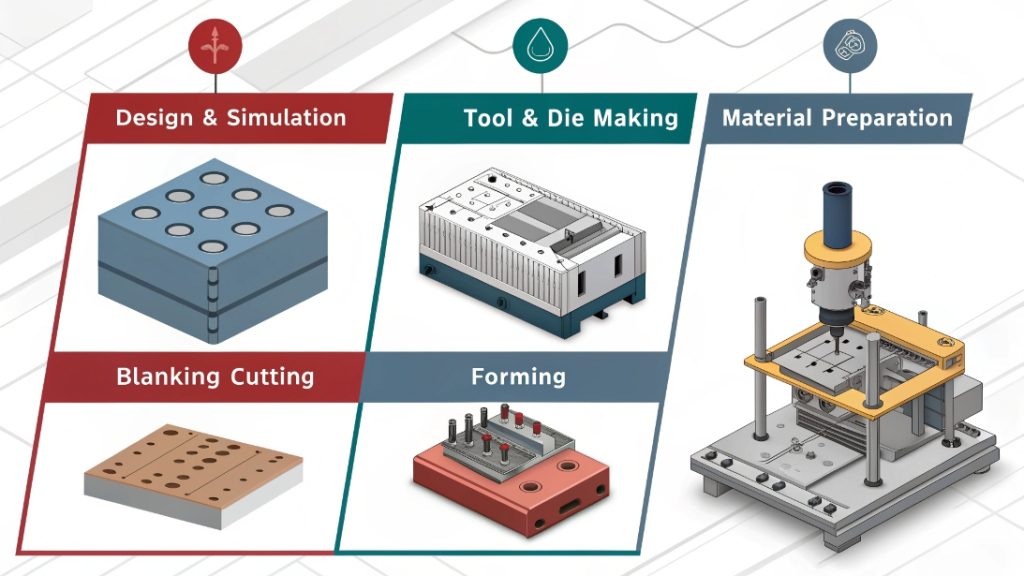
From Concept to Component
Every successful stamping project we handle, from a simple retainer to a complex shield, follows a structured path. This structured approach is critical for avoiding delays and quality problems, which I know are major pain points for procurement managers. Here’s how we break it down:
The Importance of Each Stage
| Step Number | Stage Name | Why It's Critical |
|---|---|---|
| 1 | Design & Simulation | We use software to predict how the metal will behave, catching potential problems before any steel is cut. |
| 2 | Tool & Die Making | This is the most crucial step. Our in-house engineers craft the dies with tolerances as tight as 0.025mm. |
| 3 | Material Preparation | Selecting the correct ferrous or non-ferrous metal and preparing it for the press. |
| 4 | Blanking/Cutting | The sheet metal is cut into a "blank," the flat piece that will be formed into your part. |
| 5 | Forming | The press uses the die to form the blank into its final shape through progressive or deep draw stamping. |
| 6 | Secondary Operations | We perform any necessary tapping, trimming, deburring, or riveting in this stage. |
| 7 | Finishing & Inspection | Parts are plated or coated if needed, and every single part undergoes a 100% inspection before packing. |
This final inspection step is our promise. Many suppliers do batch-testing, but we check every single piece. This way, when a customer in North America or Europe receives a shipment from us, they know it's ready for their assembly line without any surprises.
What is the difference between deep drawing and stretch forming?
Choosing the wrong metal forming method for your part? This common mistake leads to material failure, project delays, and costly re-tooling. Knowing the key differences saves you from these major headaches.
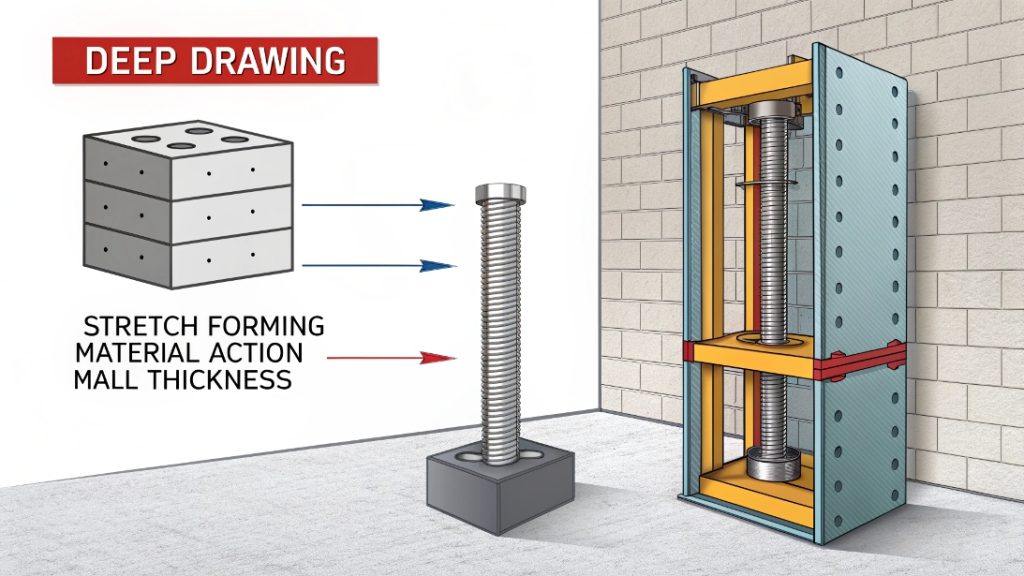
In deep drawing, metal flows into a die as a punch pushes it, maintaining a relatively consistent wall thickness. In stretch forming, the metal is clamped and stretched over a form, causing it to thin as it takes the shape of the die. They are fundamentally different.
How the Metal Behaves
The biggest mistake I see new buyers make is confusing these two processes. While both shape metal, how they do it impacts the final part's strength and dimensions. In deep drawing, we are carefully controlling the flow of material into a cavity. Think of it like shaping clay by pushing it into a mold. In stretch forming, we are pulling the material over a shape, like stretching a rubber sheet over a ball. This stretching action inherently thins the material.
Choosing the Right Process for Your Part
The application determines the correct method. You wouldn't use stretch forming to make a deep can, and you wouldn't use deep drawing to make a large, shallow car hood.
| Feature | Deep Drawing | Stretch Forming |
|---|---|---|
| Material Action | Material is compressed and flows into a die. | Material is gripped and stretched over a die. |
| Wall Thickness | Stays relatively uniform or can slightly thicken. | Thins out, especially at the highest point. |
| Best For | Deep, cylindrical, or box-shaped parts (e.g., cans, housings). | Large, shallow, curved surfaces (e.g., car roof panels, aircraft skins). |
| Tooling | Requires a matched punch, die, and blank holder. | Often uses a single form die and grippers. |
At Worthy Hardware, our expertise lies in precision deep drawing. We focus on producing strong, seamless components where maintaining wall thickness and achieving specific depths are critical for performance, which is exactly what automotive applications for brackets, connectors, and terminals demand.
Conclusion
Deep draw stamping is a vital drawing process for quality automotive parts. Understanding its mechanics, the 7 key project steps, and how it differs from stretch forming ensures reliable production.