
How To Choose The Right Metal Stamping Process For Your Project?

Choosing the wrong metal stamping process can waste time and money. This mistake leads to project delays, budget overruns, and parts that don't meet your essential specifications.
To choose the right metal stamping process, you must consider your part's complexity, the total quantity needed, and the required precision. For high-volume, high-precision jobs, progressive dies are best. For simpler, low-volume runs, single-station dies are more cost-effective and save on tooling.
Getting this choice right is crucial for your budget and timeline. I have worked with many business owners and procurement officers, like Mark from Canada, who sometimes struggle with this decision. It can be a challenge when you're managing so many other parts of your business. But we can find the perfect fit for your specific needs by breaking the problem down into simple questions. Let's walk through the details together so you can make your next project a success.
What are the 7 steps in the stamping method?
Does the metal stamping process feel like a black box? This confusion can make supplier communication difficult and leave you unsure about your project's status.
The 7 steps of metal stamping are: design engineering, tool and die creation, material selection, stamping operation, secondary operations, finishing, and finally, quality inspection and assembly. Each step is critical for a successful outcome and delivering a part that meets your standards.
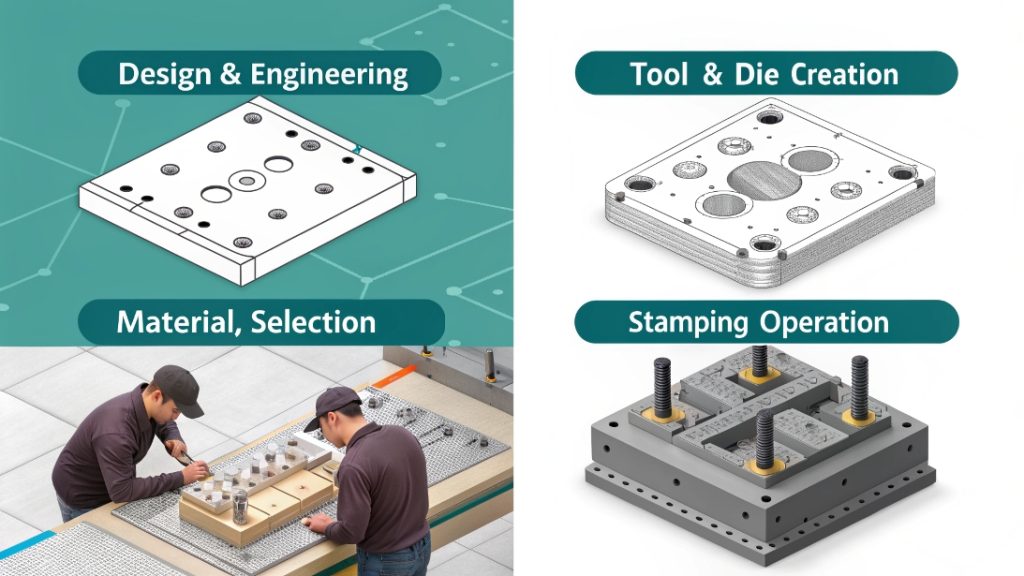
Let’s dive deeper into each stage of the process. Understanding these steps helps you know what questions to ask and how to manage your project timeline effectively. It’s what I discuss with my clients every day to ensure we are always on the same page.
A Closer Look at Each Stamping Stage
- Design & Engineering: This is where it all starts. You provide a 2D or 3D CAD file. Our engineers and I review it. We perform a Design for Manufacturability (DFM) analysis to spot potential issues and suggest improvements that can save you money.
- Tool & Die Creation: This is the heart of the process. Based on your design, we build the custom tool, or die. This tool will shape your parts. It must be made with extreme precision.
- Material Selection: We select the raw metal coil or sheet. The choice depends on your needs for strength, weight, and corrosion resistance.
- Stamping Operation: We feed the metal into the press. The press and die work together to cut, bend, and form the metal into your desired shape.
- Secondary Operations: Sometimes, a part needs extra features. This can include in-die tapping to create threads, or other processes that happen after the main stamping.
- Finishing: Here we apply a final surface finish. This could be plating, powder coating, or anodizing to protect the part or improve its look.
- Quality Inspection & Assembly: Every part is checked. We perform 100% inspection to ensure it meets your tolerances. If needed, we can then assemble the stamped parts with other components.
What is the process of metal stamping?
Do different stamping terms like progressive or fourslide confuse you? Choosing the wrong one can increase costs, lower efficiency, and hurt your project's profitability.
Metal stamping is a process that uses a die to shape a flat metal sheet. Key methods include progressive die stamping for complex, high-volume parts, single-station stamping for simple, low-volume runs, and fourslide stamping for intricate parts with multiple bends.
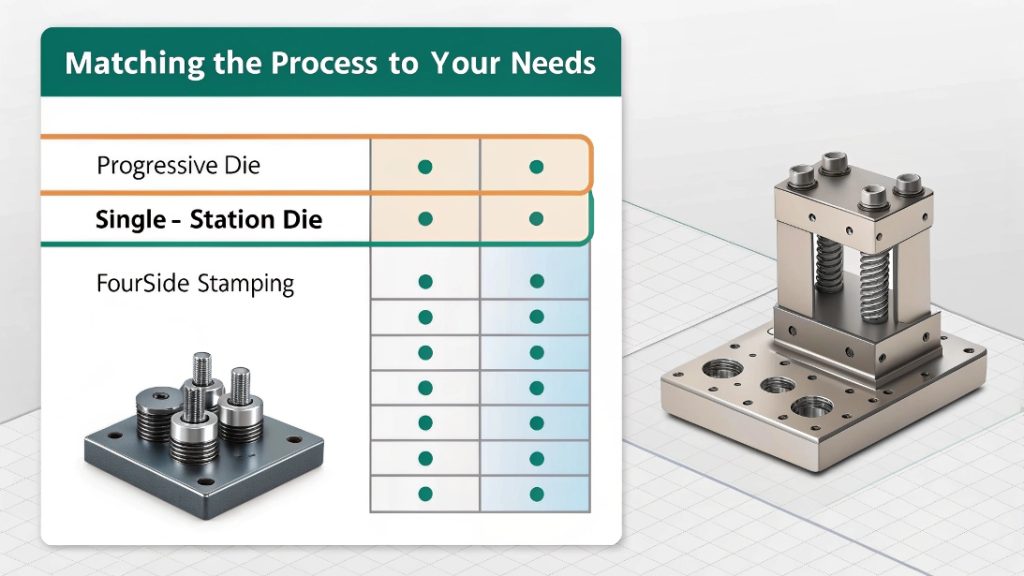
The most important decision we make with clients is choosing between a progressive die and a single-station die. This choice directly impacts your tooling cost and your price per part. I always guide my clients based on their project's volume and complexity. A smart choice here saves a lot of money. For example, for a client who needs millions of precise terminals, a progressive die is the only way to go. But for a startup needing 500 simple brackets, a single-station die is the better financial choice.
Matching the Process to Your Needs
Here is a simple table to help you understand which process fits your project. I use this to explain the options to my clients.
| Process Type | Best For | Tooling Cost | Part Cost |
|---|---|---|---|
| Progressive Die | High volume, complex parts | High | Very Low |
| Single-Station Die | Low volume, simple parts | Low | Higher |
| Fourslide Stamping | Intricate, bent parts (clips) | Medium | Medium |
A progressive die has a high upfront tooling cost, but it's automated and very fast. This makes the cost per individual part extremely low, which is perfect for large orders. A single-station die is much cheaper to make but requires more labor per part, so it's best for smaller quantities where the initial tooling investment needs to be low.
How to choose the right metal?
Worried about your parts failing due to the wrong material? A bad material choice can lead to product failure in the field, expensive recalls, and damage to your brand’s reputation.
To choose the right metal, consider its strength, corrosion resistance, conductivity, weight, and cost. Steel offers strength at a low price. Aluminum is light and resists rust. Copper and brass are best for electrical parts. Stainless steel gives strength and excellent corrosion resistance.
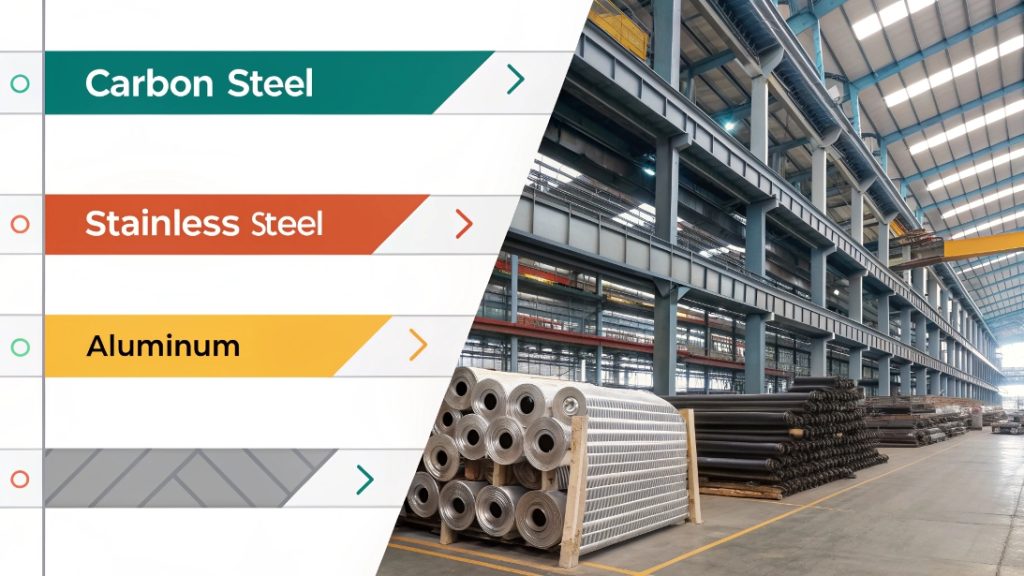
The material you select is fundamental to your part's performance. I always ask my clients, "What job does this part need to do, and where will it live?" The answer tells us everything we need to know. For an electronic connector, conductivity is key, so we look at brass or copper. For a mounting bracket on a boat, corrosion resistance is the most important factor, so stainless steel is a great choice. We have experience with over 100 materials, so we can always find the perfect match for your application and budget.
Common Metals and Their Applications
Let’s look at some of the most common materials we use in our facility.
| Material | Key Properties | Common Applications |
|---|---|---|
| Carbon Steel | Strong, hard, low cost | Brackets, automotive frames, industrial parts |
| Stainless Steel | High strength, excellent corrosion resistance | Medical and dental tools, food equipment, clips |
| Aluminum | Lightweight, resists corrosion, conducts heat | Aerospace parts, electronics enclosures, lighting |
| Copper & Brass | Excellent electrical conductivity, resists corrosion | Terminals, connectors, contacts, shields |
| Titanium | Very high strength-to-weight ratio | Aerospace and Defense, high-performance parts |
How to correctly use metal stamps?
You’ve picked a process and material, but a project can still fail. Poor communication with your supplier is frustrating and leads to missed deadlines and poor-quality parts.
To correctly manage a metal stamping project, provide clear CAD drawings and specify all tolerances, materials, and finishing requirements. Maintain open communication with your supplier, approve first article samples, and establish clear quality control checkpoints throughout the production process.
The best way to "use" metal stamping services is to be a clear and active partner in the process. I've found that the smoothest projects are the ones where communication is constant and requirements are crystal clear from day one. This avoids the terrible pain point I hear about from new clients: waiting weeks or months for an order, only to find out it was made incorrectly. At Worthy, my engineering team and I work hard to prevent this. We create a partnership with you.
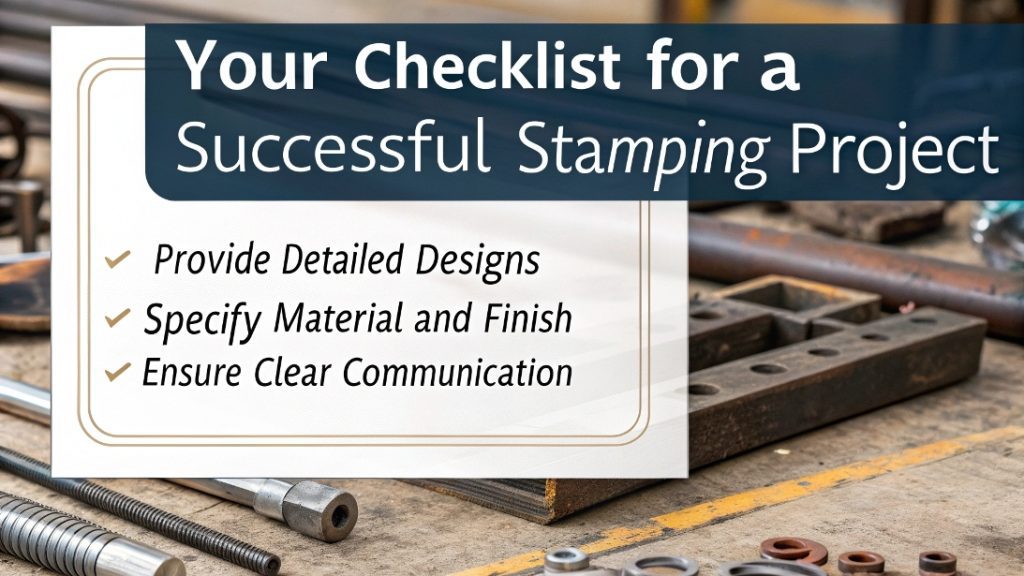
Your Checklist for a Successful Stamping Project
Here’s a simple checklist to follow for your next project.
- Provide Detailed Designs: Always send both 2D and 3D CAD files. Make sure to clearly mark all critical dimensions and tolerances. The more specific you are, the better we can make your part.
- Specify Material and Finish: Don't leave things open to interpretation. Name the exact material grade (e.g., Stainless Steel 304) and the finish you need (e.g., zinc plating, Class 1).
- Request a DFM Review: Ask your supplier to review your design for manufacturability. Our four engineers have rich experience helping clients optimize designs to cut costs and improve part function.
- Approve First Samples: Before we start mass production, you should always review and approve a First Article Inspection (FAI) report and physical samples. This ensures we are perfectly aligned.
- Communicate Regularly: Ask for updates. Clear and regular communication prevents surprises and keeps your project on track for a flexible and on-time delivery.
Conclusion
Choosing the right stamping process, material, and communication method is key. This ensures you get high-quality parts on time and on budget for every single one of your projects.