
What Are The Challenges Of CNC Machining Titanium And How To Overcome Them?

Struggling with high costs and failed parts when machining titanium? This frustration often comes from a common misunderstanding of the material, leading to wasted time and expensive material scrap.
The biggest challenge in CNC machining titanium is not its hardness, but its extremely low thermal conductivity. It acts as an insulator, trapping intense heat at the cutting edge. This causes rapid tool failure, material welding to the tool, and poor surface finishes, making it difficult to machine effectively.
Many people think titanium is tough to machine because it's so hard. I used to think that too. But through years of working with it at Worthy, we’ve learned the truth is more complex. The cutting force needed is only slightly higher than for steel of the same hardness. The real enemy is heat. This single property is the root cause of most problems. Once you understand how to manage the heat, machining titanium becomes much more predictable and successful. In this article, I'll break down the specific challenges and share the practical solutions we use every day to deliver high-quality custom titanium parts for our clients worldwide.
What are the challenges of machining titanium?
Facing a titanium project but worried about the high failure rate? Wasted material, broken tools, and blown budgets are common when you don't know the specific challenges of this unique metal.
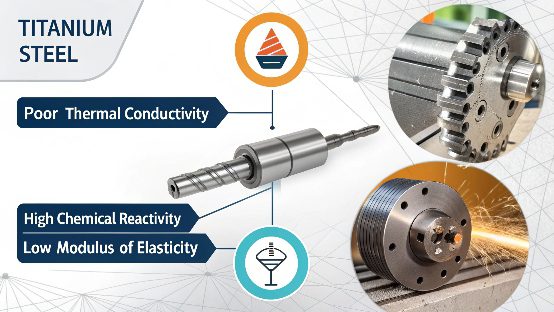
The main challenges are its low thermal conductivity, which traps heat at the tool tip, and its high chemical reactivity, causing material to weld to the tool. Other issues include a low modulus of elasticity leading to part spring-back and a tendency to work-harden during machining.
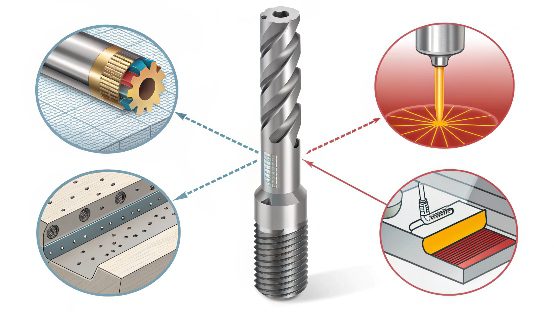
When we first started machining titanium parts, we went through expensive cutting tools incredibly fast. We learned the hard way that you can't treat titanium like steel. The challenges are unique and must be managed carefully.
Key Machining Challenges
- Poor Thermal Conductivity: This is the number one problem. Titanium has a thermal conductivity of about 7 W/m·K, while steel is around 50 W/m·K. This means heat generated during cutting doesn't escape into the chip or the workpiece. It concentrates on the cutting tool's edge, causing it to overheat, soften, and fail quickly.
- High Chemical Reactivity: At the high temperatures created during machining, titanium becomes very reactive. It can chemically react with the cutting tool material, causing galling (material sticking) and a built-up edge (BUE). This ruins the surface finish and can lead to tool fracture.
- Low Modulus of Elasticity: Titanium is "springy." It deflects away from the cutting tool more than other metals. This can cause the tool to rub against the workpiece instead of cutting cleanly, which leads to chatter, poor accuracy, and excessive work hardening.
- Work Hardening: If the tool rubs instead of cuts, the surface of the titanium becomes significantly harder. This makes the next machining pass even more difficult and puts more stress on the tool.
| Property | Titanium (Ti-6Al-4V) | Steel (4140 Alloy) | Implication for Machining |
|---|---|---|---|
| Thermal Conductivity | Very Low (~7 W/m·K) | Medium (~43 W/m·K) | Heat concentrates at the tool tip, causing rapid wear. |
| Elastic Modulus | Low (~114 GPa) | High (~205 GPa) | Part can "spring back," causing chatter and inaccuracy. |
| Reactivity | High at high temps | Low | Tends to weld to the cutting tool (galling). |
| Hardness (HRC) | ~36 HRC | ~30 HRC (Annealed) | Not the primary issue, but still requires significant force. |
How to solve a CNC machine problem?
A sudden problem during a CNC run can halt your entire production. A machine alarm or a bad part stops everything, costing you time and money while you try to figure out what went wrong.
To solve a CNC machining problem, first identify the specific issue (e.g., poor finish, wrong dimensions). Then, check the basics: tool condition, workholding rigidity, and coolant flow. Adjust your speeds, feeds, and depth of cut one by one to isolate and fix the cause.
When machining a tricky material like titanium, a systematic approach is critical. I remember helping our customer, Mark from Canada, troubleshoot an issue over a video call. His parts were coming out with a terrible finish. Instead of just changing settings randomly, we went through a checklist. It turned out to be a partially clogged coolant nozzle, a simple fix that saved a large batch of expensive aerospace parts.
A Systematic Approach to Problem-Solving
-
Stop and Identify: Don't let the machine keep running and making bad parts. Stop the cycle and clearly define the problem. Is it tool breakage, chatter marks, a bad surface finish, or incorrect dimensions? Be specific.
-
Check the Foundation (The "Big Three"):
- Workholding: Is the part held securely? Any slight movement can cause major issues, especially with titanium's springiness.
- Tooling: Is the tool sharp? Is it the right type for titanium (e.g., sharp-edged carbide with a PVD coating)? Is it held tightly in a high-quality holder?
- Coolant: Is the coolant flow strong and aimed directly at the cutting edge? For titanium, high-pressure coolant (over 1,000 psi) is ideal to blast away chips and fight the heat.
-
Review the Programming (Speeds & Feeds): The golden rule for titanium is low surface speed and high feed rate. A slow speed reduces heat generation. A high feed rate creates a thicker chip that can carry some heat away and helps prevent the tool from rubbing and work-hardening the material. Also, use toolpaths like trochoidal milling that maintain constant tool engagement and prevent sharp corners that spike tool load.
Why is titanium difficult to machine?
Everyone says titanium is hard to machine, but what does that really mean? Just knowing it's "difficult" doesn't help you plan your machining strategy or explain why a project might cost more.
Titanium is difficult to machine primarily because of its very low thermal conductivity. It traps extreme heat at the cutting edge, which rapidly degrades the tool. This, combined with its chemical reactivity at high temperatures and its tendency to work-harden, creates a challenging machining environment.

The biggest misconception is that titanium is difficult to cut because of its hardness. As I mentioned, its hardness is often similar to many stainless steels. The real villain is its inability to get rid of heat. Think of it like this: machining generates energy from friction. In metals like aluminum or steel, that heat energy quickly flows away from the cutting zone into the chips and the workpiece. But titanium is an insulator. All that heat energy gets trapped in a tiny area right where the tool meets the metal. This intense, localized heat is what causes all the problems. It's not about brute force; it's about temperature management.
The Domino Effect of Poor Heat Dissipation
-
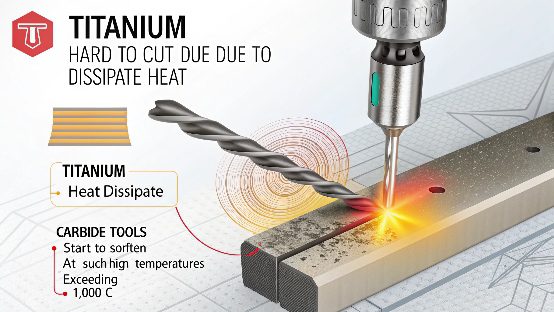
Heat Trap: The cutting process generates temperatures exceeding 1,000°C. Since titanium doesn't conduct this heat away, the tool's cutting edge absorbs it all.
-
Tool Softening & Deformation: Carbide tools, which are very hard at room temperature, begin to soften and deform at these extreme temperatures, causing the sharp edge to dull almost instantly.
-
Chemical Reaction: The intense heat makes the titanium chemically "sticky." It reacts with the tool's coating and carbide substrate, welding tiny bits of titanium onto the tool tip (galling).
-
Failure: This cycle of heat, softening, and galling quickly leads to catastrophic tool failure, a poor surface finish on the part, and a work-hardened surface that is even harder to cut on the next pass.
| Material | Thermal Conductivity (W/m·K) |
|---|---|
| Titanium (Ti-6Al-4V) | ~7 |
| Stainless Steel (304) | ~16 |
| Carbon Steel (1045) | ~51 |
| Aluminum (6061) | ~167 |
This table clearly shows why heat is the main issue. Titanium is a thermal insulator compared to other common metals.
What are the risks of machining titanium?
Taking on a titanium job without knowing the risks is a major gamble. The potential for catastrophic tool failure, scrapped expensive material, and even fire hazards can seriously hurt your bottom line and reputation.
The main risks include rapid and unpredictable tool wear leading to part damage, and work-hardening that can make a part impossible to finish. There is also a significant fire risk, as fine titanium chips are highly flammable, especially without proper coolant.
![]()![]()![]()![]()
At our facility, safety and risk management are top priorities, especially with titanium. We've seen the consequences of things going wrong. The risks aren't just about losing money on a part; they're about ensuring the safety of our team and our equipment. A titanium fire, for example, is not like a regular fire. You cannot use water or a standard ABC extinguisher on it; that will only make it more violent. You must have a Class D fire extinguisher specifically for combustible metals on hand. This is non-negotiable for anyone machining titanium.
Operational and Safety Risks
-
Financial Risks:
-
High Material Cost: Titanium alloys are significantly more expensive than steel or aluminum. Scrapping a single part due to a machining error can wipe out the profit on a job. At Worthy, our 100% inspection process helps catch issues early, but preventing the error in the first place is key.
-
High Tooling Cost: You need premium tools to machine titanium, and they wear out faster. Without the right strategy, your tooling budget can skyrocket unexpectedly.
-
- Production Risks:
- Unpredictable Tool Life: A tool can fail suddenly, often breaking inside the part. This can damage the workpiece beyond repair and potentially harm the machine spindle.
- Dimensional Instability: Because of its springiness and tendency to heat up, holding tight tolerances (like the +/- 0.001" we often handle) requires careful strategy and constant monitoring.
- Safety Risks:
- Fire Hazard: This is the most serious risk. Fine titanium chips and dust can ignite from a single spark. The fire burns incredibly hot and is difficult to extinguish. Never allow chips to accumulate in the machine. Good housekeeping and proper coolant usage are critical fire prevention measures.
Conclusion
The key to machining titanium isn't its hardness, but managing its poor heat dissipation. By using low speeds, high feeds, high-pressure coolant, and rigid setups, you can successfully overcome the main challenges.