
Can 1045 carbon steel be welded effectively? What are the challenges?
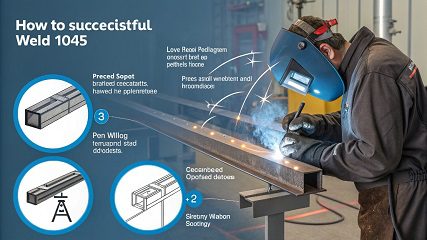
You need to join 1045 steel parts, but you're worried about the weld cracking. Don't let a failed weld ruin your project; a few key steps make it successful.
Yes, 1045 carbon steel can be welded effectively, but its higher carbon content requires special care. You must use preheating, low-hydrogen welding materials, and post-weld heat treatment to prevent cracks and ensure a strong, durable bond.
I've seen many projects involving 1045 steel. It’s a great material for strength and toughness, but welding it can be tricky if you don't know the proper procedure. It’s not like welding mild steel. The carbon that gives it strength also creates challenges. But don't worry, these challenges can be managed with the right knowledge. Let’s break down exactly what you need to do to get a perfect weld every time.
Can you weld 1045 carbon steel?
You have a project with 1045 steel that must be welded. You've heard it can be difficult and are concerned about cracks. Knowing the correct procedure will give you strong welds.
Yes, you can weld 1045 carbon steel. The key is preheating to over 200°C, using low-hydrogen electrodes, and applying immediate post-weld stress relief. This process prevents cracks and ensures the final part is strong and reliable.
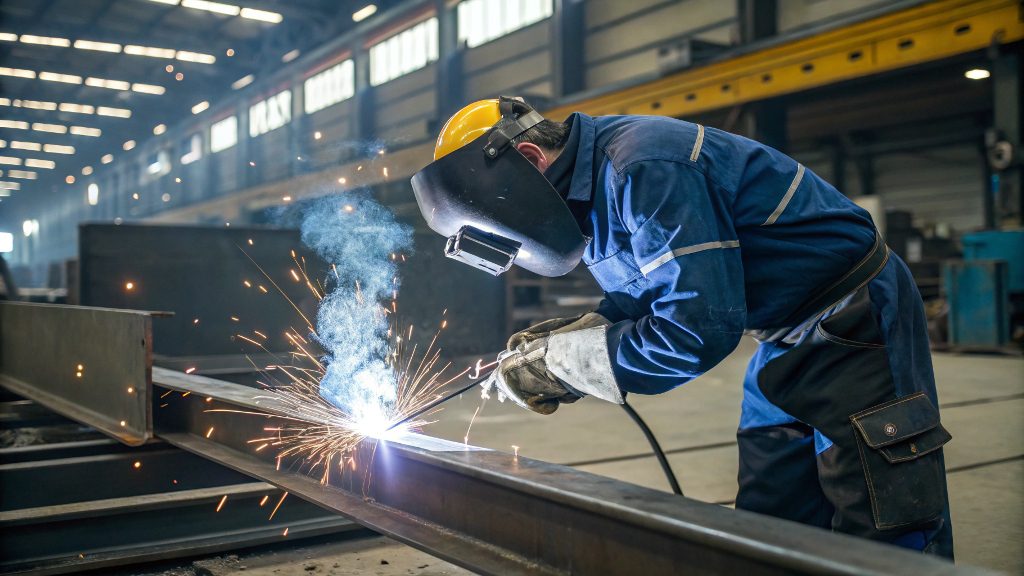
The main reason 1045 steel is challenging to weld is its carbon content, which is around 0.45%. During rapid cooling after welding, this high carbon content can cause a hard, brittle structure called martensite to form in the heat-affected zone (HAZ). This brittle area is very susceptible to cracking, especially cold cracking, which can appear hours or even days after welding. At my company, Worthy, we follow a strict procedure to avoid this. First, we preheat the base metal. This slows down the cooling rate and reduces the risk of martensite formation. Then, we use special low-hydrogen welding rods to minimize hydrogen embrittlement, another cause of cracking. Finally, right after welding, we perform a post-weld heat treatment (PWHT), like stress-relief annealing, to reduce internal stresses and soften the brittle structures. It's a precise process, but it's the only way to guarantee a reliable weld.
Key Welding Parameters for 1045 Steel
| Parameter | Recommendation | Why it's important |
|---|---|---|
| Preheat Temperature | 200°C - 300°C (400°F - 575°F) | Slows cooling to prevent brittle martensite formation. |
| Welding Material | Low-hydrogen electrodes (e.g., E7018) | Reduces the risk of hydrogen-induced cracking. |
| Welding Current | Use a smaller current, low heat input | Minimizes the size of the heat-affected zone. |
| Post-Weld Heat | Stress relief at ~650°C (1200°F) | Relieves internal stresses and tempers the weld area. |
Is 1045 steel hard to machine?
You need to machine 1045 steel parts. You're trying to figure out if it will slow down production or increase tooling costs. Choosing the right approach makes it simple.
No, 1045 steel is not considered hard to machine; it actually has good machinability in its standard state. It becomes difficult only after it has been hardened. Using the right tools, speeds, and feeds makes it a very cooperative material.


In our workshop, we machine 1045 steel every day. In its as-rolled or normalized condition, it cuts cleanly and gives a good surface finish. We compare it to a baseline material, 1212 steel, which has a machinability rating of 100%. In that context, 1045 steel has a rating of about 55%. This is a very workable rating for a carbon steel with its level of strength. The key is using the correct cutting parameters. Carbide tools are my recommendation for consistent results. Where machinists run into trouble is when they try to machine 1045 steel after it has been through a hardening process like quenching and tempering. The increased hardness makes it much tougher on cutting tools. For hardened 1045, you must reduce cutting speeds and use tougher tool grades to avoid premature wear. For our customers, we always clarify the material's condition before starting a job to ensure we are using the most efficient and cost-effective machining strategy.
Machinability Comparison of Common Steels
| Material | Hardness (Brinell) | Machinability Rating | Notes |
|---|---|---|---|
| 1212 Steel | 121 | 100% (Baseline) | Free-machining, excellent finish. |
| 1018 Steel | 126 | 70% | Good machinability, soft and ductile. |
| 1045 Steel | 170 | 55% | Good machinability in as-rolled state. |
| 4140 Alloy Steel | 197 | 65% | Good, but tougher than 1045. |
Is it difficult to weld carbon steel?
You need to weld carbon steel but are unsure if your team has the skills. You worry about weak joints causing product failures. Understanding the carbon content is the solution.
This depends entirely on the carbon content. Low-carbon steels (like 1018) are very easy to weld. Medium-carbon steels (like 1045) are challenging, while high-carbon steels are very difficult and require highly specialized procedures.
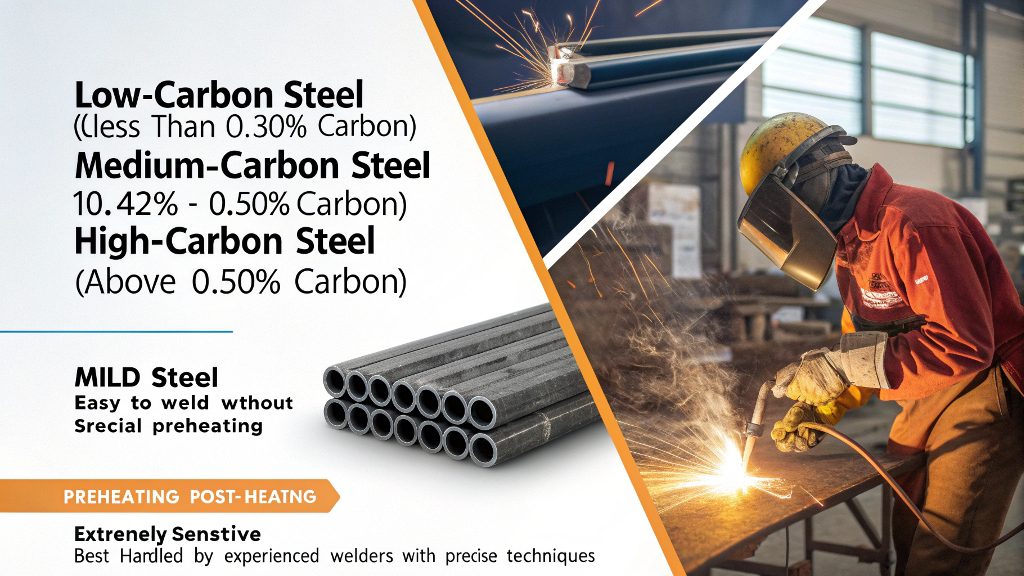
I tell my customers to think of carbon as the ingredient that makes steel both strong and tricky to weld. The more carbon, the more care you need to take. Low-carbon steel, often called mild steel, has less than 0.30% carbon. It is very forgiving and can be welded easily with basic techniques without any special preheating. This is what most general fabrication uses. But when you get to medium-carbon steel like 1045 (0.42%-0.50% carbon), everything changes. As I mentioned before, this amount of carbon makes the steel hardenable. The heat from welding, followed by rapid cooling, can create brittle zones that are prone to cracking. So for 1045, preheating and post-heating are not optional; they are required. For high-carbon steels (above 0.50% carbon), welding becomes even more specialized. These materials are so sensitive to cracking that only very experienced welders using precise, controlled procedures should attempt it. At Worthy, we can weld both low and medium carbon steels, and we always adjust our process based on the specific grade to create strong, reliable parts for our clients.
Can 1045 steel be carburized?
You want to harden the surface of a 1045 steel part. You wonder if carburizing is a good option. This treatment is not effective for 1045 steel.
No, 1045 steel cannot be effectively carburized. Carburizing is a process used to add carbon to the surface of low-carbon steels. Since 1045 steel already has a high carbon content, this process is unnecessary and provides no benefit.
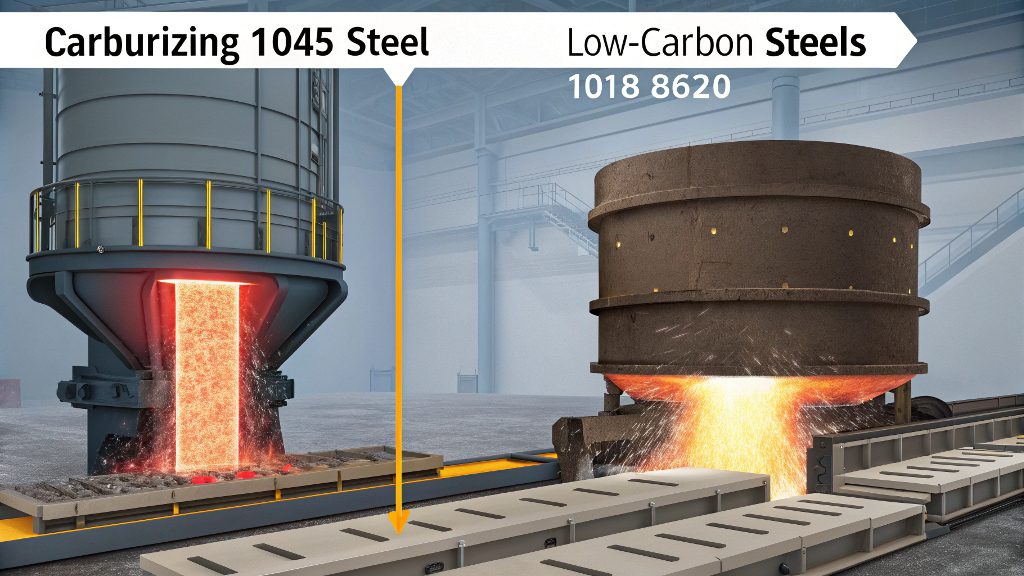
People sometimes ask me about carburizing 1045 steel, and I always explain that it's the wrong tool for the job. Carburizing is designed for low-carbon steels, like 1018 or 8620, which have less than 0.30% carbon. The process involves heating the steel in a carbon-rich atmosphere, which allows the surface to absorb more carbon. This creates a part with a hard, wear-resistant surface and a soft, ductile core. The problem is that 1045 steel already has about 0.45% carbon. This is enough carbon for the steel to be hardened directly through a different process called induction hardening or flame hardening. These methods use rapid heating and quenching to selectively harden the surface without changing its chemical composition. For a material like 1045, trying to add more carbon through carburizing is pointless. It won't significantly increase the surface hardness beyond what can be achieved with direct hardening. In fact, it could make the surface layer too brittle. If you need a hard surface on a 1045 part, induction hardening is the far better and more effective choice.
Conclusion
In summary, 1045 steel can be welded well with proper preheating and post-heating. It's also easy to machine in its standard state but best hardened through direct methods, not carburizing.