
What Are the Best Beveling Methods for Stainless Steel Components?

Struggling with poor stainless steel welds? Incorrect beveling leads to weak joints and costly reworks. Let's explore precise methods like CNC milling to ensure strong, perfect welds every time.
The best beveling methods for stainless steel are CNC milling and laser cutting. CNC milling with custom cutters offers high precision and smooth finishes. Laser cutting provides speed and accuracy for various thicknesses, making both excellent choices for preparing parts for strong, reliable welding.
Getting the right bevel is critical for the final strength of your component. I've seen many projects succeed or fail based on this one step. In my years of running Worthy Hardware, I've learned that a good bevel isn't just about an angle; it's about creating the perfect foundation for a strong weld. Before we compare the top methods, it's important to understand the basics. This foundation will help you make better decisions for your projects and communicate more clearly with your manufacturing partners.
What is the beveling method?
Confused about what "beveling" truly means in machining? This confusion can cause costly errors and delays in your projects. Let's define it clearly so you can communicate effectively with your supplier.
Beveling is the process of creating an angled edge on a metal component, usually to prepare it for welding. This angled surface, or bevel, allows for deeper weld penetration, creating a much stronger and more reliable joint between two pieces of metal.
Beveling is more than just cutting an angle; it's a foundational step for structural integrity. I often talk with clients like Mark from Canada, who need parts that are not only priced competitively but are also exceptionally reliable. A proper bevel is the first sign of quality.
Why Beveling is Essential
The main reason for beveling is to prepare a joint for welding. When you put two flat-edged pieces together, the weld can only fuse the material on the surface. By creating a V-shaped or U-shaped groove, you create a channel. This channel allows the welding material to flow deep into the joint, fusing the parts through their entire thickness. This full penetration is what creates a bond that is as strong, or even stronger, than the base metal itself. Without it, you risk a weak surface weld that can easily fail under stress.
Common Types of Bevels
The type of bevel depends on the application. A simple V-bevel is common, but other shapes are used for specific needs.
| Bevel Type | Description | Common Use Case |
|---|---|---|
| V-Bevel | A single straight angle on each piece, forming a 'V' shape. | The most common type, for general purpose butt joints. |
| X-Bevel | A double V-bevel, one on each side of the joint. | For very thick plates, allows welding from both sides. |
| U-Bevel | A curved, 'U' shaped groove. | Requires less weld material than a V-bevel on thick sections. |
| J-Bevel | Like half of a U-bevel, often used on T-joints. | Good for corner or T-joints where one piece is perpendicular. |
Choosing the right type is a critical design decision that impacts the cost and strength of the final product.
What is the best way to grind stainless steel welds?
Are your stainless steel welds looking rough? A poor finish looks bad and can even cause corrosion. Let's cover the best grinding methods for a clean, professional result.
The best way to grind stainless steel welds is using a flap disc on an angle grinder. Start with a coarser grit (like 40 or 60) for initial material removal, then move to a finer grit (120 or higher) for a smooth finish.
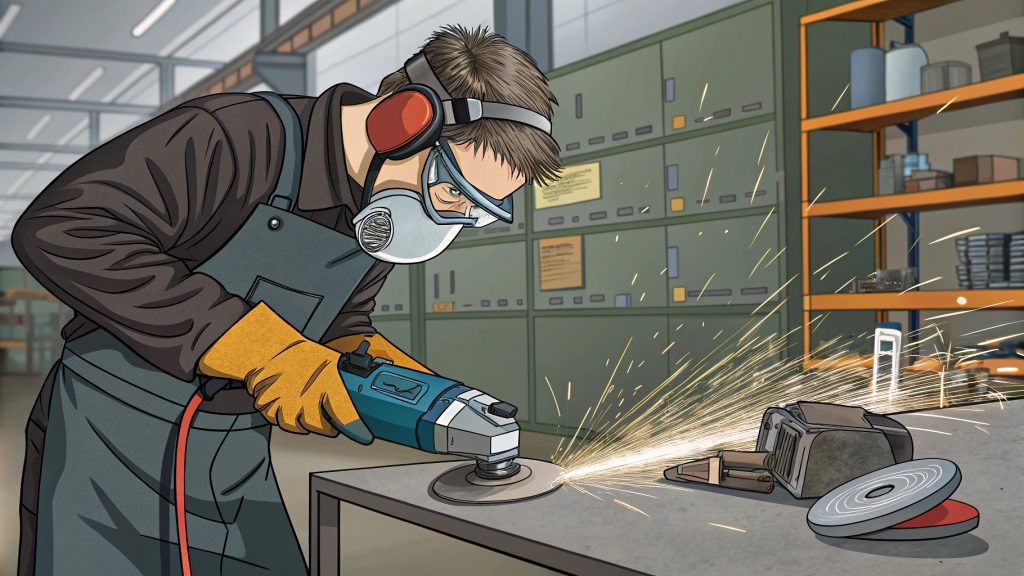
After a part is welded, the work isn't over. The final finish is just as important, especially for consumer products or medical devices where appearance and cleanliness are key. A good grinding job removes excess weld material and blends the seam perfectly with the parent material.
Choosing the Right Abrasive
For stainless steel, a flap disc is my go-to tool. It grinds and finishes at the same time and is less aggressive than a hard grinding wheel, which reduces the risk of gouging the metal. It's also important to use abrasives made specifically for stainless steel. Using a disc that was previously used on carbon steel can contaminate the stainless steel and lead to rust.
Step-by-Step Grinding Process for a Perfect Finish
Getting a mirror finish takes patience and the right steps.
-
Safety First: Always wear safety glasses, gloves, and respiratory protection. Grinding creates sparks and fine dust.
-
Rough Grinding: Start with a low-grit flap disc (e.g., 40-grit) to quickly remove the bulk of the excess weld bead. Use light pressure and keep the angle grinder moving constantly to avoid overheating any one spot. Overheating can warp the part and ruin the corrosion resistance of stainless steel.
-
Intermediate Sanding: Switch to a medium-grit disc (e.g., 80-grit) to remove the deeper scratches left by the rough grinding step.
-
Fine Finishing: Finally, use a high-grit disc (e.g., 120-grit or higher) to achieve a smooth, blended finish. For an even better look, you can follow this with a non-woven abrasive pad to get a brushed finish.
This multi-step process ensures a high-quality result that will pass any visual inspection.
What is the standard for bevelling?
Getting inconsistent bevels from your supplier? This lack of standards can lead to failed welds and project delays. Let's look at the industry standards for perfect, repeatable results.
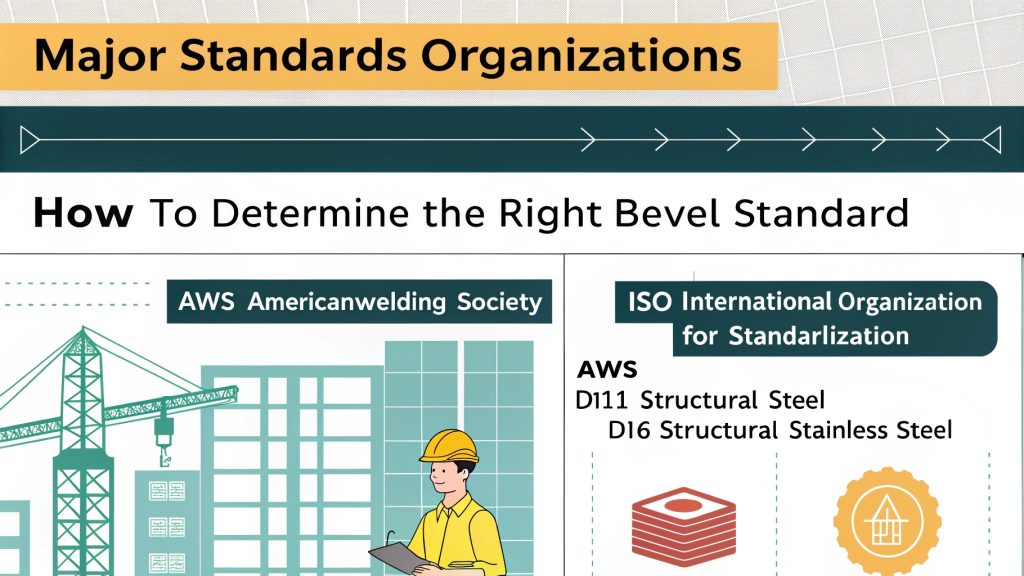
There isn't one single standard, but the American Welding Society (AWS) provides comprehensive guidelines. For example, a common standard for a V-groove weld is a total included angle of 60 degrees. The specific standard depends entirely on the application, material thickness, and welding process.
For customers like Mark, who manage procurement, consistency is everything. Inconsistent parts from a supplier are a huge pain point, causing delays and quality problems. This is where standards become so important. Clear standards communicated on an engineering drawing eliminate guesswork.
Major Standards Organizations
Two main bodies set the guidelines for weld joint preparation:
-
AWS (American Welding Society): Their codes, like AWS D1.1 for structural steel or D1.6 for structural stainless steel, are the go-to reference in North America. They provide pre-qualified joint designs with specific bevel angles, root openings, and land thicknesses.
-
ISO (International Organization for Standardization): ISO 9692-1 covers recommendations for joint preparation for a wide range of welding processes. This is more commonly used in Europe and other parts of the world.
How to Determine the Right Bevel Standard
The correct bevel design isn't a single number; it's determined by several factors. As a manufacturer, we look at the customer's drawing to understand these needs.
| Factor | Influence on Bevel Design | Example |
|---|---|---|
| Material Thickness | Thicker materials require wider angles or U/J grooves for full weld penetration. | A 1-inch thick plate might need an X-bevel to be welded from both sides. |
| Welding Process | Processes like TIG need very precise and clean joints, while MIG is more forgiving. | A TIG weld may require a tighter, more accurate bevel than a MIG weld. |
| Joint Type | A butt joint (end-to-end) will have a different bevel than a corner or T-joint. | A corner joint might use a single bevel on one piece only. |
The most important thing is to clearly specify the required bevel angle and root opening on your technical drawings. This removes all ambiguity and ensures you get parts that meet your exact specifications every time.
What is the best method to weld stainless steel?
Worried about weak stainless steel welds? The wrong process can cause cracks and corrosion, leading to product failure. Let’s compare the top methods for strong, lasting joints.
The best methods are TIG (Tungsten Inert Gas) and MIG (Metal Inert Gas) welding. TIG offers the highest quality and precision, ideal for thin materials and visible joints. MIG is faster and more cost-effective, making it great for thicker materials and production runs.
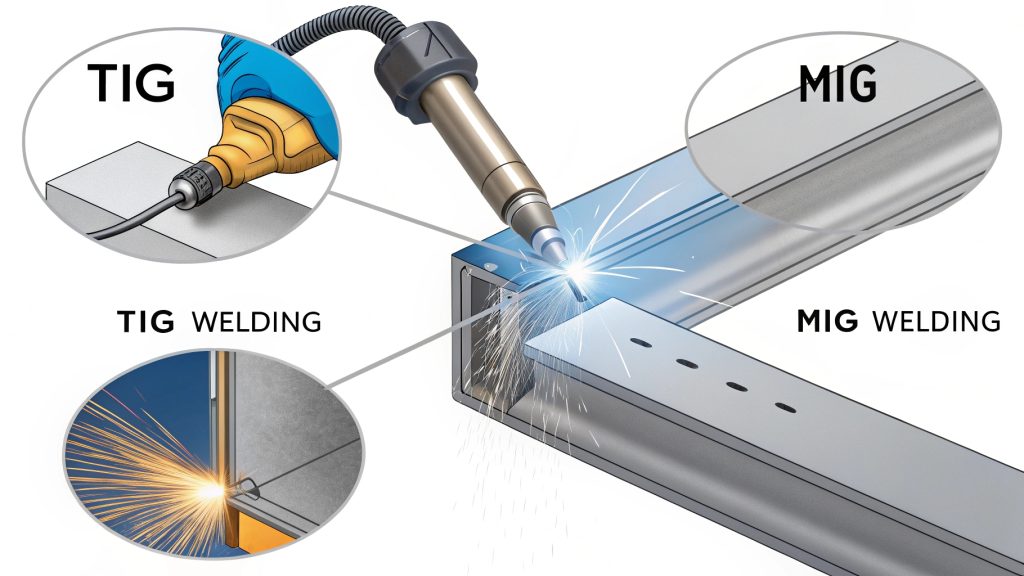
Once you have a perfectly beveled part, you need to join it with the right welding technique[^1]. For stainless steel, the choice almost always comes down to TIG or MIG. Both are excellent, but they serve different purposes. Understanding the difference helps you specify the right process for your application.
TIG Welding: The Precision Choice
TIG welding[^2] uses a non-consumable tungsten electrode to create the arc, and a separate filler rod is added to the joint by hand. It's a highly controlled, clean process. It produces beautiful, strong welds with no spatter, making it perfect for aerospace, medical, and high-end consumer products where appearance is critical. The downside is that it is much slower and requires a highly skilled operator, which increases the cost.
MIG Welding: The Speed and Efficiency Choice
MIG welding[^3] uses a continuous wire feed that acts as both the electrode and the filler material. It's much faster than TIG and easier to learn, making it the preferred method for high-volume production. It's great for thicker stainless steel sections where speed is more important than perfect aesthetics. While modern MIG welders can produce very clean welds, there can be some spatter to clean up afterward.
| Feature | TIG Welding | MIG Welding |
|---|---|---|
| Precision | Very High | Good |
| Speed | Slower | Faster |
| Appearance | Very Clean, No Spatter | Good, Some Spatter |
| Cost | Higher | Lower |
| Best For | Thin materials, visible welds | Thicker materials, production runs |
The right choice depends on your project's priorities: for ultimate quality and appearance, choose TIG. For speed and cost-effectiveness on thicker parts, MIG is the better option.
Conclusion
Proper beveling, like with CNC milling, and correct welding are key to strong stainless steel parts. Understanding these methods ensures you get the quality and reliability your projects demand.