
What Are The Best Practices For CNC Machining Composite Materials?

Struggling with composite machining? These materials offer amazing properties. But they can be tricky to work with, leading to costly errors if not handled correctly.
The best practices for CNC machining composite materials involve selecting appropriate cutting tools (like PCD), optimizing cutting speeds and feeds, ensuring robust workpiece clamping, and managing dust extraction. Controlling heat generation is also very important to prevent material damage.
I've seen many projects encounter difficulties when they first try machining composites. The unique nature of these materials, often combining fibers with a matrix, presents challenges that are different from metals or plastics. But once you understand the key factors, you can achieve excellent results. We want to help you navigate these challenges and get the best out of your composite parts. So, let's explore this topic further.
What is the best material for CNC machine?
Choosing the right material for your CNC project can feel overwhelming. So many options exist! Pick the wrong one, and your part might fail or cost too much.
There isn't one single "best" material for CNC machining. The ideal choice depends entirely on your specific application, considering factors like required strength, weight, temperature resistance, budget, and the part's end-use. We machine over 100 different materials at Worthy Hardware.
When I talk to customers like Mark Chen, who sources various custom CNC parts, the material choice is always a key discussion. He needs parts that are high quality but also competitively priced. For some applications, aluminum like 6061 is fantastic because it's lightweight, machines easily, and has good strength-to-weight. For others needing higher strength, steel or stainless steel might be the answer. Plastics like Delrin or PEEK offer unique properties like low friction or high-temperature resistance. And then, of course, there are composites, which we are focusing on. Each material has its pros and cons.
Here's a simple way to think about some common categories:
| Material Category | Key Advantages | Common Examples | Considerations |
|---|---|---|---|
| Metals | Strength, durability, conductivity | Aluminum, Steel, Stainless Steel, Titanium | Weight, cost, machinability varies |
| Plastics | Lightweight, corrosion resistance, cost-effective | ABS, Nylon, Polycarbonate, PEEK | Lower strength, temperature limits |
| Composites | High strength-to-weight, tailorable properties | Carbon Fiber, Fiberglass | Machining difficulty, cost |
| Wood | Aesthetics, ease of working (some types) | Hardwoods, Softwoods, Plywood | Dimensional stability, strength |
At Worthy Hardware, we help you select the best material from our extensive list, ensuring it meets your project's demands for performance and budget.
How to machine composites?
Machining composites seems tough. Their layered nature can cause delamination or tool wear. This can lead to scrapped parts and frustration for any business.
To machine composites, use very sharp, wear-resistant tools (like diamond-coated or PCD). Employ high speeds and moderate feed rates. Proper clamping and support are crucial to prevent vibration and delamination. Effective dust extraction is also essential for safety and machine longevity.
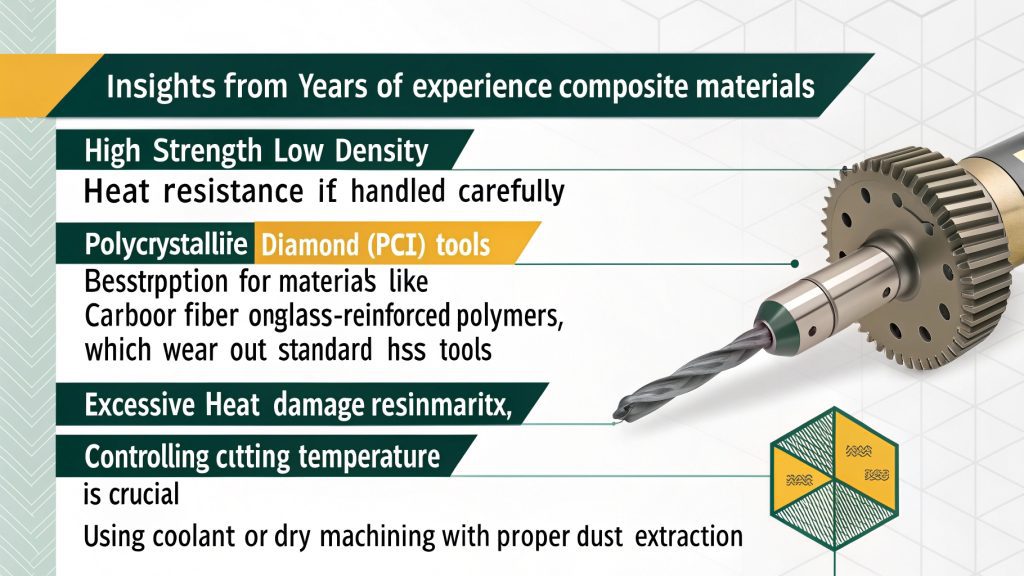
My insights from years of experience, and what I always emphasize, is that composite materials are special. They often have high strength and low density, and can be heat resistant. But these properties mean they can fracture easily during machining if you are not careful. The geometry of the cutting tool is very important. For materials like carbon fiber or glass-reinforced polymers, standard HSS tools wear out incredibly fast. Polycrystalline Diamond (PCD) tools are often the best choice, though carbide tools with specific coatings can also work for some applications.
You also need to think about cutting parameters. Too much heat can damage the resin matrix, affecting the material's performance. This is why controlling cutting temperature is a big deal. Sometimes, we use coolant, but often dry machining with good dust extraction is preferred to avoid contaminating the composite. Because composite machining generates a lot of abrasive dust and fine chips, this isn't just bad for the machine; it's a health hazard for operators. So, a powerful vacuum system is non-negotiable. We've found that a combination of up-cut and down-cut spirals or compression cutters can help manage delamination at the top and bottom surfaces. Supporting the material well, close to the cut, is also key to getting a clean finish.
How is CNC technology more efficient than traditional woodworking methods?
Traditional woodworking is an art. But it can be slow and inconsistent for production. Businesses need speed and repeatability that manual methods often can't provide.
CNC technology is more efficient than traditional woodworking through automation, precision, and speed. It allows for complex designs, reduces material waste, and ensures consistent repeatability, something very hard to achieve manually, especially at scale for CNC routing services.
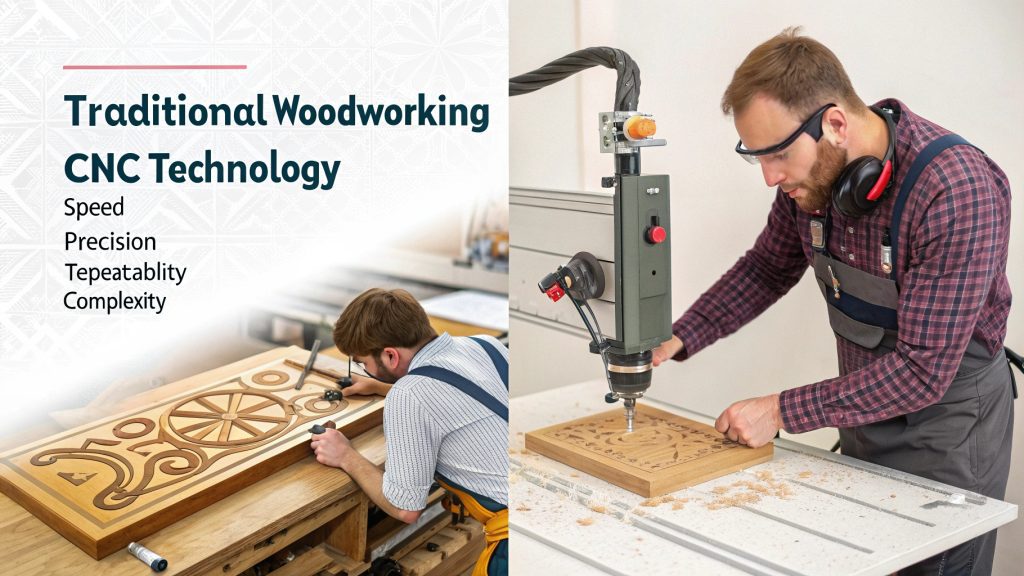
I've seen the shift firsthand. While there's incredible skill in traditional woodworking, CNC machining, including CNC routing for wood and similar materials, brings a new level of efficiency. Think about complex curves or intricate patterns. Doing that by hand requires a master craftsperson and a lot of time. A CNC machine can produce these designs perfectly, over and over again, much faster. This speed and repeatability directly impact costs and production capacity.
Here's a quick comparison:
| Feature | Traditional Woodworking | CNC Technology |
|---|---|---|
| Speed | Slower, manual pace | Faster, automated process |
| Precision | Relies on skill | Highly precise, software-controlled |
| Repeatability | Difficult to achieve | Excellent, consistent results |
| Complexity | Limited by hand tools | Can produce very complex shapes |
| Waste | Can be higher | Optimized cutting paths reduce waste |
| Labor | Labor-intensive | Reduced direct labor, skilled operator |
For businesses needing high volume or intricate custom parts, CNC is a game-changer. It allows for "lights-out" manufacturing in some cases, where machines run with minimal supervision. This means faster turnaround times for customers. While the initial investment in CNC equipment is higher, the long-term savings in labor, material, and improved output often make it a very smart choice. We even machine engineered wood and carbon fiber, which are beyond most traditional woodworking shops.
What is the most accurate machining process?
Need parts with incredible precision? Many processes exist. But achieving those tight tolerances consistently can be a real challenge for any design engineer or procurement officer.
While many CNC processes offer high accuracy, 5-axis CNC machining and precision grinding are often considered among the most accurate. The achievable precision depends on the machine quality, tooling, material, and operator skill. Worthy Hardware can hold tolerances like +/- 0.001 inch.
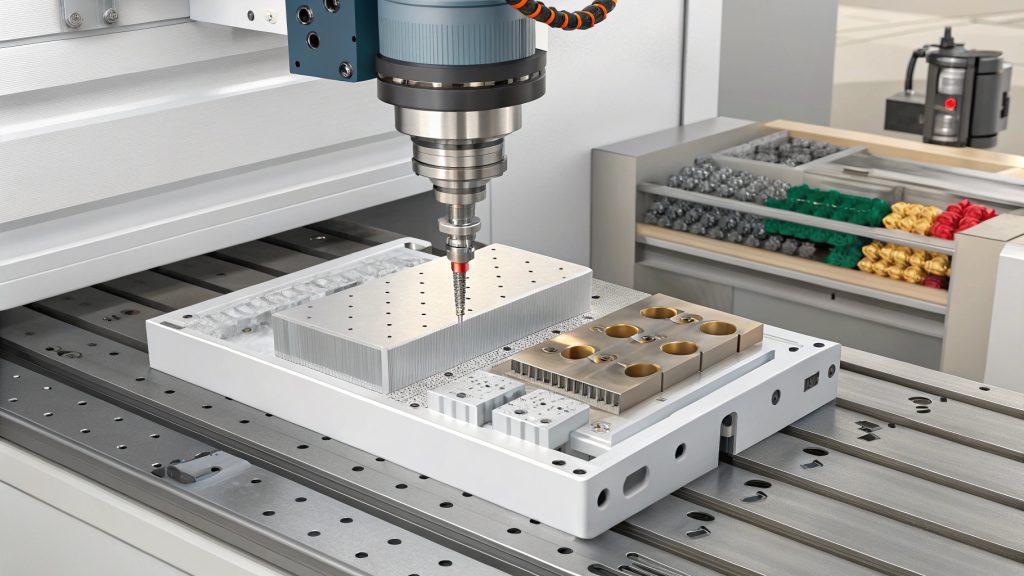
Accuracy is a big deal for my customers. Mark Chen, for instance, expects top quality, and that means parts must meet the drawing specifications every time. When we talk about the "most accurate," it's not always a single answer. Different processes excel in different areas. For complex geometries and reducing setups (which itself improves accuracy), 5-axis CNC machining is outstanding. It allows the cutting tool to approach the workpiece from five different directions simultaneously. This means we can machine intricate features in a single setup, minimizing errors from re-clamping.
For achieving the absolute finest surface finishes and extremely tight dimensional tolerances, processes like precision grinding or Electrical Discharge Machining (EDM) might be used, often as secondary operations. However, for general metal and plastic parts, a well-maintained, high-quality CNC mill or lathe can achieve remarkable accuracy.
At Worthy Hardware, we invest in good machines and skilled people. Our standard tolerance is +/- 0.005 inches, but we regularly achieve much tighter tolerances, down to +/- 0.001 inches or even better when the design demands it. We confirm this with 100% inspection. This commitment to precision is crucial for applications in aerospace, medical, and electronics, all sectors we serve.
Conclusion
Machining composites effectively requires specific tools, parameters, and heat control. CNC enhances efficiency over traditional methods, with 5-axis offering top accuracy for complex parts.