
What Are The Advantages of Laser Welding Compared to Traditional Methods in Sheet Metal Fabrication?

Traditional welding methods can be slow and leave messy results. You want strong, clean welds, fast. Laser welding offers a superior solution for your sheet metal projects.
Laser welding provides significant advantages like higher speed, greater precision, minimal heat distortion, and stronger, cleaner welds. This makes it ideal for complex parts and high-quality finishes.
When I talk to clients like Mark Chen in Canada, who are looking for top-quality sheet metal fabrication, the conversation often turns to welding. Mark, being a company owner, is always focused on quality and efficiency. He needs parts that not only perform well but also look good, all while keeping costs in check.
This is where understanding different welding technologies becomes crucial. Many of our customers are curious about how newer methods stack up against the old standbys. So, let's explore why laser welding is becoming such a game-changer in our industry. We want you to have all the facts to make the best choice for your projects.
What are the advantages of a laser welding machine?
Are you tired of inconsistent welds and high post-processing costs? A laser welding machine can solve these issues. It delivers precise, repeatable results with minimal finishing work needed.
Laser welding machines offer high precision, fast welding speeds, deep penetration with a small heat-affected zone, and suitability for automation. This means better quality and higher productivity for you.
When we at Worthy Hardware invested in our laser welding capabilities, we saw an immediate difference. The advantages are clear. Firstly, the precision is outstanding. The laser beam can be focused to a very small spot, allowing us to weld intricate parts and thin materials that would be challenging with traditional methods.
This precision also means a much smaller heat-affected zone (HAZ). Less heat input means less distortion, which is a huge benefit, especially for delicate components.
Another key advantage is speed. Laser welding is significantly faster than methods like TIG welding. For long, straight seams, the speed increase can be dramatic, directly impacting production times and costs.
We also find that laser welds are incredibly strong and clean. The seams are typically smooth and aesthetically pleasing, often requiring little to no post-weld grinding or finishing. This saves time and labor.
Plus, laser welding is very versatile; we can weld a wide range of metals, including dissimilar metals, which opens up new design possibilities. From a safety perspective, it's also a step up. While all industrial processes require safety measures, modern laser welders often have enclosed systems, reducing operator exposure to fumes and radiation. This means a safer environment for our skilled technicians.
What is the difference between laser welding and normal welding?
Confused about whether laser welding is truly different from your usual methods? Traditional welding can be less precise and slower. Laser welding offers a modern, efficient alternative for many jobs.
The main differences lie in the heat source, precision, speed, and heat input. Laser welding uses a concentrated light beam, offering higher precision, faster speeds, and less material distortion than most normal welding methods.
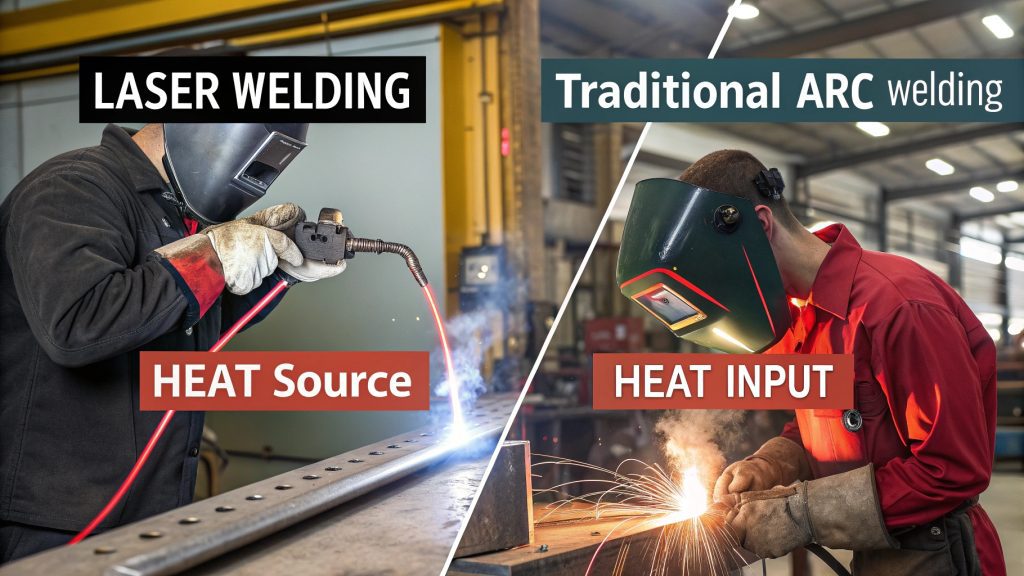
When I talk about "normal welding," I often think of methods like MIG (Metal Inert Gas) or TIG (Tungsten Inert Gas) welding, also known as arc welding methods, or even older methods like stick welding. These are very common in sheet metal fabrication. The fundamental difference starts with the heat source. Traditional arc welding uses an electric arc to melt the base materials and filler. Laser welding, on the other hand, uses a highly concentrated beam of light. This focused energy is key.
Here's a breakdown of the key differences:
| Feature | Laser Welding | Traditional Arc Welding (e.g., TIG, MIG) |
|---|---|---|
| Heat Source | Focused laser beam | Electric arc |
| Heat Input | Low, localized | Higher, wider spread |
| Speed | Generally faster | Slower, especially for precision work |
| Precision | Very high, small spot size | Good, but less precise than laser |
| Distortion | Minimal | More prone to distortion |
| Weld Seam | Narrow, deep, often smooth | Wider, may require more finishing |
| Filler Metal | Can be used with or without | Often requires filler metal |
| Automation | Highly suitable for automation | Can be automated, but often manual |
| Operator Skill | Requires specific training, but can be simpler for automated setups | High skill needed for quality manual welds |
One of my clients in the automotive sector needed very precise, clean welds on thin stainless steel components. Traditional TIG welding was too slow and caused some warping. When we switched to laser welding for their parts, they were amazed by the speed and the almost invisible, distortion-free seams.
This is a typical example of how the differences play out in real-world applications. The high energy density of the laser allows for deep penetration with minimal heat spreading to the surrounding material, which is a game-changer for quality.
What are the advantages of laser beam welding compared with arc welding?
Is arc welding your go-to, but you're wondering if there's something better? Arc welding is reliable but can be slow and cause material warping. Laser beam welding offers key improvements.
Laser beam welding provides faster welding speeds, deeper penetration with a narrower weld bead, significantly less heat distortion, and superior aesthetics compared to most arc welding processes.
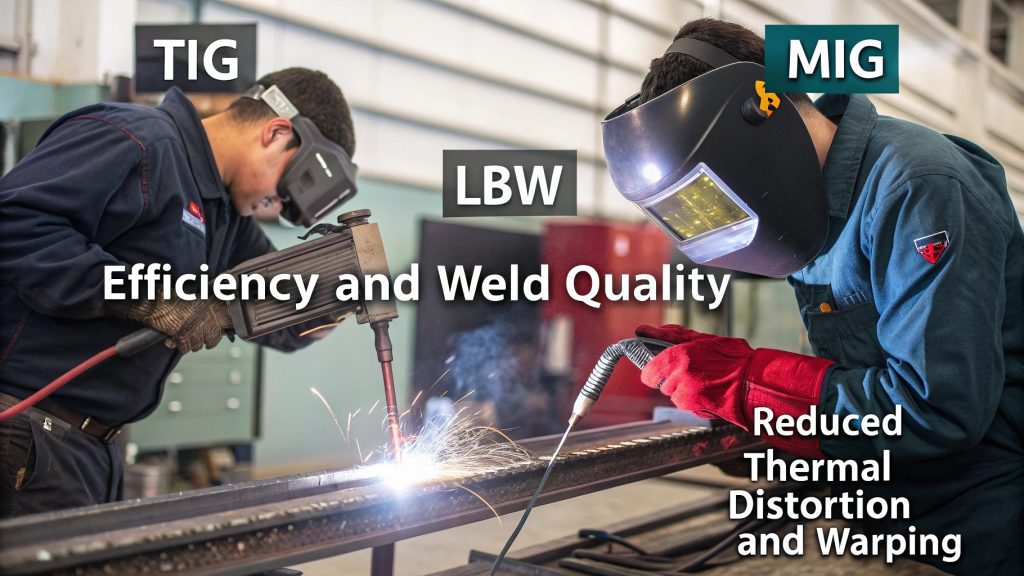
Arc welding, which includes common processes like TIG (Argon Arc Welding ) and MIG (CO2 welding), has been a cornerstone of fabrication for decades. At Worthy Hardware, we use these methods too, as they are excellent for many applications. However, when we compare them directly to laser beam welding (LBW), several advantages of LBW become apparent, especially for demanding projects.
My insights clearly show that laser welding shines in efficiency and weld quality. The welding speed of laser systems can be 5 to 10 times faster than TIG welding, for example. This isn't just about moving the torch faster; it's about the physics of how the energy is delivered. The focused laser creates a deep, narrow weld with a minimal heat-affected zone (HAZ). This means less overall heat goes into the part.
The result? Significantly reduced thermal distortion and warping. This is a huge benefit for sheet metal parts where flatness and dimensional accuracy are critical. Think about welding thin sheets – arc welding can easily cause them to buckle. Laser welding handles this much better.
The weld seam itself is another major plus. Laser welds are typically very smooth, flat, and aesthetically pleasing. Often, they require no post-weld grinding or finishing, saving time and cost. The high sealing quality mentioned in my insights is also a direct result of the consistent, deep penetration.
Furthermore, as I highlighted, laser welding is generally safer for the operator. Many laser welding systems are automated or enclosed, reducing exposure to intense light, fumes, and spatter compared to open-arc processes. This means a better working environment and fewer occupational hazards. For Mark Chen, who values quality and efficiency, these advantages translate directly to better parts and potentially lower overall costs when considering the entire production cycle.
What are the advantages of welding compared to other types of assembly operations?
Are you choosing between welding, bolting, or riveting for your assembly? Other methods can add weight or create potential leak paths. Welding offers unique benefits for permanent, strong joints.
Welding generally creates stronger, permanent, and often lighter joints compared to mechanical fasteners. It can also provide better sealing and a cleaner aesthetic for many assemblies.
While laser welding offers specific advantages over traditional welding, it's also important to understand why welding, in general, is often preferred over other assembly methods like bolting, riveting, or using adhesives. Each method has its place, of course, but welding provides a unique set of benefits that are crucial for many applications we handle at Worthy Hardware.
One of the primary advantages is joint strength and permanence. A properly executed weld essentially fuses the metal pieces into a single, continuous part. This typically results in a stronger joint than one made with mechanical fasteners, which can loosen over time due to vibration or stress.
Welded joints are also inherently leak-proof if done correctly, making them ideal for tanks, enclosures, or any application where sealing is critical. This directly aligns with the "high sealing" benefit I mentioned for laser welding, but it's a general advantage of good welding practices.
Another benefit is weight reduction. By eliminating the need for bolts, nuts, and washers, or overlapping material for rivets, welded assemblies can often be lighter. This is a significant factor in industries like aerospace and automotive.
Aesthetics can also be improved; welded joints can be ground smooth to be virtually invisible, offering a cleaner look than a row of bolt heads or rivets.
From a cost perspective, for high-volume production, welding can be more economical than mechanical fastening, especially when automated. While fasteners themselves might seem cheap, the labor and time involved in drilling holes and installing them can add up. Welding can often be a faster process overall, particularly with advanced techniques like laser welding. For customers who need robust, permanent, and often streamlined assemblies, welding is frequently the superior choice.
Conclusion
Laser welding offers superior speed, precision, aesthetics, and safety. It's a clear winner for modern, high-quality sheet metal fabrication, ensuring efficient production and excellent results.