
How Much Does 4140 Steel Cost Compared To Other Engineering Metals?

Choosing materials is tricky. Costs can quickly add up. This guide compares 4140 steel prices, helping you decide wisely for your projects.
4140 steel offers a good balance of cost and performance. It's generally more affordable than high-alloy or specialized metals like titanium, but pricier than basic carbon steels. Its properties make it a cost-effective choice for many engineering applications.
You now have a general idea of where 4140 steel stands in the cost spectrum. But you probably want more specific details. How does its price really compare, and what makes it a good value? Let's dig deeper into these questions. This will help you make the best material choice for your CNC machining needs, ensuring you get quality without overspending.
Is 4140 steel expensive?
Worried 4140 steel might strain your budget? Material costs are a big concern. Overspending on materials can really hurt your profits. Let's see if 4140 is truly expensive.
No, 4140 steel is not usually considered an expensive alloy steel. It provides very good mechanical properties for what it costs. It's cheaper than many special high-strength alloys. However, it does cost more than plain carbon steels because it contains chromium and molybdenum.
What Makes a Steel "Expensive"?
Several things determine if a steel is seen as costly. The alloying elements are a big factor. Elements like chromium, molybdenum, nickel, and vanadium add to the price. The complexity of making the steel also matters. This includes things like special heat treatments or needing very pure steel. Market demand and how much is available also play a part. If a steel is hard to find or many people want it, the price can go up.
Where 4140 Stands in Terms of Cost
4140 steel contains chromium and molybdenum. These elements make it cost more than simple carbon steels, such as 1018 or 1045 steel. However, 4140 is much cheaper than stainless steels like 304 or 316. This is because stainless steels have a lot more chromium and also nickel, which 4140 has very little or none of.
It's also more affordable than tool steels, for example D2 or A2. Tool steels have more alloying elements and need more complex heat treatments. And, of course, 4140 is much less expensive than high-performance alloys such as Inconel or titanium.
The Value Proposition of 4140 Steel
So, why do people choose 4140 if it's not the absolute cheapest? It offers a great mix of properties. It has good strength, toughness, and wear resistance. It also hardens well with heat treatment. For many engineering uses, this combination is ideal. Plus, it's fairly easy to machine, especially when it's in an annealed (softened) state. I often work with customers like Mark Chen from Canada. He runs a company and handles procurement. Mark is always looking for that sweet spot: high quality but at a competitive price.
He knows that choosing the right material is essential for his business, which involves buying OEM CNC machining parts and selling them. For him, 4140 often hits that perfect balance of performance and cost, making it a "value" choice, not an "expensive" one. At Worthy Hardware, we help many clients find this kind of value.
What is the price of 4140 steel per kg?
Need exact figures for your project budget? Vague prices are not very helpful. Without specific costs, good planning is tough. Let's look at current 4140 steel price estimates.
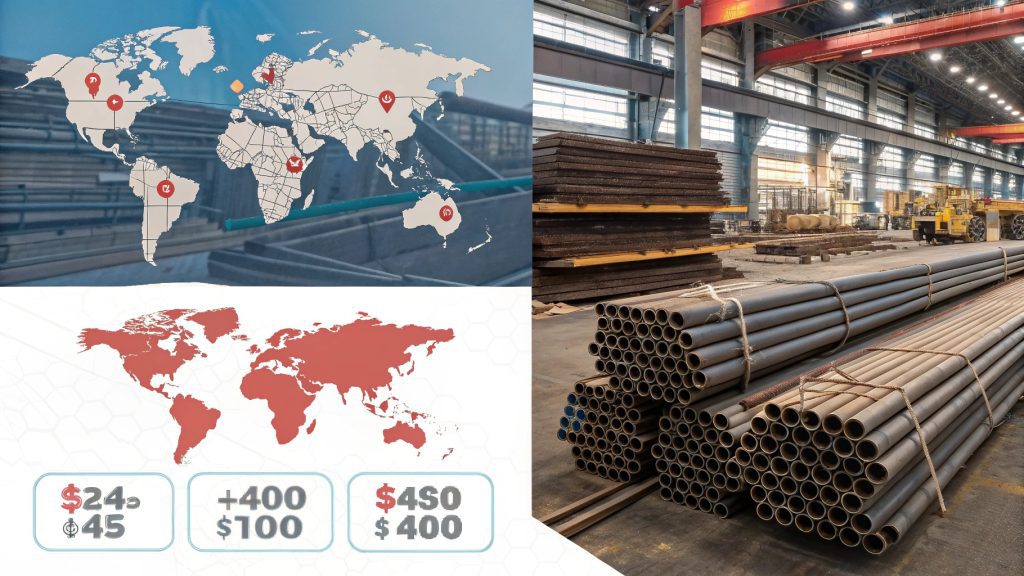
Based on my insights as of June 6, 2025, 4140 alloy steel typically costs around 10 to 12 Chinese Yuan (RMB) per kilogram. This is about $1.50 to $2.00 US dollars per kilogram. Remember, prices can change based on the supplier, how much you buy, and current market conditions.
Factors Influencing 4140 Steel Price per kg
The price you pay for 4140 steel per kilogram isn't fixed. Many things can change it.
First, the cost of raw materials like iron ore, chromium, and molybdenum goes up and down. This directly affects the steel's price.
Second, suppliers add their own markups. Different mills and distributors will have different prices.
Third, the quantity you order makes a big difference. If you order a large amount, like for high-volume CNC machining services, you usually get a better price per kilogram. This is an area where we at Worthy Hardware can offer competitive rates.
The form of the steel also matters. Round bars, flat plates, or forged pieces will have different costs.
The condition of the steel when you buy it, such as annealed, pre-hardened, or quenched and tempered, will also affect the price.
Your geographical location plays a role too. Local market conditions, import taxes, and shipping costs can add to the final price. For buyers like Mark Chen, sourcing from China, where Worthy Hardware is located, can often be more cost-effective due to direct factory access and potentially lower base material costs.
Finally, current market dynamics, like global demand, trade policies, and the overall economy, impact steel prices everywhere.
My Direct Insight on Pricing
I always tell my clients that while I can give a current estimate, it's very important to get a specific quote for their exact project needs. Prices are not static. For example, my information from June 6, 2025, shows 4140 alloy steel at 10-12 RMB per kilogram in China, which is roughly $1.50 to $2.00 USD. This is a useful reference point.
However, for your specific order quantity, desired form, and delivery requirements, the price might be slightly different. At Worthy Hardware, we believe in transparent pricing and work to get our customers the best possible deal. We can machine over 100 materials, including all kinds of metals like 4140 steel, and our engineers are great at helping customers save costs.
What is 4140 steel equivalent to?
Are you looking for alternatives to 4140 steel? You might need comparable options. Choosing the wrong substitute can cause big problems. Compatibility is very important.
4140 steel has several international equivalents. These include EN19 (a British Standard - BS), SCM440 (a Japanese Industrial Standard - JIS), and 42CrMo4 (a German DIN and European UNI standard). These alloys have similar chemical makeups and mechanical properties. They offer comparable performance for many uses.

Understanding Material Equivalency
When we talk about "equivalent" steels, we mean they are very similar in key areas. This includes their chemical composition (what they're made of), their mechanical properties (like tensile strength, yield strength, and hardness), and how they respond to heat treatment. It's rare to find an absolutely perfect match from one standard to another.
However, there are usually very close equivalents available across different international specifications. This is really helpful when you're sourcing materials globally or if a specific grade isn't easy to find in your area.
Common International Equivalents for AISI/SAE 4140
Here's a table showing some of the most common equivalents for AISI/SAE 4140 steel from different parts of the world:
| Standard System | Grade Designation | Key Notes |
|---|---|---|
| BS (British) | EN19 / 708M40 | A very common equivalent in the UK and related markets; similar properties. |
| JIS (Japanese) | SCM440 | Widely used in Japan and other Asian countries; very close match to 4140. |
| DIN (German) | 42CrMo4 / 1.7225 | The primary European equivalent; offers excellent interchangeability. |
| GB (Chinese) | 42CrMo | The standard Chinese equivalent; shares similar characteristics and uses. |
| ISO | 42CrMoS4 | An international standard aiming for global consistency. |
Why Equivalents Matter in Practice
Knowing these equivalents is very useful. First, availability: if 4140 isn't easy to get where you are, an equivalent might be. Second, cost: sometimes, an equivalent material might be cheaper in a certain region. Third, specifications: some projects might require materials that meet a specific international standard, not just AISI/SAE.
For my business, Worthy Hardware, we export to many countries like Singapore, North America, Japan, and Europe. Understanding these equivalents is vital. It helps us communicate clearly with clients like Mark Chen. If he's sourcing from China, he might see "42CrMo" on a material certificate.
Knowing this is the Chinese equivalent of 4140 ensures he's getting the right material for his custom CNC parts. Our engineers have rich experience and can help clarify these details, making sure the material properties match the design needs. It's always a good idea to check the specific properties of any equivalent grade to ensure it meets all your critical requirements.
Is 4140 cheaper than 4340?
Are you trying to decide between 4140 and 4340 steel? Cost is often a big factor. You might be unsure which one gives better value. Your material choice really impacts your budget.
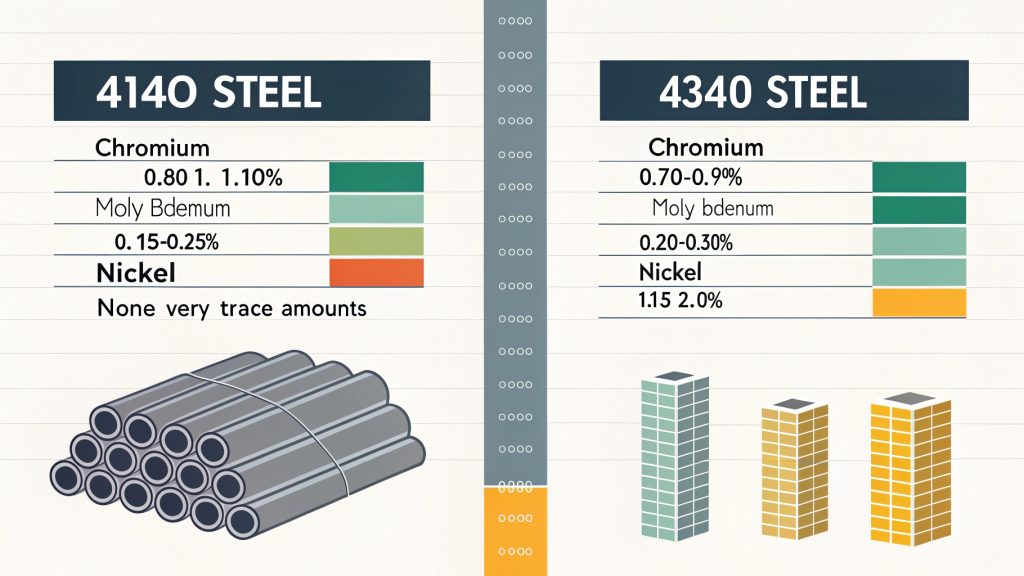
Yes, 4140 steel is generally cheaper than 4340 steel. The main reason is that 4340 contains a higher amount of nickel. Nickel is an expensive alloying element, and its presence in 4340 significantly increases the material's cost. Both are chromium-molybdenum steels, but the added nickel in 4340 improves its toughness and hardenability.
Key Differences in Composition and Cost
The main difference between 4140 and 4340 steel that affects cost lies in their alloying elements.
4140 steel typically contains:
- Chromium: about 0.80-1.10%
- Molybdenum: about 0.15-0.25%
- Nickel: usually none or very trace amounts.
4340 steel typically contains:
- Chromium: about 0.70-0.90%
- Molybdenum: about 0.20-0.30%
- Nickel: about 1.65-2.00%
Nickel is a relatively costly metal. The significant amount of nickel in 4340 steel is the primary reason it's more expensive than 4140 steel. This extra nickel isn't just for show; it enhances certain properties.
Performance Benefits of 4340 Justifying Its Cost
While 4140 steel offers a great balance of strength and toughness for many applications, 4340 steel takes some of these properties a step further, largely due to its nickel content.
4340 steel provides:
-
Higher Toughness: It's exceptionally tough, especially at lower temperatures and in larger sections. This means it can absorb more energy before fracturing.
-
Greater Hardenability: It can be hardened more deeply and uniformly through its cross-section, especially in larger parts. This is crucial for components that need consistent high strength all the way through.
-
Improved Fatigue Strength: The combination of strength and toughness often leads to better performance under cyclic loading.
When to Choose 4140 vs. 4340
The decision often comes down to the specific demands of the application versus the budget.
I tell my customers at Worthy Hardware to choose 4140 steel if:
- Cost is a major consideration.
- The application requirements for toughness and through-hardenability are met by 4140's properties. It's great for many general-purpose shafts, gears, axles, and bolts. Mark Chen, who focuses on competitive pricing for his resale business, would often lean towards 4140 if its properties are sufficient.
Consider 4340 steel if:
- The application demands superior impact strength and fracture toughness, like in aerospace components (e.g., landing gear) or highly stressed industrial machinery parts.
- You need to through-harden very large cross-sections while maintaining high strength and toughness.
- The higher cost is justified by the need for enhanced reliability and performance under extreme conditions.
At Worthy Hardware, we machine both 4140 and 4340 parts. Our ability to handle parts up to 80 inches milled and lathe parts up to 62 inches means we work with various sizes where hardenability can be a factor. We always aim to help customers select the most cost-effective material that meets their design and performance criteria.
Conclusion
4140 steel is a smart choice for many projects. It offers excellent properties without a high price tag. Understanding its cost against others helps you budget and select wisely.